
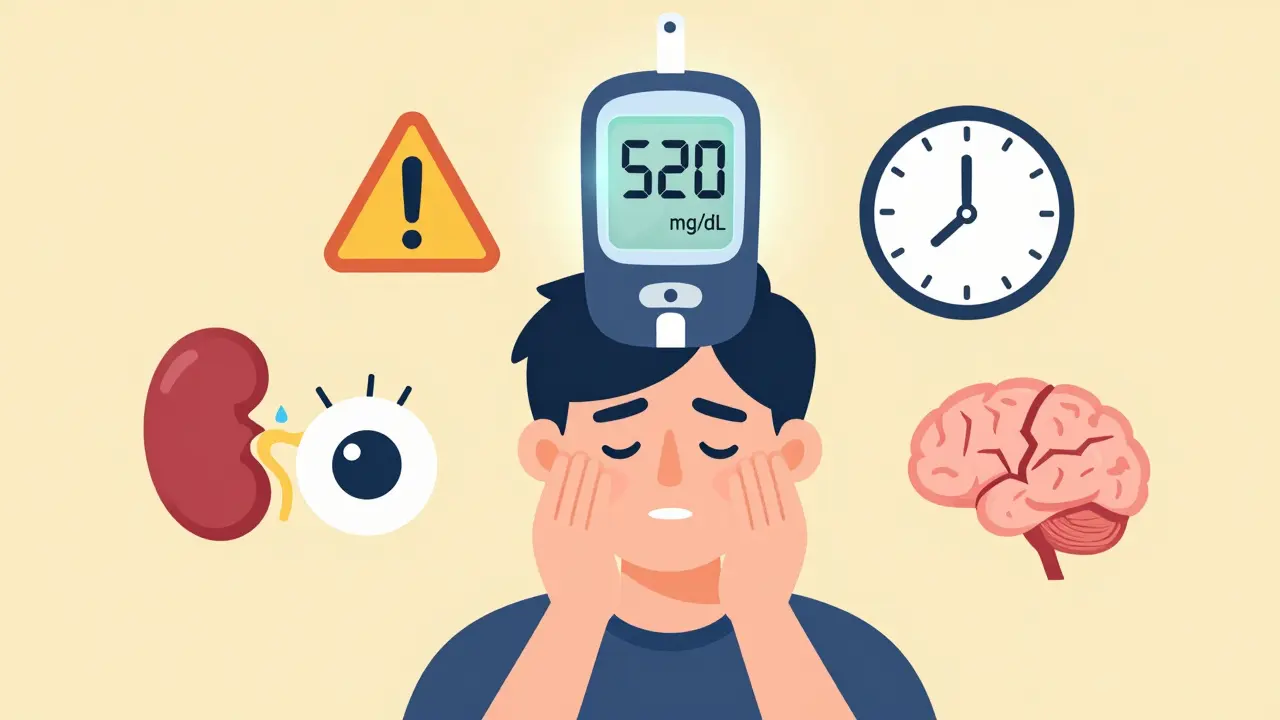
When your blood sugar climbs too high, your body doesn’t just feel off-it starts shutting down. Hyperglycemia isn’t just a number on a glucometer. It’s a silent alarm that something’s seriously wrong. For people with diabetes, ignoring it can lead to hospitalization, coma, or worse. But here’s the truth: hyperglycemia is preventable. And knowing the signs before it turns deadly could save your life.
What Exactly Is Hyperglycemia?
Hyperglycemia means your blood glucose is too high-usually above 180 mg/dL. That’s the point where your kidneys start spilling sugar into your urine. It’s not just about eating too much cake. It’s about your body failing to move glucose from your blood into your cells. In type 1 diabetes, your pancreas stops making insulin. In type 2, your cells ignore insulin like it’s a broken phone number. Either way, sugar piles up. And over time, that sugar damages nerves, blood vessels, and organs.
Doctors classify it in stages:
- Mild: 180-250 mg/dL
- Moderate: 251-300 mg/dL
- Severe: Over 300 mg/dL
- Emergency: Over 600 mg/dL
At 600 mg/dL, you’re not just diabetic-you’re in a life-or-death zone. This is where two dangerous conditions can show up: diabetic ketoacidosis (DKA) and hyperosmolar hyperglycemic state (HHS). Both need immediate care. Neither should be ignored.
Early Warning Signs You Can’t Afford to Miss
Most people wait until they’re dizzy or confused before acting. That’s too late. The real signs start quietly.
- Peeing nonstop: You’re going to the bathroom more than 2.5 liters a day. That’s not just coffee. Your kidneys are working overtime to flush out sugar.
- Thirst that won’t quit: Drinking 4 liters of water a day and still parched? That’s your body begging for hydration.
- Blurry vision: Sugar swells the lenses in your eyes. It’s temporary-but if you ignore it, it becomes permanent.
- Constant fatigue: You’re not tired because you worked late. You’re tired because your cells are starving. Sugar is in your blood, but it can’t get inside your muscles or brain.
A 2023 survey by the American Diabetes Association found 68% of people with diabetes experienced blurry vision during high blood sugar episodes. Yet, 67% of patients in a DiabetesDaily.com survey didn’t recognize these signs until their blood sugar hit 300 mg/dL or higher. That’s like waiting for a fire alarm to go off before you notice smoke.
When It Gets Worse: The Red Flags
Once your blood sugar climbs past 250 mg/dL, things escalate fast.
- Headaches and brain fog: A 2021 JAMA study found 47% of type 2 patients had trouble concentrating when their glucose hit 250+. It’s not stress. It’s your brain drowning in sugar.
- Unexplained weight loss: Losing more than 5% of your body weight in 3 months without trying? Your body is breaking down fat and muscle for energy because it can’t use glucose.
- Nausea and abdominal pain: Especially if you have type 1 diabetes. This isn’t food poisoning. It’s your body making ketones-acidic fuel from fat breakdown.
At this stage, your body is in survival mode. You might feel like you have the flu. But if you don’t act, you’re heading into emergency territory.
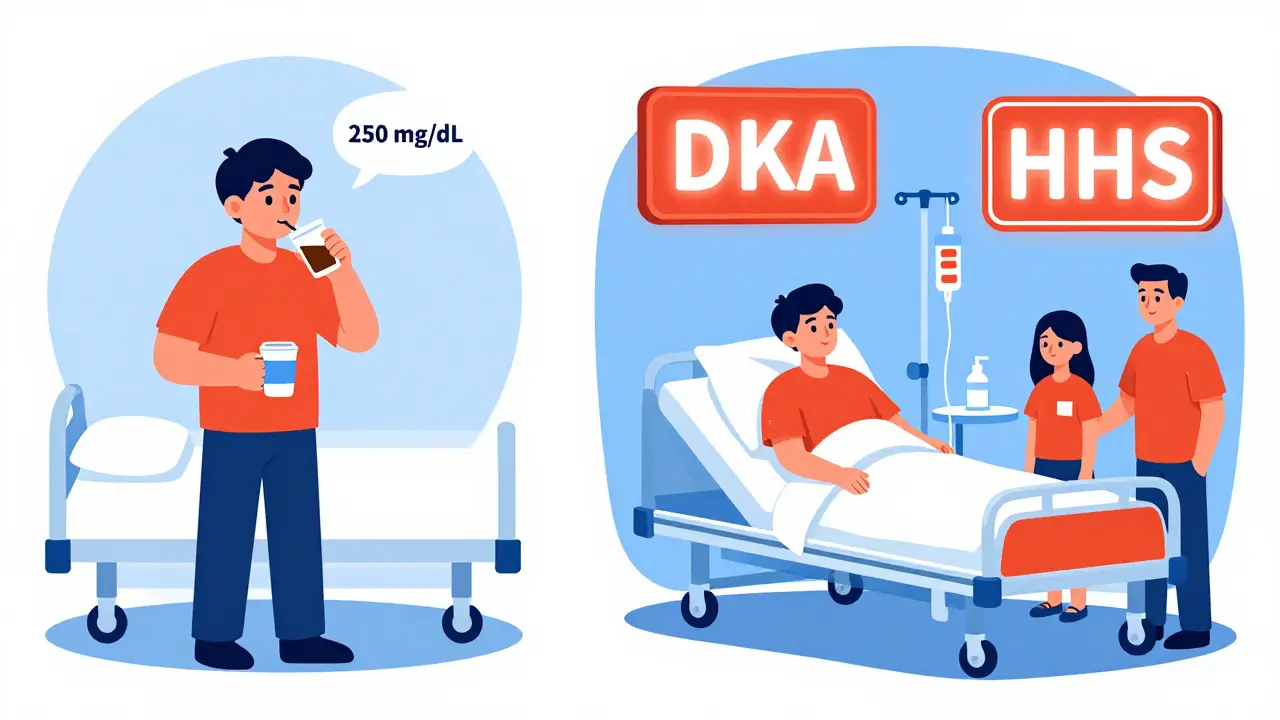
Two Life-Threatening Emergencies: DKA vs HHS
Not all high blood sugar is the same. Two conditions can develop when glucose surges past 250 mg/dL.
Diabetic Ketoacidosis (DKA) mostly hits type 1 diabetics. It happens fast-within 24 to 48 hours. Your body runs out of insulin. So it starts burning fat. That produces ketones, which make your blood acidic. Symptoms:
- Fruity, acetone-smelling breath (like nail polish remover)
- Rapid, deep breathing (Kussmaul respirations-more than 24 breaths per minute)
- Nausea, vomiting, stomach pain
- Confusion or drowsiness
Hyperosmolar Hyperglycemic State (HHS) is worse. It mostly affects type 2 diabetics, especially older adults. It develops over days or weeks. No ketones. Just extreme dehydration and blood sugar over 600 mg/dL. Symptoms:
- Extreme thirst
- Very dry skin
- High fever
- Weakness on one side of the body
- Seizures or coma
Here’s the scary part: HHS has a 15-20% death rate. DKA kills 1-5%. But HHS is more common in people over 65, and mortality jumps to 22% in that group. If you’re elderly and your blood sugar keeps climbing, don’t wait.
What Triggers a Hyperglycemia Emergency?
It’s rarely just “I ate too much.” Real triggers are often hidden:
- Sickness: Infections like the flu or UTIs spike blood sugar. Illness stresses your body. It releases hormones that block insulin.
- Insulin pump failure: A clogged catheter or empty reservoir? That’s a silent emergency. 18% of hyperglycemia episodes in Kaiser Permanente’s 2023 data came from pump issues.
- Missing insulin: Skipping doses because you’re stressed, traveling, or in denial? That’s the #1 cause of DKA in young adults.
- Dawn phenomenon: Between 4-8 a.m., your body naturally releases cortisol and growth hormone. For many, that spikes glucose by 30-50 mg/dL. It’s not laziness. It’s biology.
- Medications: Steroids for asthma, arthritis, or even allergies can spike glucose by 50-100 mg/dL. 70% of users see this effect.
One patient on Reddit said, “I thought my headache was from working too hard. My glucose was 520.” That’s not stress. That’s a medical crisis.

What to Do in an Emergency
If your blood sugar is over 240 mg/dL and you feel unwell, follow this:
- Test for ketones. Use urine strips or a blood ketone meter. If ketones are moderate to high (over 1.5 mmol/L), don’t wait.
- Take insulin. If you’re on insulin, give your correction dose. Most people use 1 unit per 10-15 grams of carbs above target. But if you’re in DKA, you need medical help-don’t try to fix it alone.
- Drink water. 8-16 oz of sugar-free fluid every hour. Dehydration makes everything worse.
- Call your doctor or go to the ER. If you have vomiting, confusion, trouble breathing, or blood sugar over 300 mg/dL for more than 6 hours, get help now.
Never try to “wait it out.” DKA and HHS don’t resolve on their own. And don’t take extra insulin without checking ketones. Too much insulin too fast can crash your blood sugar into hypoglycemia-and that’s just as dangerous.
How to Prevent It Before It Starts
The best treatment is prevention. And it’s not about perfection.
- Check your blood sugar 2-4 times a day. Especially if you’re sick, stressed, or eating out.
- Use a continuous glucose monitor (CGM). A 2023 Dexcom study showed CGM users reduced severe hyperglycemia by 57%. Real-time alerts give you 30 minutes of warning before a spike.
- Know your insulin-to-carb ratio. Work with your provider to calculate how much insulin you need per gram of carbs. Don’t guess.
- Manage stress. Cortisol raises glucose. Meditation, walking, or talking to someone helps more than you think.
- Have a sick-day plan. When you’re ill, your insulin needs change. Have a written plan from your doctor for when to call for help.
One study found people who completed a CDC-approved diabetes education program cut their emergency room visits by 42%. Knowledge isn’t power-it’s survival.
What’s Changing in 2026?
The tools are getting smarter. In January 2024, the FDA approved Dexcom G7’s “Glucose Guardian” algorithm. It predicts high blood sugar 30 minutes before it happens. That’s huge. It’s like a smoke detector for sugar.
The NIH just launched a $150 million initiative to use AI and wearables to catch hyperglycemia before it hits. And by 2025, new guidelines will relax blood sugar targets for older adults-no longer pushing for 120 mg/dL if it causes dangerous lows.
But the biggest problem? Access. Black patients experience 2.3 times more hyperglycemia emergencies than White patients-not because of behavior, but because of cost, insurance gaps, and lack of access to insulin and CGMs.
Hyperglycemia isn’t about willpower. It’s about systems failing. Your body can’t do this alone. And no one should have to.
Can you have hyperglycemia without having diabetes?
Yes. While most cases are linked to diabetes, severe stress from trauma, infection, stroke, or steroid use can temporarily spike blood sugar. Pancreatic diseases like chronic pancreatitis or tumors can also cause it. If someone without diabetes has repeated high readings, they need testing for prediabetes or other conditions.
Is it safe to exercise when blood sugar is high?
If your blood sugar is over 250 mg/dL and you have ketones, don’t exercise. It can make ketones worse. If you have no ketones and your glucose is 250-300 mg/dL, light activity like walking may help lower it. Always check ketones first. Never push through dizziness or chest pain.
How long does it take to recover from a hyperglycemia emergency?
Recovery depends on severity. Mild episodes may resolve in 1-3 hours with insulin and fluids. DKA usually takes 24-48 hours in the hospital to stabilize. HHS can take 3-5 days because of severe dehydration. Even after discharge, it takes weeks for your body to fully recover and reset insulin sensitivity.
Can you die from high blood sugar without knowing it?
Yes. HHS often develops slowly, especially in older adults. People may feel tired or confused for days and assume it’s aging or a cold. By the time they’re found unconscious, organ failure has already begun. This is why regular monitoring and caregiver awareness are critical, especially for elderly diabetics.
What’s the difference between a high blood sugar spike and diabetic ketoacidosis?
A spike is just elevated glucose-maybe from a meal or missed dose. DKA is a metabolic emergency: glucose over 250 mg/dL, ketones in the blood, and acidic pH. It’s not just high sugar-it’s your body turning to fat for fuel because insulin is gone. DKA needs IV fluids and insulin in a hospital. A spike can often be fixed at home with insulin and water-if caught early.
9 Comments

Philip Mattawashish
March 9, 2026 AT 09:42 AM
Let me break this down for you. You think this is about insulin? Nah. It's about the pharmaceutical-industrial complex. They want you dependent. Why? Because insulin costs $300 a vial. Why not make a cure? Because they'd go bankrupt. The FDA approves new CGMs every year but won't touch generic insulin. And don't get me started on the 'dawn phenomenon'-that's just Big Pharma gaslighting diabetics into thinking their biology is the problem. Wake up. It's not your body. It's the system.

Jazminn Jones
March 10, 2026 AT 17:10 PM
While the article provides a clinically accurate framework for hyperglycemic emergencies, it fundamentally misrepresents the sociopolitical dimensions of metabolic care in the United States. The emphasis on individual responsibility-'check your blood sugar,' 'use a CGM'-obscures structural inequities in access to care. Data from the CDC indicates that 31% of low-income diabetic patients in rural areas lack consistent access to insulin, and 47% report skipping doses due to cost. To frame this as a personal health management issue is not merely reductive; it is ethically indefensible. A systems-based approach is not optional-it is imperative.

Stephen Rudd
March 10, 2026 AT 18:09 PM
Everyone here is acting like this is a medical issue. It's not. It's a psychological one. People who get DKA? They're emotionally repressed. They don't process stress. They bottle it up. Then their body rebels. I've seen it. My cousin had 12 DKA episodes in two years. He refused therapy. Said 'I don't need a shrink.' Yeah. Well now he's got kidney damage. You can't out-physiologize your trauma. The real emergency isn't the blood sugar-it's the unresolved childhood abandonment.

Erica Santos
March 11, 2026 AT 10:59 AM
Oh wow. So if you're over 65 and your blood sugar hits 600, you're just 'aging'? That's rich. Meanwhile, my 72-year-old dad had HHS because his Medicare didn't cover his CGM. He passed out in his recliner for 14 hours. They found him because the cat was meowing. The system doesn't care. And now we're supposed to be grateful for 'new algorithms' that come out in 2024? Honey, my dad's dead. Your tech won't bring him back. Try fixing the insurance first. Then we'll talk about 'smoke detectors for sugar.'

George Vou
March 12, 2026 AT 05:13 AM
wait so if you dont check your bs 2-4 times a day youre just lazy? what about people who work 2 jobs? or have no health insurance? or cant afford test strips? this article sounds like a rich person wrote it while sipping organic matcha. also why is there a 2026 thing? who even knows what the f*** is gonna happen in 2026?

Scott Easterling
March 12, 2026 AT 14:29 PM
...and yet, despite all this, people still say 'just take your insulin.' I've been diabetic for 22 years. I've had 7 hospitalizations. I've lost two friends to DKA. I've had my insulin freeze in the car in winter. I've had my pump fail while I was at work. I've had insurance deny my CGM because 'it's not medically necessary.' You think I don't know what 'mild' and 'severe' means? I live it. But here's the truth no one says: It's not about knowledge. It's about access. And if you're telling me to 'check my levels more' while I'm choosing between insulin and rent? Then you're part of the problem.

Mantooth Lehto
March 13, 2026 AT 16:15 PM
I'm so tired of people acting like this is just 'a number.' My sister had HHS and they didn't even call 911 for 8 hours because she was 'just tired.' She was 57. She's in a wheelchair now. I hate that people think this is something you can 'manage.' It's not. It's a war. And if you're not fighting for insulin access, you're on the other side. I'm done being polite.

Melba Miller
March 13, 2026 AT 19:57 PM
My brother died from this. No one knew. He was 34. No insurance. Worked nights. Thought he was just 'burned out.' They found him with a glucose meter reading 892. No ketones. No vomiting. Just... gone. This isn't a guide. It's an obituary waiting to happen. And they're still selling 'lifestyle changes' like it's a yoga retreat. Fuck your advice. We need insulin. Now. Not in 2026. Now.
Write a comment
Popular Posts

10 Best Alternatives to Bactrim in 2025
Mar, 23 2025

Dan Mayer
March 8, 2026 AT 03:33 AM
Okay so first off, the article says hyperglycemia is 'preventable' like it's some kind of moral failing? Bro. I had a UTI, missed two days of insulin because my pump catheter clogged, and woke up at 580. Not because I 'ate too much cake.' It's a medical failure, not a character failure. Stop acting like this is about discipline. I've seen people die from this. You don't get to lecture us when you've never had a ketone strip turn purple.