
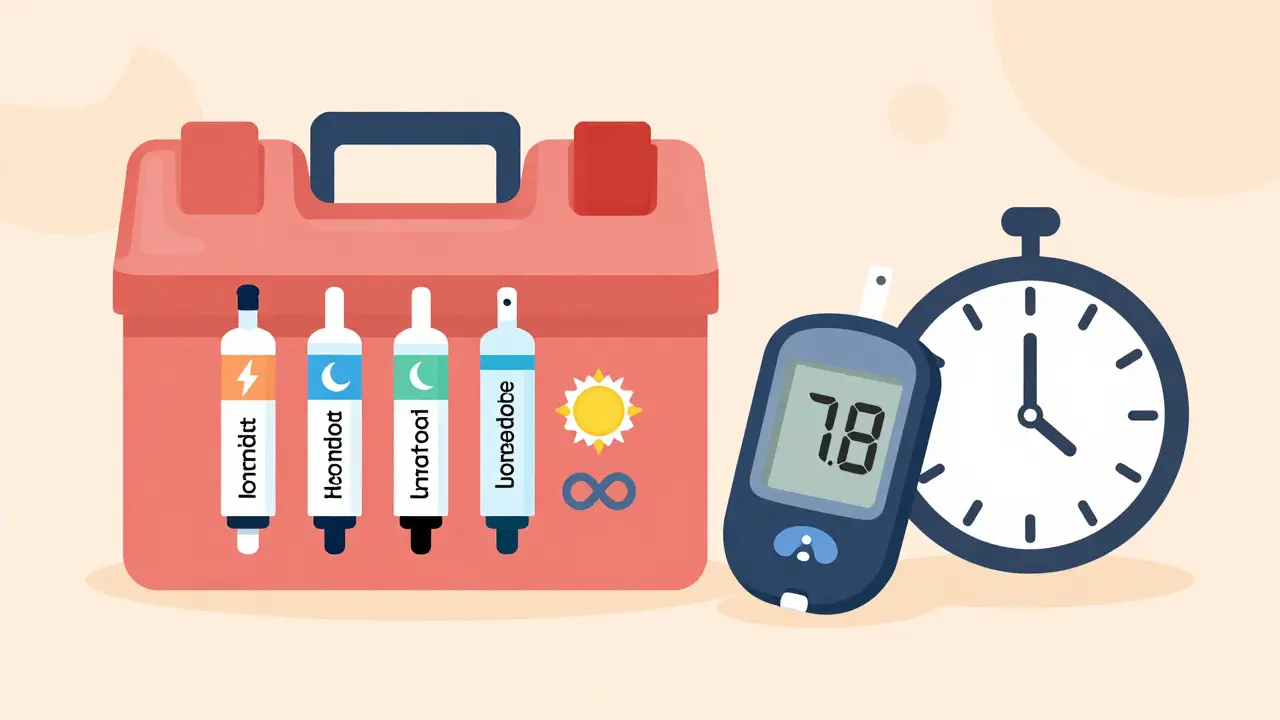
Choosing the right insulin for diabetes isn’t about picking the most expensive or newest option. It’s about matching your life, your body, and your goals with a plan that works-without putting you at risk for low blood sugar or financial stress. For millions of people with diabetes, insulin isn’t just a treatment; it’s a daily rhythm. And getting that rhythm right can mean the difference between feeling in control or constantly playing catch-up.
What Are the Main Types of Insulin?
Insulin comes in different flavors, each with its own timing and job. Think of them like tools in a toolbox: you don’t need every tool for every job, but you do need the right one for the task.
Rapid-acting insulins (like Humalog, NovoLog, and Apidra) start working in 10 to 15 minutes, peak around 30 to 90 minutes, and wear off in 3 to 5 hours. These are your mealtime insulins. They’re designed to cover the sugar spike after eating. Studies show they control post-meal blood sugar better than older short-acting insulins and cause 25% fewer low blood sugar episodes.
Regular or short-acting insulin (like Humulin R) takes about 30 minutes to kick in, peaks in 2 to 3 hours, and lasts up to 8 hours. It’s cheaper and still used, especially where cost is a concern, but it’s less flexible. You have to eat within 30 minutes of injecting, which doesn’t work well for unpredictable meals or kids.
Intermediate-acting insulin (NPH, like Humulin N) starts working in 1 to 2 hours, peaks between 4 and 12 hours, and lasts 12 to 18 hours. It’s often used at night to cover fasting blood sugar. But here’s the catch: its peak can cause nighttime lows. A 2022 study found that 27% of Medicare users on NPH experienced dangerous hypoglycemia during sleep.
Long-acting insulins (like Lantus, Levemir, and Toujeo) are designed to mimic your body’s natural background insulin. They don’t have a strong peak, which means fewer lows. Glargine U300 (Toujeo) lasts up to 36 hours, while detemir (Levemir) lasts 18 to 24 hours. These are the backbone of most modern regimens.
Ultra-long-acting insulin (Tresiba, or insulin degludec) is the longest-lasting option. It starts working after 6 hours, has no real peak, and lasts over 42 hours. Clinical trials show it cuts severe low blood sugar episodes by 40% compared to glargine. But it’s slow to adjust-if you need to raise your dose, you might wait days to see the full effect.
Inhaled insulin (Afrezza) is a powder you breathe in. It works as fast as rapid-acting shots but without the needle. It’s great for people with needle fear, but it’s not for smokers or those with lung issues. And at over $1,000 a month without insurance, many stop using it after a few months.
How Insulin Regimens Work
It’s not just about the type-it’s about how you use it. There are two main approaches: basal-bolus and premixed.
Basal-bolus therapy (also called MDI, or multiple daily injections) uses a long-acting insulin once or twice a day for background coverage, plus rapid-acting insulin before each meal. This is the gold standard for type 1 diabetes. It gives you the most control. You can skip a meal without worrying about leftover insulin crashing your blood sugar. You can adjust your meal dose based on what you eat. But it requires learning carb counting, checking blood sugar 4+ times a day, and adjusting doses. Most people take 6 to 12 weeks to get comfortable.
Premixed insulins (like Humalog Mix 75/25) combine a fast-acting and intermediate-acting insulin in one shot. You take it twice a day, usually before breakfast and dinner. They’re simpler-no need to mix two types. But they’re rigid. You have to eat the same amount of carbs at the same time every day. If you skip lunch or eat pizza instead of rice, your blood sugar will swing. They’re often used in older adults or people who struggle with complex regimens.
Insulin pumps deliver rapid-acting insulin continuously through a small device worn on the body. You still bolus for meals, but the pump handles your background insulin. Studies show they can lower A1C by 0.5% to 1.0% compared to injections, especially for motivated users. But they come with their own problems: 62% of users report issues with clogged tubes or skin irritation at the insertion site.
Which Insulin Is Right for You?
There’s no one-size-fits-all answer. Your choice depends on your diabetes type, lifestyle, budget, and health goals.
If you have type 1 diabetes, you need insulin. Always. The American Diabetes Association recommends basal-bolus therapy with rapid-acting and long-acting analogs. Pumps are an excellent option if you’re tech-savvy and willing to manage the device. Inhaled insulin isn’t approved for type 1.
If you have type 2 diabetes, insulin isn’t always the first step. Newer medications like GLP-1 agonists (semaglutide, tirzepatide) and SGLT2 inhibitors (empagliflozin) are now preferred for people with heart or kidney disease because they protect those organs and often cause weight loss. But if your A1C is above 9.5%, or you’re very sick, insulin may be needed right away. For many, starting with once-daily long-acting insulin (like Lantus or Tresiba) and adding mealtime insulin only if needed works well.
If cost is a problem, human insulin (Humulin R, Novolin N) costs as little as $25 per vial at Walmart’s ReliOn brand. It’s not perfect-it’s slower, less predictable, and causes more lows-but it saves lives. In 2023, 1 in 4 insulin users admitted to rationing because they couldn’t afford it. The Inflation Reduction Act now caps insulin at $35/month for Medicare, and that cap will expand to commercial insurance in 2025. Biosimilars like Semglee (a cheaper version of Lantus) are already cutting prices.
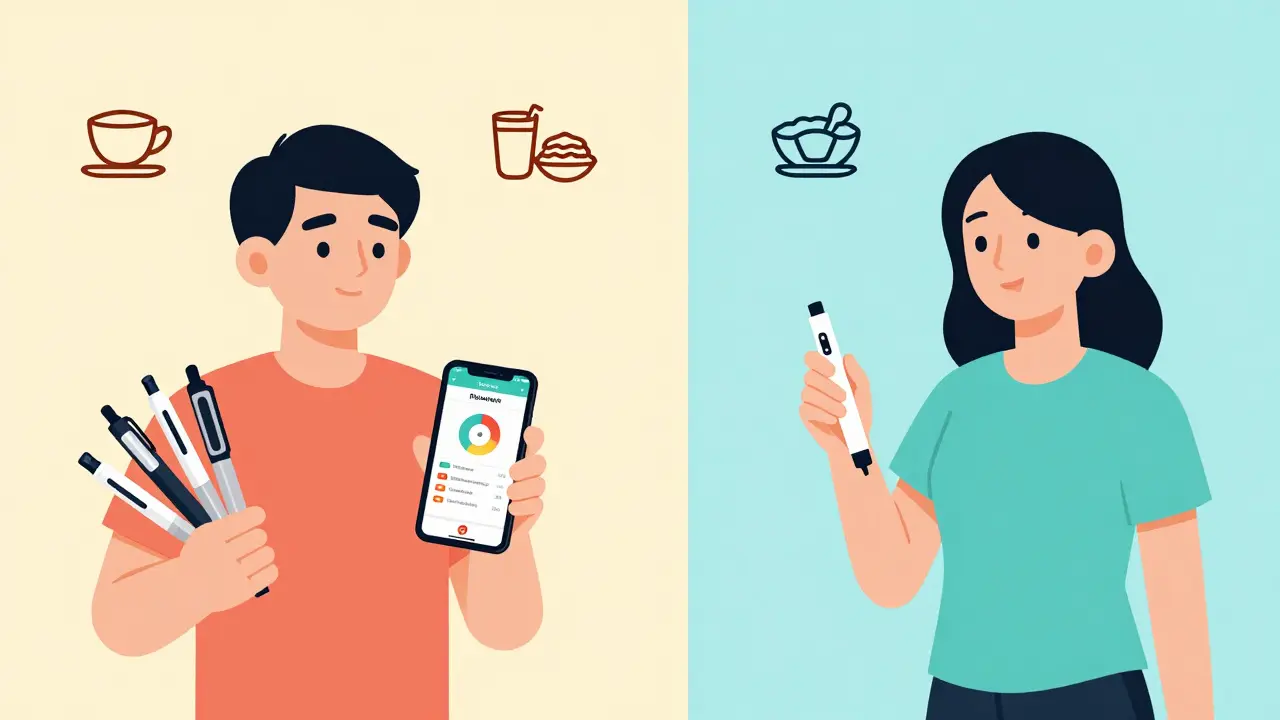
If you hate needles, inhaled insulin is an option-but only if your lungs are healthy and you can afford it. Otherwise, consider a smart insulin pen. These devices track doses, remind you, and sync with apps. They’re growing fast and make managing insulin less stressful.
What Experts Say
Dr. Richard Bergenstal, former president of the American Diabetes Association, says: “Analog insulins are preferred because they act more like your body’s natural insulin-with less risk of low blood sugar.”
But Dr. Silvio Inzucchi from Yale adds: “For type 2 diabetes, we now start with GLP-1 RAs or SGLT2 inhibitors before insulin-unless blood sugar is dangerously high.”
And Dr. Jane Reusch reminds us: “Inhaled insulin is a real option for needle-averse patients, but we need to monitor lung function.”
The consensus? Use analog insulins when you can afford them. Use human insulin when you can’t. Prioritize safety over convenience. And never delay insulin if your body needs it.
Practical Tips for Starting or Adjusting Insulin
- Start low, go slow. Basal insulin usually begins at 0.2 to 0.4 units per kilogram of body weight. Bolus insulin starts at 4 to 6 units per meal.
- Learn carb counting. Most people need 1 unit of rapid-acting insulin for every 10 to 15 grams of carbs. Use an app or a certified diabetes educator to get it right.
- Check your blood sugar before meals and at bedtime. Four checks a day is the minimum for injection users.
- Keep a log. Note what you ate, your insulin dose, and your blood sugar. Patterns reveal what needs fixing.
- Know your correction factor. If your target is 100 mg/dL and you’re at 200, you might need 2 units to bring it down (1 unit per 50 mg/dL is common). But this varies-test yours.
- Never skip meals after taking rapid-acting insulin. You risk a dangerous low.
- Use a certified diabetes care and education specialist (CDCES). People who work with them lower their A1C by 0.5% to 1.0%.
What’s New in Insulin Therapy?
In 2024, the FDA approved the first once-weekly insulin: basal insulin icodec. In trials, it worked as well as daily degludec-and lowered A1C slightly more. It’s a game-changer for people who forget doses.
Smart insulins are in development: ones that turn on only when blood sugar rises, and stay off otherwise. These are still in trials, but they could eliminate the guesswork.
Oral insulin is also being tested. Oramed’s ORMD-0801 showed a 0.8% A1C drop in phase 3 trials. If approved, it could change everything-no more injections.
But the biggest barrier isn’t science-it’s cost. Even with the $35 cap, many people without Medicare still pay over $250 a month. Biosimilars are coming, and prices are expected to drop 30% to 50% by 2027. That could save millions.
Final Thoughts
Insulin isn’t a failure. It’s a tool. A powerful, life-saving tool. The right regimen isn’t the one with the fanciest name or the highest price tag. It’s the one you can stick to, that keeps you safe, and that lets you live your life without fear.
Work with your doctor. Ask about cost-saving options. Learn your numbers. And remember: better blood sugar control cuts your risk of kidney disease, blindness, and nerve damage by up to 60%. That’s not just a statistic-it’s your future.
8 Comments

Diane Hendriks
January 16, 2026 AT 02:05 AM
Insulin isn’t a privilege-it’s a right. The fact that Americans still ration life-saving medication because of corporate greed is a national disgrace. We spend billions on military hardware but won’t cover $35 vials for seniors? This isn’t healthcare-it’s capitalism with a stethoscope.
And don’t get me started on the FDA’s slow-walking of biosimilars. Big Pharma’s lobbying is literally killing people. We need price controls now, not in 2025.
My cousin died at 42 because she skipped doses to pay rent. That’s not a statistic. That’s policy failure dressed in white coats.
Yes, analogs are better. But if you can’t afford them, you’re not failing-you’re being failed by a system that values profit over people.
And yes, I’m angry. I’ve seen too many people choose between insulin and groceries. This isn’t about personal responsibility. It’s about justice.

Gloria Montero Puertas
January 16, 2026 AT 15:13 PM
Oh, please. You’re all romanticizing ‘human insulin’ like it’s some noble, rustic tradition-when in reality, it’s a dangerous, archaic relic that causes more hypoglycemia than a toddler with a candy stash.
And let’s be honest: anyone who’s still on NPH in 2024 is either financially irresponsible or clinically negligent. The science has been settled since 2001.
Yes, it’s cheaper-but ‘cheap’ isn’t ‘smart.’ It’s just cheaper suffering. You wouldn’t drive a 1987 Corolla with bald tires and no brakes and call it ‘frugal.’ Why do this with your pancreas?
And inhaled insulin? Brilliant. If you’re not using it because you’re too lazy to breathe properly, then maybe you shouldn’t be managing your own diabetes.
Also, the idea that ‘basal-bolus is gold standard’ is outdated. Why not just use a pump? Or a closed-loop system? The tech is here. People just refuse to adapt.
Stop glorifying struggle. Modern medicine exists for a reason.

Tom Doan
January 16, 2026 AT 23:47 PM
It’s fascinating how the article presents cost as a ‘barrier’ while simultaneously recommending the most expensive options as ‘gold standard.’
So let me get this straight: the medically optimal choice is also the one that 25% of users can’t afford? That’s not a medical recommendation-that’s a cruel joke.
And yet, we’re told to ‘work with your doctor’-as if doctors aren’t also constrained by insurance formularies and pharmaceutical reps.
The real ‘final thought’ here is that the healthcare system has weaponized gratitude: ‘Be thankful you have insulin at all.’ Meanwhile, people are dying because they can’t pay for the version that doesn’t kill them in their sleep.
It’s not that the science is flawed. It’s that the system is.

Sohan Jindal
January 18, 2026 AT 21:47 PM
They don’t want you to know this but insulin was invented by the government and then sold to big pharma. Now they charge you $300 a vial. That’s not capitalism. That’s treason.
And why do they keep pushing these fancy new insulins? So you get hooked. So you can’t go back to the cheap stuff. So you’re always paying. It’s a trap.
I know a guy who switched to Walmart insulin and his A1C dropped. He didn’t need all that fancy junk. The truth is hidden. They don’t want you to be free.
Also, why is inhaled insulin only for non-smokers? That’s a lie. It’s because they don’t want the poor to use it. They want you to suffer so you’ll buy more.
And why is there no oral insulin yet? Because the needle industry is too powerful. The same people who sell syringes own the FDA.

Nicholas Urmaza
January 20, 2026 AT 14:00 PM
If you’re still struggling with insulin management you’re not trying hard enough. It’s not complicated. Test. Dose. Eat. Repeat. No excuses.
My brother was diagnosed at 19. He didn’t have a single smart pen or app. He used paper logs and a $25 vial. He’s 42 now. Healthy. Active. No complications.
You don’t need fancy tech. You need discipline. You need to stop treating diabetes like a hobby and start treating it like your life depends on it-because it does.
Stop blaming the system. Start owning your health. The tools are there. Use them.

Amy Ehinger
January 20, 2026 AT 20:31 PM
I’ve been on Tresiba for three years now and honestly? It’s been a game-changer. I used to wake up at 3 a.m. sweating and shaking from lows, and now I just… sleep. Like, actually sleep. No alarms. No panic. Just peace.
It took me forever to get the dose right though-like six months of tweaking and crying and feeling like a failure every time my sugar dropped. But my CDCES? She was patient. Like, really patient. She didn’t make me feel dumb for not knowing carb ratios. She just helped me learn.
And the cost? Yeah, I’m on Medicare so I pay $35. If I weren’t? I don’t know. I might’ve had to choose between insulin and my cat’s meds. That’s not a choice anyone should have to make.
Also, I tried Afrezza once. It felt like inhaling powdered sugar and then sneezing for ten minutes. It worked fast, sure. But I missed the needle. Not because I’m scared-I just liked the ritual. The click. The calm before the prick. Weird, right?
Anyway. If you’re reading this and you’re scared to start insulin? I get it. I was terrified too. But it’s not the end of your life. It’s the start of a better one. Just take it slow. And find someone who gets it.

Crystel Ann
January 22, 2026 AT 09:00 AM
My mom started insulin at 72 after her A1C hit 11. She cried for a week. Thought it meant she’d failed. But now? She bakes pies on Sundays, hikes with her grandkids, and checks her sugar like it’s her morning coffee. It didn’t change her life-it gave it back.
And she’s on Humulin N. Cheapest option. She doesn’t care about analogs. She cares about not passing out at the grocery store.
There’s no ‘right’ insulin. There’s only the one that lets you live.
Write a comment
Popular Posts

Divalproex in Children: Safety and Efficacy
Nov, 8 2023

ellen adamina
January 15, 2026 AT 15:09 PM
My dad’s been on NPH for 15 years and never had a nighttime low until last winter. The doctor switched him to Lantus and he’s sleeping through the night for the first time in a decade. I wish more people knew how dangerous those peaks can be.