
Medication Safety Calculator for Seniors
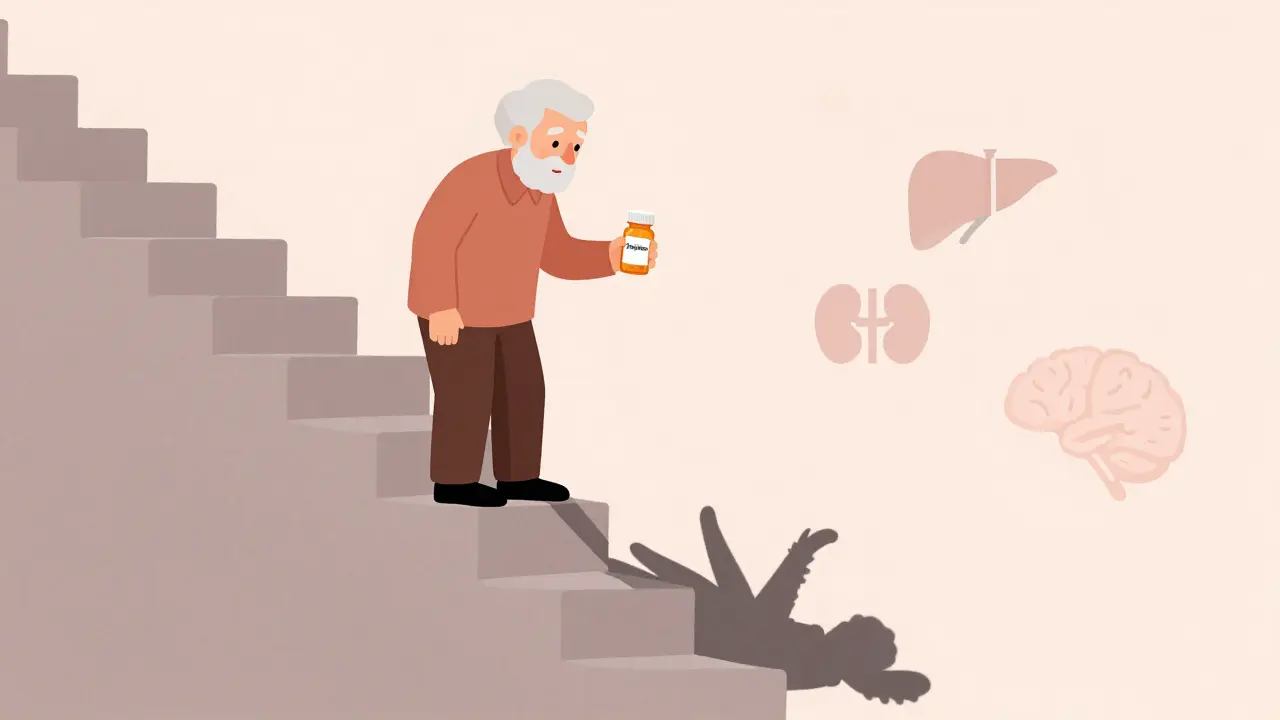
When you’re 25, a little drowsiness from a sleep aid might just mean a lazy Sunday. But at 75, that same pill can send you tumbling down the stairs, break a hip, and land you in the hospital. This isn’t rare. It’s standard. As we age, our bodies change in ways that make medications behave differently-often dangerously so. The same dose that worked fine at 50 can become toxic at 80. And most doctors still prescribe the same way they did 30 years ago.
Why Your Body Handles Drugs Differently After 65
Your liver doesn’t process drugs like it used to. Your kidneys don’t flush them out as fast. Your body composition shifts-less water, more fat. These aren’t minor tweaks. They’re fundamental changes that alter how drugs move through you, how long they stay, and how strongly they hit.By age 80, your kidneys filter blood at about half the rate they did at 30. That means drugs like digoxin, lithium, or certain antibiotics build up in your system. Even if you take the same pill, your blood holds more of it. That’s why older adults are more than twice as likely to have serious side effects from medications than younger people.
At the same time, your liver’s blood flow drops by 20-40% between ages 25 and 65. That slows down the breakdown of drugs like propranolol or verapamil. These medications stick around longer, increasing the chance of dizziness, low blood pressure, or even heart rhythm problems.
And then there’s body fat. As you age, fat increases while water decreases. That changes how drugs dissolve. Fat-soluble drugs like diazepam (Valium) or antidepressants like amitriptyline linger in fatty tissue, releasing slowly and unpredictably. Water-soluble drugs like antibiotics or diuretics become more concentrated because there’s less fluid to dilute them.
Your Brain Gets More Sensitive-Even at the Same Dose
It’s not just about what your body does to the drug. It’s what the drug does to your brain. Aging brains respond more strongly to certain chemicals. A 2023 study showed that older adults get 50% more sedation and memory loss from diazepam than younger people-even when their blood levels are identical.Anticholinergic drugs-commonly found in allergy pills, sleep aids, and even some bladder medications-can cause confusion, hallucinations, and delirium in older adults. A University of Florida study found people over 75 were 4.2 times more likely to go into delirium from these drugs than those under 65. That’s not a side effect. That’s a medical emergency.
Even common painkillers like ibuprofen or naproxen can cause kidney damage or stomach bleeding in older adults. And opioids? They’re far more dangerous. Fentanyl and alfentanil need 30-50% lower doses in people over 70 to avoid dangerous breathing problems. Yet many still get the same doses as 40-year-olds.
Medications That Are Riskier After 65
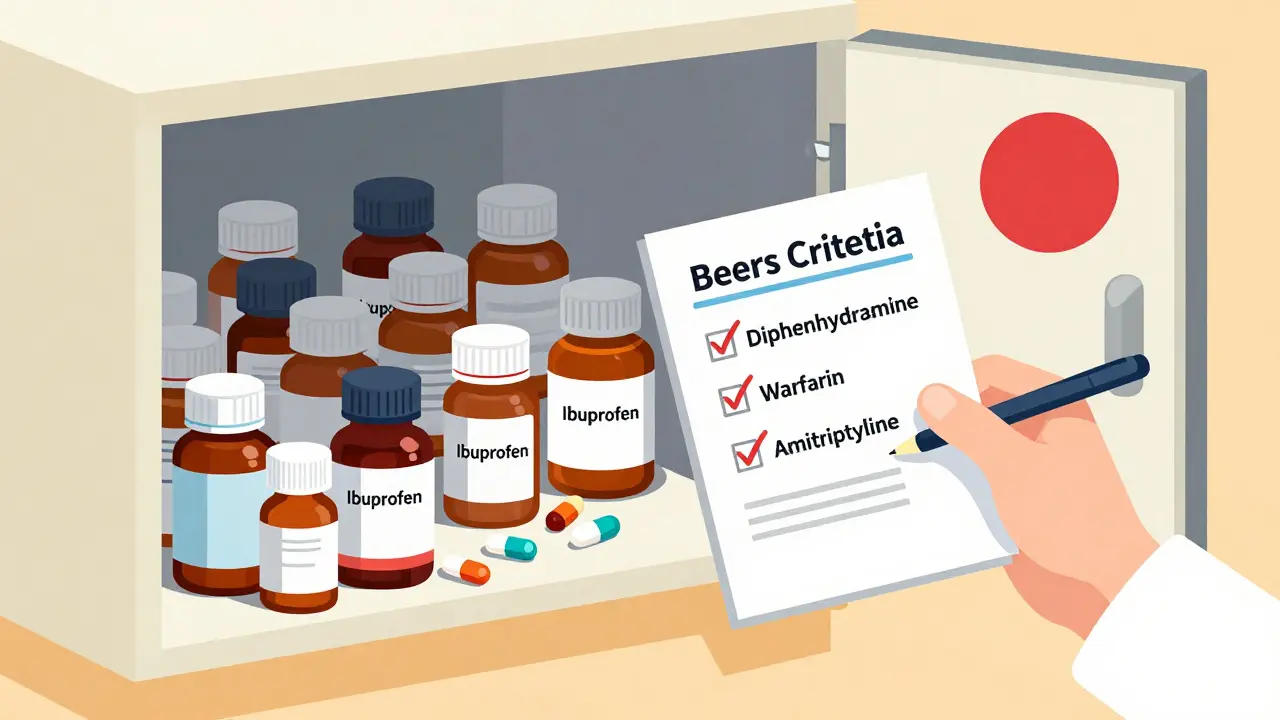
The American Geriatrics Society keeps a list called the Beers Criteria. It’s updated every two years. The 2023 version lists 56 drugs that are risky for older adults. Many of them are still prescribed regularly.- Benzodiazepines (like lorazepam or zolpidem): 2-3 times higher risk of falls and hip fractures. Zolpidem causes 80% more next-day drowsiness in people over 65.
- Anticholinergics (like diphenhydramine or oxybutynin): Linked to memory loss, confusion, and dementia-like symptoms. One in four older adults on these drugs report serious memory issues.
- NSAIDs (ibuprofen, naproxen): Increase risk of stomach bleeding and kidney failure. Risk jumps after age 70.
- Warfarin: Older adults need 20-30% lower doses. Their blood thins more easily, and their INR levels become unstable 35% of the time versus 15% in younger patients.
- Antidepressants (amitriptyline, nortriptyline): Cause urinary retention in older men with enlarged prostates. One Reddit user, age 78, needed a catheter after three days on amitriptyline.
Some of these drugs are sold over the counter. That’s the problem. People think if it’s on the shelf, it’s safe. It’s not. Diphenhydramine is in Benadryl, Unisom, and even some sleep aids. It’s a major contributor to confusion and falls in older adults.
Polypharmacy: When More Pills = More Danger
Forty-eight percent of adults over 65 take five or more prescription drugs every month. That’s not unusual. It’s the norm. But each extra pill adds risk. Why? Because drugs interact. One drug might slow the metabolism of another. Another might increase blood pressure, while a third lowers it. The result? A confusing, dangerous mess.A 2022 study found that older adults on five or more medications had a 70% higher chance of being hospitalized for a side effect than those on two or fewer. And 62% of those hospitalizations were preventable.
Take this real example: A woman on blood pressure meds, a statin, a diuretic, a sleep aid, and an anticholinergic for bladder control. She starts feeling dizzy. Her doctor adds another drug for dizziness. She gets confused. Her family blames aging. No one asks: What’s the root cause? It’s the combination. Five drugs. One problem.
What Doctors Should Be Doing-But Often Aren’t
There are tools to fix this. The STOPP/START criteria help doctors know which drugs to stop and which to start. The Beers Criteria tells them which drugs to avoid. Yet, a 2019 study found 42% of older adults were still taking at least one drug on the Beers list.Doctors don’t always know the guidelines. Or they’re rushed. Or they assume the patient’s other doctor handled it. But here’s what works:
- Start low, go slow. Initial doses for older adults should be 25-50% of standard adult doses.
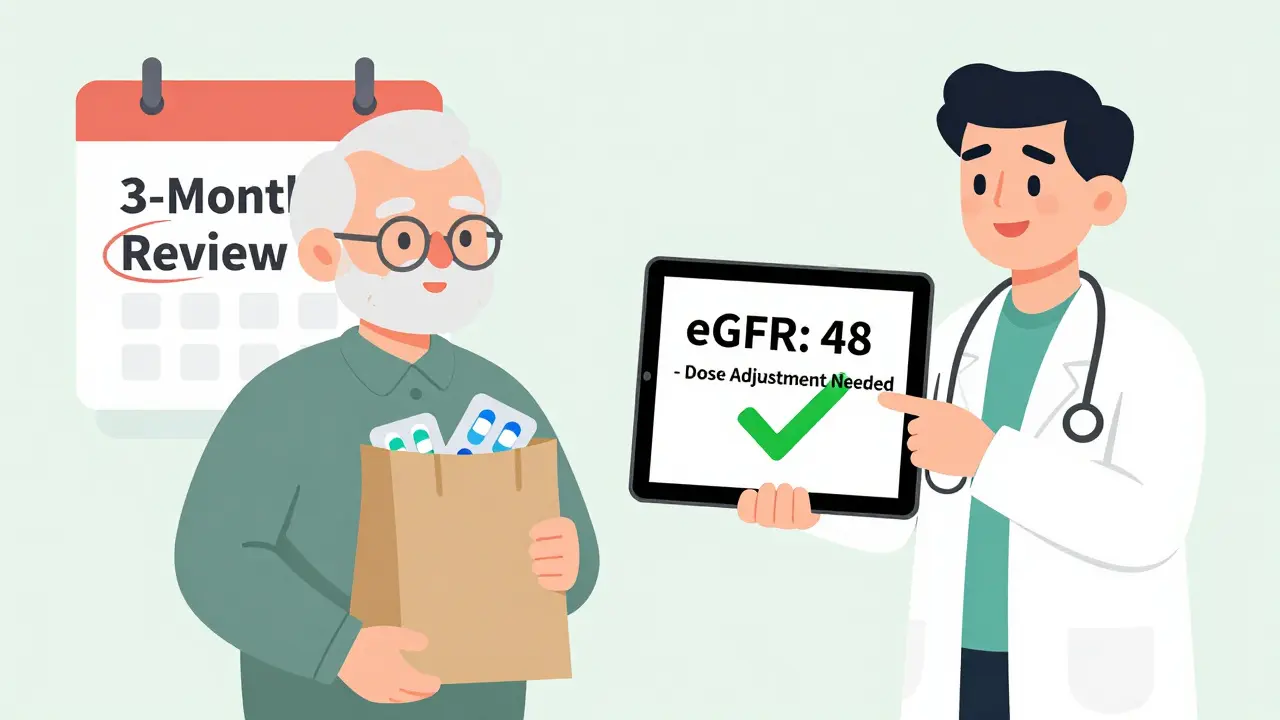
- Review every 3-6 months. The American Medical Association recommends full medication reviews for anyone over 65 on multiple drugs.
- Do a Brown Bag Review. Bring all your pills-prescription, OTC, supplements-to your appointment. Pharmacists find an average of 3.2 errors per patient.
- Check kidney function. Use eGFR, not just creatinine. If your eGFR is below 60, many drugs need dose adjustments.
- Ask: Is this still necessary? Dr. Michael Steinman says, "We must actively consider stopping medications that no longer provide benefit as patients age."
Deprescribing isn’t giving up. It’s taking control. A 2022 study showed that when doctors actively stopped unnecessary drugs in nursing homes, 30-50% of the medications were inappropriate. Removing them improved balance, alertness, and quality of life.
What You Can Do Right Now
You don’t need to wait for your doctor to act. Here’s how to protect yourself or a loved one:- Make a list. Write down every pill, patch, cream, vitamin, and supplement you take. Include dosages and why you take them.
- Ask your pharmacist. Pharmacists are trained to spot interactions. Bring your list to them. Ask: "Which of these could be causing dizziness or confusion?"
- Challenge the script. If you’re prescribed a new drug, ask: "Is this safe for someone my age? Are there safer alternatives?"
- Watch for red flags. New dizziness, confusion, falls, urinary problems, or sudden weight loss? It might be a drug, not aging.
- Use the Beers Criteria app. It’s free. Download it. Look up any new prescription before you fill it.
One woman, 82, fractured her hip after her blood pressure pill was prescribed at the same dose as her daughter’s. Her doctor didn’t adjust for age. She didn’t know to ask. After switching to a safer drug and lowering the dose, she stopped falling. She’s walking again.
The Bigger Picture: Why This Isn’t Getting Fixed
Most clinical trials exclude people over 75. That means we’re prescribing based on data from 30-year-olds. The FDA’s 2022 guidance wants 25% of trial participants to be over 75 by 2026. But we’re not there yet.And the cost? The U.S. spends $30 billion a year treating preventable side effects in older adults. That’s 15% of all medication costs for this group. It’s not just money. It’s broken hips, lost independence, and hospital stays that could have been avoided.
Change is coming. Medical schools are teaching geriatric pharmacology. AI tools like MedAware are cutting errors by 42%. Pharmacogenomic testing is helping match drugs to genetic profiles. But until you ask the questions, until you demand reviews, until you say "stop" when something doesn’t feel right-nothing will change for you.
Medication isn’t magic. It’s chemistry. And chemistry changes with age. What worked before might be harming you now. The solution isn’t more pills. It’s fewer. Smarter. Slower. And always, always checked.
Why do older adults have more side effects from medications?
Older adults have more side effects because their bodies process drugs differently. Kidneys filter slower, liver metabolism declines, body fat increases, and the brain becomes more sensitive to certain chemicals. Even the same dose that was safe at 50 can become dangerous at 75.
What medications should older adults avoid?
The Beers Criteria lists 56 medications to avoid or use with extreme caution in older adults. These include benzodiazepines (like Valium), anticholinergics (like Benadryl), NSAIDs (like ibuprofen), certain antidepressants (like amitriptyline), and some sleep aids (like zolpidem). Many are still prescribed because doctors don’t know the guidelines.
Is it safe to take multiple medications as you get older?
Taking five or more medications increases the risk of dangerous interactions and side effects by 70%. Polypharmacy is common but not safe. Every medication should be regularly reviewed for necessity, especially if you’re over 65.
What should I do if I think a medication is causing side effects?
Don’t stop taking it without talking to your doctor. But do bring a full list of all your medications to your next appointment. Ask specifically: "Could any of these be causing dizziness, confusion, or falls?" Many side effects are mistaken for normal aging.
Can I stop taking a medication on my own?
No. Stopping some medications suddenly can be dangerous-like blood pressure or antidepressant drugs. But you can ask your doctor to review them. Many medications can be safely reduced or stopped over time, especially if they’re no longer needed or are causing harm.
10 Comments

Lana Kabulova
January 22, 2026 AT 11:37 AM
Let me just say-doctors are not magic. They’re humans who get paid to write scripts, not to read your entire medical history. I’ve seen my dad on 11 meds at 78. He’s dizzy all day. He’s confused. He’s falling. And when we asked the doctor to cut something? ‘Oh, that’s not the problem.’ Bullshit. It’s always the pills. Always. Stop pretending aging is the enemy-it’s the prescription pad.

Lauren Wall
January 24, 2026 AT 07:09 AM
My aunt died after a hip fracture from a sleep med. She was on 6 prescriptions. No one checked. No one asked. It’s not negligence. It’s negligence with a degree.

Sarvesh CK
January 25, 2026 AT 07:51 AM
The fundamental issue here is not merely pharmacological-it is systemic. The medical establishment operates on a paradigm rooted in the young, the healthy, and the statistically dominant. Clinical trials exclude the elderly because they are ‘complicated,’ yet we prescribe to them as if they were simply older versions of 30-year-olds. This is not merely a gap in knowledge-it is a moral failure. The body is not a static machine; it is a dynamic, aging system. To treat it otherwise is not medicine-it is arrogance dressed in white coats. We must shift from prescribing to *personing*-understanding the whole human, not just the drug-dosing algorithm.

Hilary Miller
January 27, 2026 AT 06:20 AM
My mom in India takes 4 meds. She also takes turmeric, ashwagandha, and this weird herbal tea her cousin sent. No one told her any of it might clash. We need a global conversation on this. It’s not just an American problem.

Margaret Khaemba
January 28, 2026 AT 02:05 AM
I’m 62 and I just started a new blood pressure med. I asked my pharmacist: ‘Is this safe for someone my age?’ She looked at me like I’d asked if I should breathe. Then she pulled up the Beers Criteria app on her phone and said, ‘You’re lucky you asked.’ I’m not lucky. I’m just not dumb. Why should I have to be the one to do the work?

arun mehta
January 28, 2026 AT 17:04 PM
Thank you for this post 🙏. I’ve been working in a nursing home for 12 years, and I’ve watched 37 residents decline after being given ‘just one more pill’ for ‘just one more thing.’ One man stopped hallucinating after we stopped his anticholinergic. He started recognizing his grandchildren again. It’s not magic. It’s just stopping the poison. We need more of this awareness. Not just in the US. Everywhere.

Chiraghuddin Qureshi
January 29, 2026 AT 01:32 AM
My dad’s doctor gave him Zolpidem for sleep. He woke up at 3am walking around the house in his underwear, talking to the TV. We thought he had dementia. Turned out, it was the pill. We stopped it. He’s back to normal. I’m telling everyone I know: if you’re over 65 and on a sleep med, ask if it’s on the Beers list. It’s not ‘just aging’-it’s a warning sign.

Oren Prettyman
January 29, 2026 AT 09:01 AM
While the sentiment is commendable, one must question the empirical validity of the claims. The Beers Criteria, while widely cited, is not universally accepted as evidence-based in its entirety. Furthermore, the assertion that 42% of older adults are prescribed Beers-listed drugs assumes uniform compliance with guidelines, which is unverified across heterogeneous clinical settings. Moreover, the notion that ‘fewer pills’ is universally optimal ignores the reality that polypharmacy may be medically necessary in complex geriatric syndromes. A blanket reductionist approach risks iatrogenic harm through under-treatment. One must balance caution with clinical nuance-otherwise, we risk replacing one dogma with another.

shivani acharya
January 30, 2026 AT 12:32 PM
Of course they’re still prescribing these drugs. The pharmaceutical companies pay the doctors. The FDA is full of ex-pharma execs. The ‘Beers Criteria’? A joke. A PR stunt to make people feel safe while the real killers-Paxlovid, statins, antipsychotics-are still on the shelf. They don’t want you to live longer. They want you to keep buying pills. And if you fall? Well, that’s just another hospital bill. They’re not trying to fix this. They’re trying to profit from it. Wake up. This isn’t medicine. It’s a money machine.
Write a comment
Popular Posts

Alec Amiri
January 21, 2026 AT 12:49 PM
This is wild. My grandma took Benadryl for sleep and started talking to her dead husband like he was sitting in the chair. We thought she was losing it-turns out, it was the pill. She’s been off it for a year now and acts like a whole new person. Why is this still on shelves???