
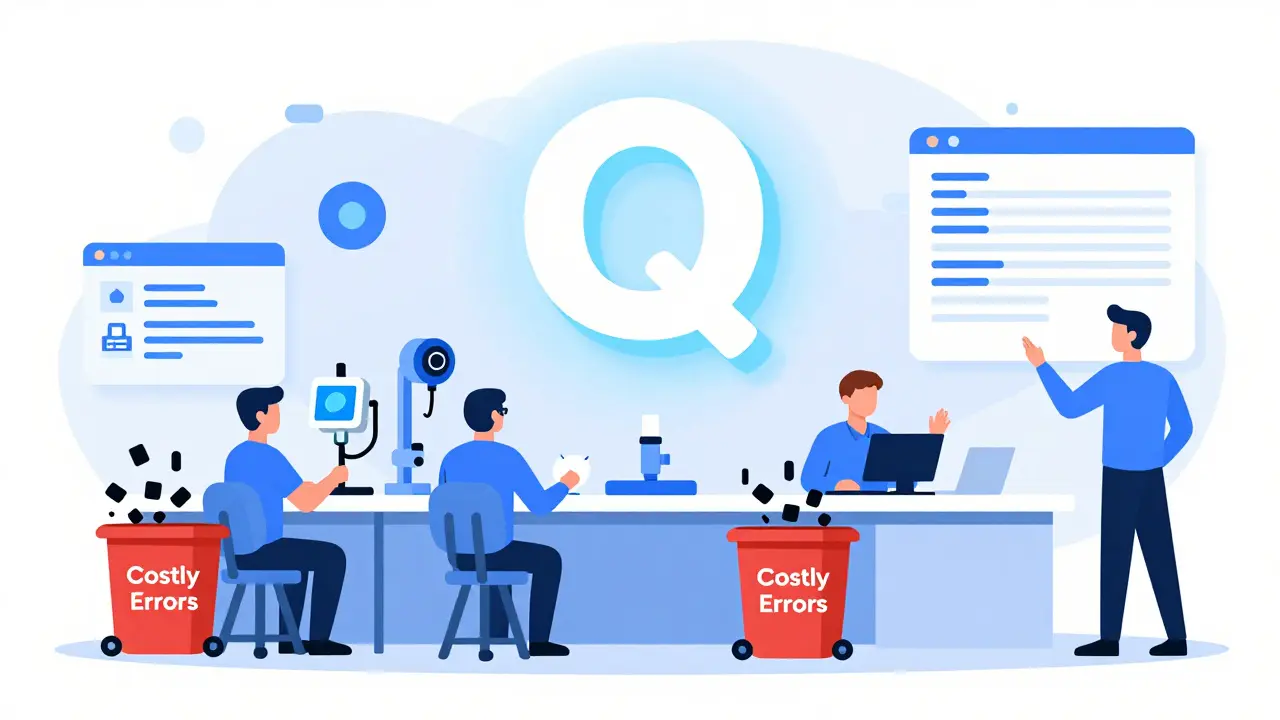
Manufacturing isn’t just about building things anymore. It’s about quality-and the fear that it’s slipping away. In 2025, 93% of manufacturers in the U.S. said quality was very or extremely important to their operations. By 2026, that number hasn’t dropped. It’s climbed. Why? Because the stakes are higher than ever. One defective part in a medical device. One misaligned sensor in an electric vehicle. One missed deadline because a batch didn’t pass inspection. These aren’t hypotheticals. They’re real, costly, and sometimes life-threatening failures happening right now.
Quality Isn’t a Department Anymore-It’s the Whole Business
Used to be, quality assurance was tucked away in a corner of the factory, with inspectors holding calipers and checking dimensions by hand. Now, it’s at the center of every decision. When executives talk about innovation, growth, or cost savings, they’re talking about quality. A 2025 ZEISS report found that 95% of manufacturing leaders see quality as mission-critical-not just for avoiding recalls, but for enabling new products, faster production, and stronger customer trust. That shift is real. Companies that treat quality as a strategic lever are seeing 22% lower rework costs and 18% faster time-to-market. The ones still treating it like a paperwork chore? They’re falling behind.
The Hidden Costs of Poor Quality
Most people think rework means fixing a broken part. It’s not that simple. Rework eats time, money, and materials. In 2025, 38% of manufacturers named the cost of rework and iterations as their biggest quality challenge. But here’s what’s worse: rising material costs. 44% of manufacturers said that’s their top concern. When copper, lithium, or specialty plastics jump in price, a single rejected component can cost hundreds of dollars in lost raw material. One medical device maker cut rework costs by $1.2 million a year-not by hiring more inspectors, but by using precise metrology tools that caught tiny deviations before they became waste. That’s not luck. That’s strategy.
The Skills Gap Is Real-And It’s Getting Worse
There’s a reason so many factories struggle with quality: they can’t find people who know how to use the tools. 47% of manufacturers say they lack skilled personnel. But it’s not just about experience. It’s about training. A worker who knows how to measure a part manually doesn’t automatically know how to interpret AI-driven inspection data. LinkedIn surveys in 2025 showed 78% of manufacturing professionals feel quality has become harder because they’re being asked to deliver aerospace-grade precision at consumer electronics speed. And here’s the kicker: median salaries for quality engineers with AI/ML skills hit $98,500 in Q2 2025-22% higher than traditional roles. Companies that don’t invest in upskilling aren’t just falling behind. They’re losing their best people.

Technology Alone Won’t Fix It
There’s a dangerous myth out there: buy the newest machine, and quality problems disappear. That’s not true. A manufacturer spent $2.3 million on automated inspection systems and saw error rates go up 40% in the first year. Why? No training. No integration. No one knew how to interpret the data. Technology without process is noise. The winners? They build teams. Cross-functional teams. Quality engineers, IT specialists, and production managers working together from day one. Deloitte found that 68% of successful implementations include this kind of collaboration. It’s not about the hardware. It’s about how people use it.
AI Isn’t Magic-It’s a Warning System
Artificial intelligence in quality isn’t about replacing inspectors. It’s about predicting problems before they happen. Early adopters report 27% fewer defects reaching customers. One automotive supplier cut defect detection time by 37% and reduced false alarms by 29%. That’s not sci-fi. That’s data. AI looks at patterns-temperature shifts, vibration spikes, material flow anomalies-and flags what humans might miss. But here’s the catch: it only works if the data is clean and connected. A Reddit thread in July 2025 had 247 comments, and 87% of respondents said their biggest frustration was inconsistent data between departments. If the design team’s numbers don’t talk to the production team’s sensors, AI just gives you more confusion.
The Supply Chain Is a Chain-Break One Link, You Break Them All
Quality isn’t just about what happens inside your factory. It’s about what your suppliers deliver. Manufacturers who treat suppliers like extensions of their own operation-sharing forecasts, communicating openly, planning ahead-see 31% greater supply chain resilience. That’s not a nice-to-have. It’s survival. When a single component from a foreign vendor is delayed, entire production lines stop. One electronics plant in Ohio idled for three weeks because a sensor chip didn’t meet specs. They didn’t have a backup. They didn’t have visibility. They didn’t have a plan. Now they’re using cloud-based Quality Management Systems (QMS) to track supplier performance in real time. 68% of new enterprise deployments in 2025 were cloud-based. The old paper-based logs? Gone.
What’s Next? The Divide Is Widening
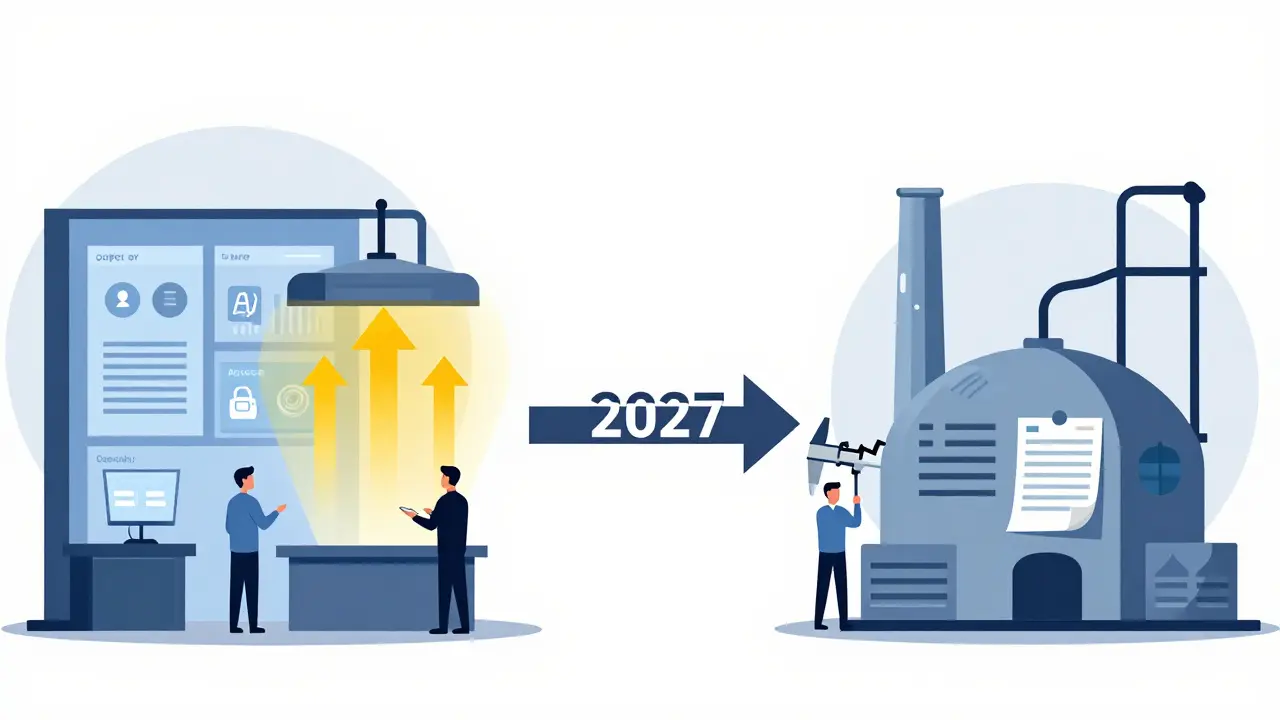
By 2027, Forrester predicts manufacturers who delay investing in predictive quality analytics will see 23% higher defect rates. That’s not a guess. That’s a trend. The gap between those who adapt and those who don’t is turning into a chasm. Aerospace and medical device makers? 78% and 72% adoption of advanced tools. General manufacturing? Only 48%. The ones lagging aren’t just losing money. They’re losing credibility. Customers don’t care if your factory is old. They care if your product fails. And when it does, they remember. One bad experience can cost you years of trust.
Can This Be Fixed?
Yes-but not overnight. It takes 6 to 9 months to fully implement a modern quality system. You can’t rush it. You need phased rollouts. You need training. You need buy-in from every level. The companies succeeding aren’t the ones with the biggest budgets. They’re the ones with the clearest plan. They’re the ones listening to their operators on the floor. They’re the ones connecting quality data to customer feedback. Because in 2026, quality isn’t just about compliance. It’s about loyalty. It’s about reputation. It’s about staying in business.
Why is quality assurance more important now than in the past?
Quality assurance is no longer just about catching defects-it’s tied directly to profitability, innovation, and customer trust. In 2025, 95% of manufacturing executives said quality is mission-critical to success. Rising material costs, tighter supply chains, and faster production cycles mean even small errors now cost far more than they used to. Companies that treat quality as a strategic advantage see 22% lower rework costs and 18% faster time-to-market.
What’s the biggest barrier to improving quality in manufacturing today?
The biggest barrier isn’t technology-it’s people. 47% of manufacturers say they lack skilled personnel, and 57% admit they don’t train staff adequately on new digital tools. Many companies invest in AI and automation but fail to train teams to use them. Without the right skills, even the best systems create more confusion than clarity.
How do AI and predictive analytics improve quality?
AI doesn’t replace inspectors-it predicts problems before they happen. By analyzing real-time data from sensors and machines, AI spots subtle patterns that signal potential defects. Early adopters report 27% fewer quality deviations reaching customers and 41% fewer customer-reported defects. One manufacturer cut false positives by 29% and improved defect detection by 37% in just eight months.
Is cloud-based QMS really better than traditional systems?
Yes, for most manufacturers. Cloud-based Quality Management Systems (QMS) offer real-time data access across departments and locations, making it easier to track supplier performance, enforce standards, and respond to issues fast. In 2025, 68% of new enterprise deployments were cloud-based, up from 52% in 2023. Traditional paper-based or isolated digital systems can’t keep up with today’s speed and complexity.
What should manufacturers do first to address quality concerns?
Start by mapping your biggest quality pain points-rework costs, inspection delays, supplier defects-and pick one to solve. Don’t try to fix everything at once. Then, form a cross-functional team (quality, IT, production) and choose one technology that directly addresses that problem-like AI-powered inspection or real-time metrology. Train your team. Integrate the data. Measure results. Scale only after you’ve proven it works.
9 Comments

Chelsea Deflyss
February 8, 2026 AT 18:23 PM
I swear every time i see "predictive analytics" i think of my ex who said "trust the process" then ghosted me. same energy. 47% lack skilled ppl? yeah. 97% of managers think buying a $500k machine fixes that. no. you need to pay people to learn. duh.

Scott Conner
February 10, 2026 AT 00:06 AM
I’ve been in this for 18 years. Used to be, if a part was 0.02mm off, you’d scrap it. Now? You’d get sued. The stakes aren’t just higher-they’re personal. I had a cousin who got a faulty pacemaker. Not from our plant. But now I check every batch like it’s my kid’s life on the line. That’s the shift. Not tech. Heart.

Tatiana Barbosa
February 11, 2026 AT 11:16 AM
YESSSSSSSSS this!!
Stop treating QA like a cost center. It’s the engine of customer loyalty.
When we stopped seeing rework as "oops" and started seeing it as "feedback loop"-our NPS jumped 32 points.
One team. One goal. One data stream.
And for god’s sake-train your damn people. AI doesn’t fix dumb processes. People do.
Also-cloud QMS? Non-negotiable. Paper logs are a museum piece.

MANI V
February 12, 2026 AT 07:14 AM
All this talk about AI and tech. Funny. The real problem? Lazy management. They don’t want to pay for training. They don’t want to hire real engineers. They want magic boxes. Meanwhile, the people who actually know how to read a micrometer are retiring. And no one’s replacing them. This isn’t a quality crisis. It’s a moral one.

Susan Kwan
February 12, 2026 AT 16:57 PM
Let me guess-the guy who wrote this is a consultant who’s never touched a caliper. "Cross-functional teams"? Cool. Try getting your IT team to talk to production when their ERP is 3 years out of date. Or when the supplier’s QC report is a scanned PDF from 2019. Technology doesn’t fix broken systems. People with authority do. And most factories don’t have any.

Ryan Vargas
February 12, 2026 AT 20:44 PM
Consider this: if quality is the new strategic lever, then who holds the lever? Not the engineers. Not the operators. Not even the C-suite. The lever is held by the invisible hand of data capitalism. Every sensor reading, every defect log, every supplier metric-it’s all feeding into a global surveillance apparatus disguised as "continuous improvement." We’re not improving quality. We’re optimizing human behavior for algorithmic efficiency. And when the AI flags a worker for "non-compliance" because their hand trembled? That’s not quality control. That’s digital Taylorism. And it’s coming for your job next.

Tasha Lake
February 14, 2026 AT 15:13 PM
The 22% lower rework stat? Real. We saw it. But what’s wild is how fast it happened after we started using the same KPIs for production and QA. No more "you guys fix it" vs "you guys break it." Now we’re all just trying to make fewer rejects. Also-AI false positives? Totally fixed once we synced our MES with the CAD files. Data alignment > new hardware.

Simon Critchley
February 15, 2026 AT 16:50 PM
LOL at the "$98.5k salary for AI QA engineers". Meanwhile, my mate in Bangalore is doing the same job for $18k and his boss still thinks "cloud" means weather. Global inequality in quality tech is wild. We’re not facing a skills gap-we’re facing a wealth gap. The real innovation? Paying people enough to care.
Write a comment
Popular Posts





Doxt-SL: Uses, Dosage, Side Effects & Price Guide
Sep, 21 2025
THANGAVEL PARASAKTHI
February 7, 2026 AT 14:02 PM
Honestly, this hits home. We’re in the middle of rolling out AI inspection at our plant and yeah, the tech is slick but the real win? When the floor guys stop seeing it as "another thing the bosses forced on us" and start using it to call out issues before QA does. One welder caught a 0.3mm misalignment his eyes missed. Now he’s the go-to guy for training new hires. Quality ain’t about cameras, it’s about culture.