

Most people think burning calories means hitting the gym, lifting weights, or running on a treadmill. But what if the real secret to losing weight isn’t intense workouts-it’s how you move between them?
That’s where NEAT comes in. Non-Exercise Activity Thermogenesis isn’t a fancy term for a new fitness trend. It’s the calories you burn just by living: walking to the bus stop, standing while you talk on the phone, taking the stairs, pacing while waiting for your coffee, even fidgeting in your chair. These tiny movements add up-way more than most people realize.
Back in the early 2000s, Dr. James Levine at the Mayo Clinic started studying why some people stay lean without working out, while others gain weight even eating the same amount. His breakthrough? It wasn’t metabolism. It was movement. People who naturally stood more, walked more, shifted positions often, burned hundreds more calories a day-without ever setting foot on a treadmill. He called this NEAT. And it’s now one of the most powerful, overlooked tools for weight management.
Why Step Counts Matter More Than You Think
Step counters turned NEAT into something measurable. Before Fitbits and Apple Watches, people had no idea how little they moved. A 2023 study by IDC found over 300 million people worldwide now track their steps daily. And it’s not just for bragging rights. Step counts give you real data on your daily movement-and that’s the key to unlocking NEAT.
Here’s the math: the average person burns about 0.04 to 0.05 calories per step. That means 10,000 steps equals roughly 400-500 calories burned. Sounds good, right? But here’s the catch: that number changes based on your weight, height, and how fast you walk.
For example, a man who’s 5’9” and weighs 187 lbs burns about 469 calories walking 10,000 steps at a normal pace. A woman who’s 5’4” and 170 lbs needs about 12,000 steps to burn the same amount. Why? Because heavier bodies require more energy to move. Your body isn’t a one-size-fits-all machine.
And pace matters more than you’d expect. Walk slowly-say, 2 mph-and you’ll burn more calories for the same number of steps because you’re moving longer. Walk fast-4 mph-and you cover the same distance faster, so you burn fewer calories overall, even though you’re working harder. It’s counterintuitive, but true: slow, steady movement burns more calories per step than rushing through them.
The 10,000-Step Myth
Everyone’s heard the 10,000-step goal. But here’s the truth: it was invented in 1965 by a Japanese pedometer company called Manpo-kei, which means “10,000-step meter.” It was a marketing slogan, not science.
Research from JAMA Internal Medicine in 2019 found that for women over 60, the health benefits of step counting plateaued at 7,500 steps per day. More steps didn’t mean lower risk of death-it just meant more walking. For younger adults, 8,000-9,000 steps is often enough to support weight loss and metabolic health.
Chasing 10,000 steps every day isn’t wrong-but it’s not always necessary. If you’re sitting at a desk all day, hitting 5,000 steps might be a win. If you’re already active, adding 2,000 extra steps-like walking during lunch or parking farther away-could be the difference between gaining weight and losing it.
The goal isn’t a number. It’s consistency. Movement that happens daily, even in small doses, is what changes your body over time.
It’s Not Just Steps-It’s How You Move
Step counters don’t tell the whole story. That’s because NEAT includes everything: standing at your kitchen counter, washing dishes, playing with your kids, gardening, even tapping your foot while you work.
One Fitbit user reported burning 2,137 calories in a day with only 14,353 steps. Another burned 3,500 calories before hitting 10,000 steps-because they were climbing stairs, carrying groceries, and walking briskly around the house. Their device wasn’t broken. It was measuring intensity, not just steps.
Modern trackers use algorithms that factor in speed, stride length, and even heart rate to estimate calorie burn. That’s why two people with the same step count can burn wildly different calories. One might be strolling through the park. The other might be power-walking uphill with a backpack.
And then there’s stair climbing. Research from PMC in 2012 found that climbing stairs one step at a time burns more total calories than double-stepping-even though it feels slower. Why? Because each step requires more muscle engagement. If you take the stairs instead of the elevator, even just once a day, you’re adding real metabolic value.

Why Your Tracker Lies (And How to Fix It)
Ever had a day where you didn’t walk much, but your device says you burned 600 calories? Or vice versa-walked all day, but the number feels too low?
That’s because trackers aren’t perfect. They can count a car ride over gravel as steps. Or miss steps if your arms aren’t swinging. Some people get 300 extra “steps” just from typing or gesturing.
To get accurate data:
- Calibrate your stride length. Most apps let you enter your height, and they calculate it for you (height × 0.414). But if you’re shorter or taller than average, adjust manually.
- Check your pace settings. If your device thinks you’re walking slowly but you’re actually jogging, it’ll undercount calories.
- Use your phone’s accelerometer as a backup. If you’re walking with your phone in your pocket, it often tracks steps more accurately than a wrist-worn device.
- Don’t trust the calorie number as gospel. Use it as a trend, not a target. Are you burning more this week than last? That’s what matters.
Also, remember: NEAT isn’t about perfection. It’s about awareness. If you notice you’ve only taken 3,000 steps by 3 p.m., go for a 10-minute walk. It’s not about hitting 10,000-it’s about not letting your day slip into stillness.
How to Use NEAT for Weight Loss
If you’re trying to lose weight, here’s what actually works:
- Track your steps for a week without changing anything. Get your baseline. Most sedentary people average 3,000-5,000 steps a day.
- Add 1,000-2,000 steps daily. Walk after dinner. Take the stairs. Park at the far end of the lot. Stand while you watch TV.
- Don’t reward yourself with food. Walking 500 calories doesn’t mean you can eat a bag of chips. That snack might be 500 calories too. NEAT is a tool, not a free pass.
- Focus on movement snacks. Five minutes of walking every hour adds up to 60 minutes of movement by the end of the day. That’s 200-300 extra calories burned-without ever calling it “exercise.”
- Combine it with sleep and stress management. Poor sleep lowers NEAT. High stress makes you more likely to sit still. Movement thrives when your body feels balanced.
People who lose weight and keep it off don’t always do intense workouts. They just move more. They don’t sit for hours. They stand. They walk. They fidget. They don’t think about it. They just do it.
What’s Next for Step Tracking
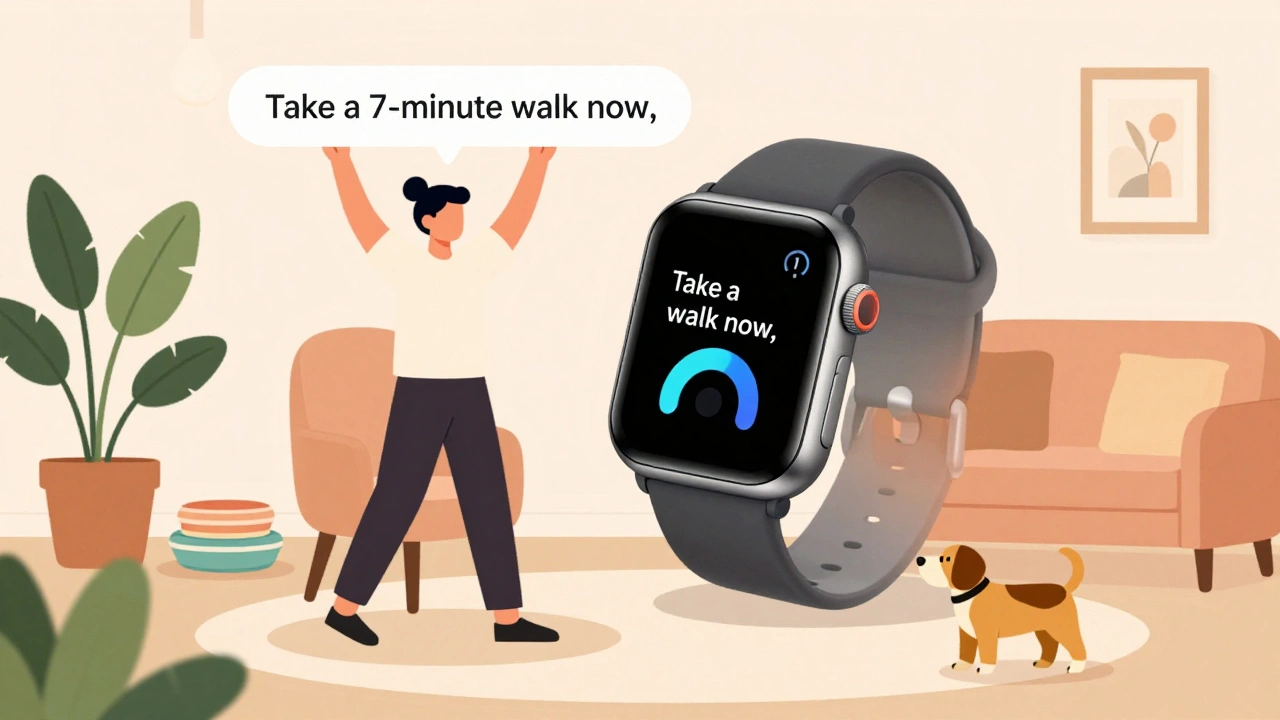
By 2025, step counting won’t just be about numbers. Devices will start suggesting “movement snacks”-short bursts of activity timed to your energy levels. If your heart rate variability is low and your steps are down, your watch might say: “Take a 7-minute walk now. It’ll help your focus.”
Apple and Fitbit are already using AI to tell the difference between walking, climbing stairs, and even standing vs. sitting. Soon, your tracker won’t just count steps-it’ll tell you which movements are helping your metabolism most.
The industry is growing fast. The global activity tracker market is expected to hit $83 billion by 2030. Why? Because science is catching up. NEAT isn’t a side note anymore. It’s central to metabolic health.
For weight management, the future isn’t about burning 500 calories in a spin class. It’s about burning 200 calories every day by simply choosing to move more-throughout the day, in small, invisible ways.
Final Thought: Movement Is Medicine
You don’t need to run a marathon. You don’t need to lift heavy. You just need to stop sitting.
Stand up every hour. Walk while you talk. Take the long way. Dance while you cook. Park farther. Play with your dog. Carry your own groceries. These aren’t chores. They’re metabolic boosts.
NEAT is the quiet hero of weight management. It doesn’t shout. It doesn’t require a gym membership. It doesn’t ask you to change your life. It just asks you to move-just a little more-every day.
And that’s the most sustainable way to burn calories, lose weight, and feel better-for life.
11 Comments

an mo
December 6, 2025 AT 17:54 PM
NEAT? Please. This is just woke fitness propaganda dressed up as science. Real Americans don’t need to count steps-they lift weights, eat clean, and don’t coddle their laziness with fancy acronyms. If you’re not sweating, you’re not burning. Period.

aditya dixit
December 8, 2025 AT 17:22 PM
There’s a quiet elegance in NEAT-it’s not about performance, but presence. The body doesn’t care if you’re chasing a goal or just existing. It only responds to motion. Standing while talking on the phone isn’t a hack-it’s a return to how humans were meant to move. We evolved to be in constant, low-grade motion, not static statues glued to chairs.
Modern life has turned us into sedentary statues, then blamed our metabolism for the consequences. But the solution isn’t more intensity-it’s more continuity. A thousand tiny movements, not one grand gesture.
When I walk to the market instead of driving, I don’t feel like I’m ‘burning calories.’ I feel like I’m remembering how to be alive.

Deborah Jacobs
December 10, 2025 AT 09:49 AM
I used to think step counts were dumb until I started noticing how my mood shifted when I hit 8k. On days I moved more, I didn’t crave sugar. I slept better. I didn’t feel like a zombie by 3 p.m. It’s like my body was whispering, ‘Hey, remember me?’ And I finally started listening.
Also-climbing stairs one step at a time? I do that when I’m stressed. Feels like a mini meditation. No one’s watching, no one cares, but my hips thank me.

Mellissa Landrum
December 12, 2025 AT 01:03 AM
They’re tracking your steps so they can sell you more crap. You think Apple gives a damn about your metabolism? Nah. They want your data. Your gait. Your heartbeat. Then they sell it to Big Pharma so they can invent a pill to fix what your own feet could’ve solved. Wake up.

luke newton
December 12, 2025 AT 08:39 AM
People who rely on step counters are just avoiding real discipline. If you can’t control your eating, don’t blame your chair. You want to lose weight? Fast. No gimmicks. Just eat less, move more, and stop pretending fidgeting counts as exercise. This is just guilt-tripping sedentary people into buying wearables.

Mark Ziegenbein
December 12, 2025 AT 19:39 PM
Let’s be brutally honest-the 10,000-step myth is a cultural artifact of capitalist fitness theater, a placebo metric engineered by Japanese marketing departments to sell pedometers in the 80s and now repackaged by Silicon Valley as biohacking gospel. The real tragedy isn’t that people believe it-it’s that they’ve surrendered their intuition to algorithms that don’t know their stride, their weight, their history, or their pain.
My Fitbit says I burned 500 calories today walking to the corner store. I weighed myself before and after. No change. That’s not science. That’s digital fiction masquerading as health. The only metric that matters is how you feel, not how many steps your wristwatch says you took while sitting on the toilet scrolling TikTok.
And don’t get me started on ‘movement snacks.’ That’s not a lifestyle. That’s corporate wellness theater for people who think productivity is a virtue and stillness is sin.

Norene Fulwiler
December 14, 2025 AT 02:40 AM
In my culture, movement isn’t tracked-it’s woven into life. My grandma carried water from the well, walked miles to market, cooked over fire, and never owned a Fitbit. She was lean at 80 because she never sat still. We don’t need gadgets to know that moving is natural. We just need to remember.

Harry Nguyen
December 15, 2025 AT 08:55 AM
Wow. So now sitting is a moral failing? Next you’ll tell me not standing during a Zoom call is a sin. I work 12-hour days. I don’t have time to ‘move more.’ If I wanted to burn calories, I’d go to the gym. Not walk to the fridge.

Katie Allan
December 15, 2025 AT 19:53 PM
I started adding 2,000 steps a day by walking while listening to podcasts. No big change. No pressure. Just… more life. And honestly? It’s the only thing that’s kept me sane during divorce season. Movement isn’t about weight. It’s about staying connected to your body when everything else feels like it’s falling apart.

Kylee Gregory
December 16, 2025 AT 23:11 PM
I think the real win here isn’t the calorie burn-it’s the awareness. Before I started tracking, I didn’t realize how much time I spent motionless. Now I catch myself slumping and just… stand up. It’s not about numbers. It’s about noticing. And that small shift? It changes everything.



Ali Bradshaw
December 6, 2025 AT 03:52 AM
Man, I never thought about how much I burn just pacing while waiting for my coffee. I’ve been doing that on purpose since I started working from home-turns out I’ve been hitting 12k steps without even trying. No gym, no sweat, just… life.