
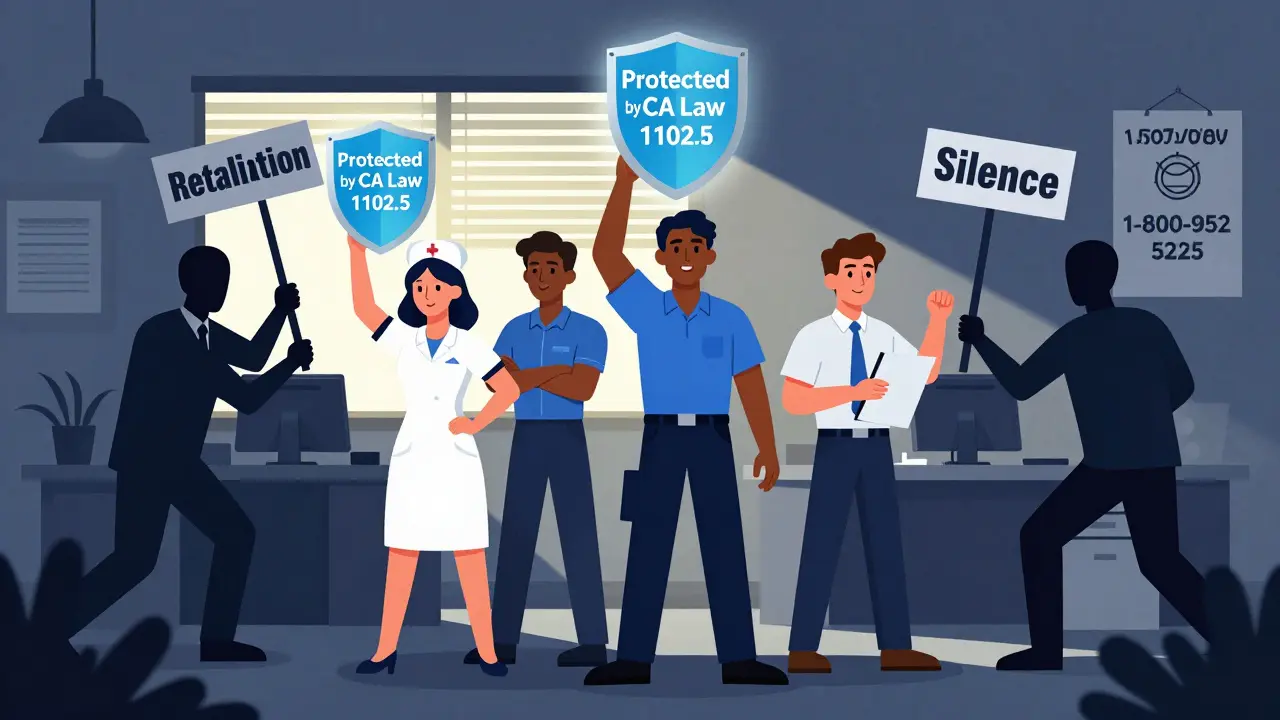
When you see something wrong at work - unsafe conditions, fraud, cover-ups, illegal dumping, or fake medical records - speaking up can feel risky. You might worry about losing your job, getting pushed out, or being labeled a troublemaker. But whistleblower laws exist to protect you. They’re not just legal fine print. They’re real shields against retaliation, and in places like California, they’re getting stronger every year.
What Counts as Protected Reporting?
You don’t need to be a lawyer or a cop to qualify for whistleblower protection. If you report something you reasonably believe is breaking the law, you’re covered. That includes telling your manager, filing a complaint with a government agency, or even testifying in court. Under California’s Labor Code Section 1102.5, which took effect in 2000 and was updated through 2024, protected reports cover violations of both state and federal laws. It doesn’t matter if the violation turns out to be minor. If you had a good-faith reason to think something was illegal, you’re protected.This isn’t just about big corporations. A nurse who reports a doctor skipping infection control steps. A warehouse worker who sees toxic chemicals being dumped illegally. A data clerk who notices payroll fraud. All of them are covered. Even if you’re just a job applicant who raises concerns during hiring, or if your employer thinks you might report something - even if you never do - you’re still protected under California law.
What Kind of Retaliation Is Illegal?
Retaliation doesn’t always mean getting fired. It can be subtle, slow, and sneaky. The law bans a long list of actions meant to punish or scare you into silence:- Termination or forced resignation
- Demotion or removal from important projects
- Reduced hours or pay cuts
- Denial of promotions or raises
- Unfair negative performance reviews
- Being isolated, excluded, or mocked by coworkers
- Being assigned impossible tasks or graveyard shifts
- Threats, intimidation, or harassment
In 2023, a nurse in Northern California was fired after reporting that her hospital was cutting corners on patient monitoring. She filed a claim under Section 1102.5. A year later, she won $287,000 in back pay and reinstatement. That case wasn’t unusual. According to California’s Division of Labor Standards Enforcement, over 1,400 whistleblower complaints were filed in 2024. About 38% of those resulted in some form of relief for the worker.
Federal vs. State: What’s Different?
Federal whistleblower laws exist, but they’re narrow. Each one covers a specific industry or type of violation. For example:- The Sarbanes-Oxley Act protects employees of public companies who report financial fraud.
- The False Claims Act covers fraud against government programs like Medicare or defense contracts.
- The Dodd-Frank Act offers cash rewards - 10% to 30% of recovered fines - if your tip leads to a $1 million+ penalty.
California’s law is broader. It doesn’t care what industry you’re in. If you report any violation of any law - even a local ordinance - you’re protected. That’s why more people in California use state law than federal law. But there’s a trade-off. Federal claims can go to federal court. California claims go through state labor boards, which can be slower and offer fewer remedies.
Also, federal laws have strict deadlines. For example:
- 30 days to file for Clean Air Act violations
- 90 days for asbestos or financial fraud under AML
- 180 days for consumer protection violations
Miss the deadline, and you’re out. California gives you three years to file a complaint. That’s a big advantage.

What Changed in California in 2025?
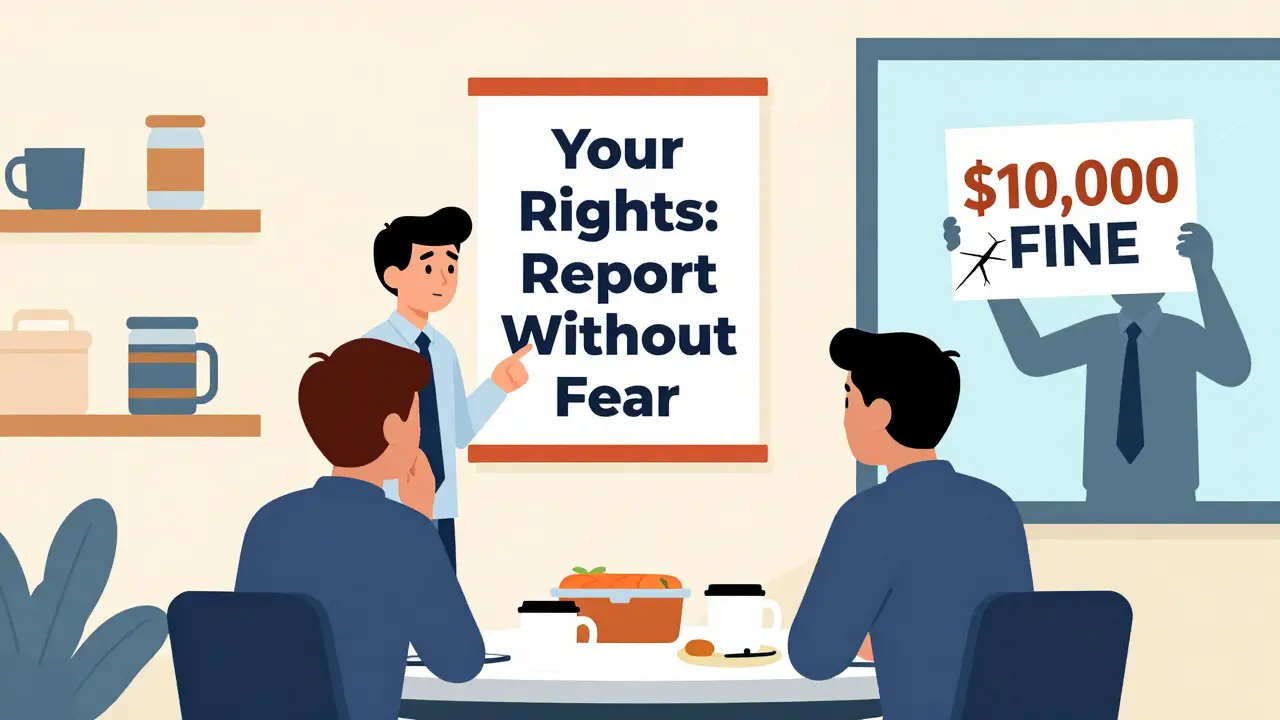
Starting January 1, 2025, every employer in California - yes, even that tiny dental office or family-run shop - must post a physical notice about whistleblower rights. It has to be in at least 14-point font, in a common area like a break room or HR office. The notice includes the Attorney General’s whistleblower hotline: 1-800-952-5225.Why? Because too many workers didn’t know they had rights. A 2024 survey by the California Chamber of Commerce found that 65% of small business owners didn’t even know about the new rule. And 42% of whistleblowers surveyed by the National Whistleblower Center said HR dismissed their complaints because they “didn’t meet the legal threshold.” Now, employers can’t claim ignorance.
The penalty for breaking this rule? Up to $10,000 per violation. That’s not a fine for missing a deadline. It’s $10,000 for every time you retaliate - even if it’s just one bad performance review. This is one of the strongest state-level penalties in the country.
Why Do So Many Whistleblowers Still Lose?
The laws are strong on paper. But in practice? The system is stacked against you.OSHA, the federal agency that handles whistleblower complaints, missed its 90-day investigation deadline in 63% of cases in 2024. The average case takes 22 months to resolve. That’s two years without a paycheck while you wait for justice. Many people can’t afford to wait. They quit. Or they take a lowball settlement just to move on.
Reddit threads from 2023 and 2024 are full of stories like this: “I reported unsafe equipment. Next week, I was moved to night shift. No one else had to work nights. I had a kid. I quit.” That’s not a firing. It’s a quiet forced exit. And it’s still retaliation under the law.
Another problem: HR departments aren’t trained to handle whistleblower reports. They’re trained to protect the company. If you go to HR and say, “I’m reporting fraud,” they might say, “We’ll look into it.” But they’re not obligated to protect you. Only the law does. That’s why legal experts say: talk to a lawyer before you report. The National Whistleblower Center says 78% of successful cases had legal representation.
What Should You Do If You Want to Report?
Don’t guess. Don’t rely on HR. Don’t wait until you’re fired.- Document everything. Save emails, texts, performance reviews, schedules, and notes. Write down dates, times, who said what. This isn’t paranoia - it’s evidence.
- Know your deadline. If it’s a federal issue (like environmental or financial fraud), check the statute. If it’s state-based, you have three years in California.
- Use official channels. File with OSHA for federal claims. File with California’s Labor Commissioner for state claims. Don’t just email your boss.
- Call the hotline. California’s 1-800-952-5225 is free, confidential, and staffed by experts. They can tell you if your case qualifies.
- Get legal help. Many nonprofits offer free advice. The National Whistleblower Center helped over 1,200 people in 2024. You don’t need to hire a pricey attorney right away.
What’s Coming Next?
The big story in 2025 isn’t just California’s new posting rule. It’s the AI Whistleblower Protection Act, introduced by Senator Grassley in May. It’s the first federal bill to specifically protect workers in AI companies who report biased algorithms, hidden data manipulation, or dangerous automation practices. Think of it like a safety valve for tech’s blind spots.Meanwhile, the Department of Labor is working on new rules to cut investigation times from 90 days to 60. And the European Union’s 2019 whistleblower directive - which requires companies to set up internal reporting systems - is influencing U.S. policy. More states are likely to follow California’s lead.
For now, though, the strongest protections are still at the state level. If you’re in California, you have more rights than most workers in the U.S. But rights mean nothing if you don’t know them - or if you’re too scared to use them.
Can I be fired for reporting a violation?
No. Under California Labor Code Section 1102.5 and multiple federal laws, firing someone for reporting a violation is illegal retaliation. If you’re fired after reporting, you can file a complaint with the Labor Commissioner or OSHA. You may be entitled to reinstatement, back pay, and damages.
Do I need proof before reporting?
No. You don’t need to prove the violation happened. You just need to have a reasonable belief that it did. That means if you saw something suspicious - like unsafe equipment, falsified records, or illegal dumping - and you thought it was against the law, you’re protected. Evidence helps later, but it’s not required to speak up.
What if my employer says I’m not covered because I’m a contractor?
In California, contractors and temporary workers are protected under Section 1102.5 if they’re performing work for the employer. Federal laws vary - some protect contractors, others don’t. But if you’re reporting on-site, you’re likely covered. Check with the California Labor Commissioner or the National Whistleblower Center.
How long do I have to file a complaint?
It depends. For California state claims, you have three years from the retaliation. For federal claims, it’s 30 to 180 days depending on the law. For example: 30 days for environmental violations, 90 days for financial fraud. Missing the deadline means losing your case. Write down the date you were retaliated against and act fast.
Can I report anonymously?
Some federal programs allow anonymous tips - like the SEC’s whistleblower program - but state laws like California’s require you to identify yourself to file a formal complaint. However, your identity is protected during the investigation. You can also call the whistleblower hotline (1-800-952-5225) to ask questions without naming yourself.
Final Thoughts
Whistleblower laws aren’t about snitching. They’re about stopping harm. Whether it’s a patient’s life, a community’s water supply, or millions in taxpayer dollars - someone has to speak up. The system isn’t perfect. It’s slow. It’s confusing. And too often, it fails people who try to do the right thing.But if you’re in California, you have more tools than ever. The law is on your side. The hotline is free. The notice is posted in every workplace. And the penalties for retaliation are steeper than ever. You don’t have to be brave. You just have to be informed. And if you’re reading this, you already are.
8 Comments

Mike Winter
March 10, 2026 AT 21:00 PM
It’s fascinating how the law has evolved from reactive punishment to proactive deterrence. The old model was: ‘You report, we retaliate, you sue, we settle.’ Now we’re seeing structural changes-mandatory notices, penalties per violation, even publicizing hotline numbers. It’s less about justice after the fact and more about prevention.
But here’s the philosophical snag: if the system is designed to protect those who speak up, why does it still feel like a trap? The burden of proof isn’t on the employer-it’s on you. You have to survive two years without income, document every microaggression, navigate bureaucratic labyrinths, and hope the state doesn’t lose your file. That’s not protection. That’s endurance testing.
And yet… if no one speaks up, the harm compounds. A nurse who stays silent about infection lapses → patient dies → hospital covers it up → next nurse sees it and thinks ‘not my problem.’ That’s how systems rot.
Maybe the real win isn’t the law-it’s the cultural shift. When ‘whistleblower’ stops being a slur and becomes a badge of integrity, we’ve won. Until then, the law’s just paper. But hey-at least it’s paper with teeth.

Chris Bird
March 12, 2026 AT 18:04 PM
This whole thing is a scam. People get fired for being lazy. They say 'whistleblower' to sound noble. HR doesn't care. Bosses don't care. The law is just for lawyers to make money.

Shourya Tanay
March 13, 2026 AT 20:26 PM
There’s something deeply structural here that’s being overlooked: whistleblower protections operate on a power asymmetry that’s fundamentally unbalanced. You’re expected to report violations while remaining entirely vulnerable to the very institution you’re challenging.
Take the ‘reasonable belief’ standard-it’s brilliant in theory. But in practice, it means you’re expected to be a legal scholar on top of your day job. A warehouse worker who sees toxic waste dumped? They don’t know if it’s a CERCLA violation or just a local ordinance. They don’t have access to legal databases. They don’t have time to read 50 pages of CFR.
And yet, the system demands they ‘know the law’ to be protected by it. That’s not protection. That’s a gatekeeping mechanism disguised as empowerment.
What if the law shifted the burden? What if employers had to prove they didn’t retaliate, instead of the employee proving they were retaliated against? That’s how it works in discrimination cases in some EU jurisdictions. It’s not perfect, but it’s less stacked against the worker.
Also-why is the federal system so fragmented? Sarbanes-Oxley for finance, Dodd-Frank for SEC, Clean Air Act for environment? It’s like having 17 different traffic laws in one state. No wonder people give up. Consolidation would be revolutionary.

LiV Beau
March 15, 2026 AT 12:16 PM
OMG YES THIS IS SO IMPORTANT!! 🙌 I work in a clinic and last year I reported a nurse falsifying vaccine logs-no one believed me at first, but I saved a kid’s life. 🥹 I called the hotline and they were so kind and gave me a step-by-step plan. You’re not alone!! 💪 Also-get the free legal help!! I used the National Whistleblower Center and they walked me through everything. 💌 I’m still here, still working, and I’m not scared anymore. If you’re reading this and thinking about it… just DO IT. You’ve got this!! 💖✨

Denise Jordan
March 17, 2026 AT 10:28 AM
So… what? Now my boss has to post a sign? Cool. I’m still gonna get moved to graveyard shift if I say anything. This law’s just for show. Like when they put ‘no smoking’ signs everywhere but nobody cares. HR is still gonna ghost you and say ‘we’re investigating’ while you’re getting passed over for promotions. Give me a break.

Gene Forte
March 18, 2026 AT 02:21 AM
Whistleblower protections are not about loyalty to an employer. They are about loyalty to the public good. When a worker chooses to speak up, they are not betraying their company-they are preserving the integrity of the systems we all depend on: healthcare, safety, financial accountability, environmental health.
The fact that California mandates physical posting of rights is a profound shift. It transforms the law from an abstract concept into a visible, daily reminder. Every employee, every contractor, every temp-sees it. They know: ‘I am not alone.’ That alone reduces fear.
And yes, the process is slow. Yes, OSHA is overwhelmed. But progress is not measured in speed-it is measured in persistence. Every complaint filed, every hotline call made, every lawyer consulted-it chips away at the culture of silence.
Do not wait for permission. Do not wait for proof. Do not wait for HR to act. The law is your tool. Use it. And if you are reading this, you already have the courage. Now go use it.

Kenneth Zieden-Weber
March 19, 2026 AT 00:09 AM
Let’s be honest-the whole ‘whistleblower’ thing is just corporate theater with a side of legal jargon.
You think the nurse who got $287k actually got justice? Nah. She got a payout and a lifetime of being ‘that person’ at every hospital in the state. No one hires you after you sue your former employer. Your reputation’s toast. The system doesn’t protect you-it compensates you after it’s already broken you.
And the 2025 posting rule? Cute. Employers will put it on the back of the break room fridge next to the expired yogurt. Nobody reads it. They’ll still whisper ‘snitch’ when you walk by.
Don’t get me wrong-I’m glad the law exists. But let’s stop pretending it’s a shield. It’s a band-aid on a gunshot wound. Real protection? That’s when HR doesn’t flinch when you speak up. That’s when your boss says ‘thank you’ instead of ‘we’ll have to talk.’
Until then? Document everything. Call the hotline. And pray your manager doesn’t have a vendetta. Because the law doesn’t care if you’re scared. It only cares if you filed before the deadline.
Write a comment
Popular Posts


10 Best Alternatives to Bactrim in 2025
Mar, 23 2025


David L. Thomas
March 10, 2026 AT 18:14 PM
Let’s be real-California’s 1102.5 is the closest thing we’ve got to a workplace superhero cape. Not just for employees, but for contractors, temp workers, even applicants who ask too many questions during onboarding. The fact that you don’t need to prove the violation, just have a reasonable belief? That’s the legal equivalent of saying, ‘Trust your gut.’
And the 2025 posting requirement? Genius. You can’t claim ignorance when it’s printed in 14-point font above the coffee machine. I’ve seen HR departments treat whistleblowers like they’re leaking classified intel, not reporting OSHA violations. Now they’ve got a legal obligation to acknowledge the law exists. Small win, but meaningful.
The AI Whistleblower Protection Act? Long overdue. We’re not just talking about biased hiring algorithms anymore. We’re talking about predictive policing tools that lock up Black neighborhoods at 3x the rate, or AI-driven medical triage that deprioritizes patients based on zip code. Someone’s gotta flip the switch on that shit. And yeah, federal deadlines are a nightmare, but three years in CA? That’s a lifeline.
Also-why the hell are we still relying on OSHA to investigate in 90 days? They’re understaffed, underfunded, and overworked. If you’ve ever filed one of these claims, you know the ‘investigation’ is usually just a form letter that says ‘we’re looking into it’ while you’re still paying rent on a job you can’t go back to.
Bottom line: Document everything. Call the hotline. Don’t wait for HR to save you-they’re not your allies. They’re corporate liability buffers. And if you’re reading this and thinking ‘I’m not ready,’ you’re already late. The clock starts ticking the second they give you the ‘performance improvement plan’ that comes out of nowhere.