

Getting your medications right isn’t just about picking up a prescription. It’s about understanding what you’re taking, why, when, and what to watch out for. But in a 15-minute appointment, with a doctor rushing and a mind full of worry, it’s easy to miss something important. That’s where bringing a caregiver or advocate makes all the difference.
Why You Need Someone With You
More than 1.5 million people in the U.S. suffer medication errors every year. Many of these happen during appointments-when new prescriptions are written, doses are changed, or interactions aren’t caught. The Institute of Medicine found that half of these errors could be prevented with better communication. And the people who catch them? Often, it’s not the patient. It’s the person sitting beside them. A caregiver or advocate doesn’t need a title. They just need to care enough to ask the right questions. They can spot a mismatch between what the doctor says and what’s on the pill bottle. They can remember the side effects the doctor mentioned, even if you’re too tired to hold onto the details. They can speak up when something doesn’t feel right. In 2022, 30% of Medicare beneficiaries had someone with them at medication appointments. That number kept climbing during the pandemic, when access to care got harder and medication confusion spiked. The data doesn’t lie: having a second set of eyes and ears reduces errors, improves adherence, and gives patients more control.Who Can Be Your Advocate?
You don’t have to hire a professional to get help. In fact, most effective advocates are family members, friends, or neighbors who know you well.- Family caregivers-spouses, adult children, siblings-are the most common. They know your routines, your fears, and your history. But they often miss key details because they’re not trained.
- Professional advocates are certified through organizations like the Patient Advocate Certification Board. They charge $75-$200 an hour but bring expertise in navigating insurance, spotting drug interactions, and communicating with providers. They’re especially helpful if you’re on five or more medications.
- Self-advocates can do well if they’re organized and have strong health literacy. But for people with memory issues, low literacy, or chronic confusion, trying to go it alone increases the risk of mistakes by 37%.
How to Prepare Before the Appointment
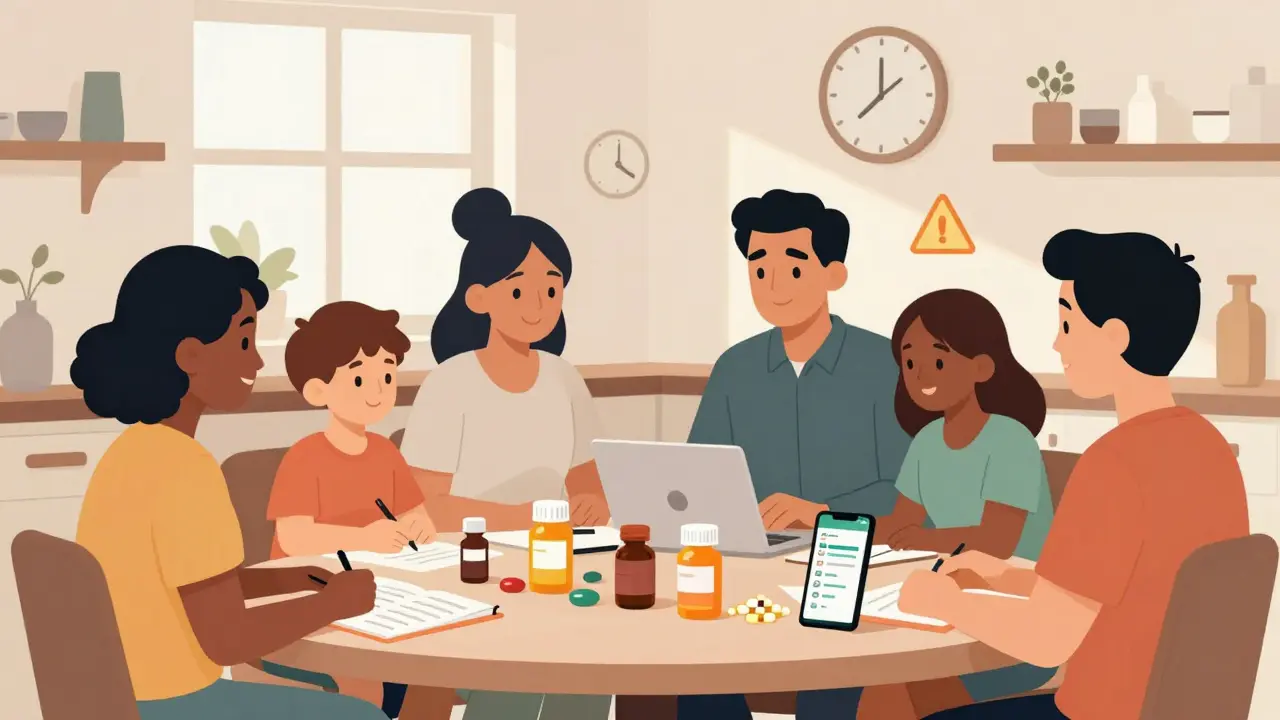
Preparation turns a routine visit into a safety check. Start three days before your appointment.- Gather every medication. Don’t rely on a list. Bring the actual bottles-pills, patches, inhalers, eye drops. The FDA found that 23% of errors come from inaccurate written lists. The real bottle might say 10mg, but the list says 5mg. Only the bottle tells the truth.
- Write down your symptoms. When do they happen? Right after you take your blood pressure pill? Do you feel dizzy at 3 p.m.? Link symptoms to timing. Use a simple notebook or a free app like Medisafe or MyTherapy.
- Know your questions. Use the “Ask Me 3” framework: What is my main problem? What do I need to do? Why is it important? Write them down. Don’t assume you’ll remember.
- Check your insurance. Call your pharmacy 48 hours before the appointment. Ask: Is this drug covered? Is there a cheaper generic? Will I need prior authorization? One in five prescription delays happen because coverage wasn’t checked ahead of time.
What to Do During the Appointment
The appointment is your chance to get clarity. Don’t waste it.- Bring your list of questions. Hand it to the doctor. Say, “We’ve prepared a few things we want to make sure we understand.”
- Use the SBAR method. It’s a simple communication tool used by nurses and advocates everywhere:
- Situation: “I’m here because my mom’s been feeling dizzy since she started this new pill.”
- Background: “She’s on warfarin, metformin, and now this new antibiotic. She’s 78, lives alone.”
- Assessment: “We think the dizziness started two days after the antibiotic was added.”
- Recommendation: “Can we check if this combination is safe? Or is there another antibiotic we could try?”
This method increases understanding by over 50% compared to just asking, “Is this okay?”
- Verify everything. Ask: “Can you write down the exact dose?” “Can this pill be crushed?” “Should I take it with food?” “What happens if I miss a dose?”
- Ask about interactions. “Could this new medicine react with anything else she’s taking?” Even over-the-counter ones like ibuprofen or melatonin.
- Confirm next steps. “Will the pharmacy call us if there’s a problem?” “Do we need to come back for a blood test?” “Who do we call if this side effect gets worse?”
Don’t let the doctor rush you. If they try, say, “We need a few more minutes to make sure we get this right.” You have a right to be heard.
What Happens After the Appointment
The real work starts after you leave the office.- Review the notes. Right after the appointment, sit down with your advocate. What did the doctor say? What did they write? Compare it to what you thought you heard. Write down any confusion.
- Create a visual schedule. Take photos of each pill. Put them in a calendar with times. Use color codes: red for morning, blue for night. GoodRx found this cuts identification errors by 67%.
- Call the pharmacy. Don’t wait for them to call you. Ask if the prescription was filled correctly. Ask if they checked for interactions. Pharmacists are trained to catch errors-use them.
- Set up a ‘medication buddy.’ If you live alone, ask someone to call you every morning to remind you to take your pills. Or set up a weekly check-in with a friend. Adherence improves by 41% when someone else is involved.
And if something doesn’t feel right in the next 24 hours-dizziness, rash, confusion-call your doctor or pharmacist immediately. Don’t wait.
What to Do If the Provider Says No
Some clinics or nurses will say, “We can’t talk to you because of HIPAA.” That’s wrong. HIPAA allows providers to share information with family or advocates if the patient gives permission-even if it’s verbal. You don’t need a form. Just say: “I give permission for my daughter to be here and receive information about my medications.” If they still refuse:- Ask to speak to the office manager.
- Request a copy of their patient rights policy.
- Call your insurance company-they often have a patient advocate on staff who can help.
In 2023, 92% of large healthcare systems in the U.S. were required by the American Medical Association to allow advocates in appointments. You have a right to be supported.

When to Consider a Professional Advocate
You don’t need one unless things get complicated. But here are signs you might:- You take five or more medications daily.
- You’ve had a medication error before.
- You have memory problems or dementia.
- Your insurance is confusing, and you’re getting denied drugs.
- Your family can’t help because they live far away.
Professional advocates can:
- Review your entire medication history from all providers.
- Find cheaper alternatives through patient assistance programs.
- Set up automatic refills and delivery.
- Communicate with specialists on your behalf.
Costs range from $75 to $200 an hour. Some nonprofit organizations offer free or low-cost services for seniors or low-income patients. Check with your local Area Agency on Aging or the National Patient Advocate Foundation.
The Bigger Picture: Why This Matters
Medication management isn’t just about pills. It’s about dignity, safety, and independence. When you have someone helping you, you’re less likely to end up in the hospital. You’re more likely to stay in your home. You’re more likely to live well. The government is starting to notice. In 2024, Medicare started requiring providers to document advocate involvement in high-risk cases. The FDA approved AI tools that help advocates spot dangerous drug combos. Pharmacies now offer certified medication advocates-4,218 pharmacists got certified in just six months in 2024. This isn’t a trend. It’s a necessary shift. Healthcare is too complex for one person to handle alone.Start Small. Start Today.
You don’t need to do everything at once. Pick one step:- Next time you go to the pharmacy, ask the pharmacist to review your list.
- Ask a family member to sit with you at your next appointment.
- Take a photo of each pill and save it on your phone.
Even one small change can prevent a big mistake. Your health isn’t just your responsibility-it’s your right to have help with it.
9 Comments

Henry Marcus
December 19, 2025 AT 20:24 PM
Y'know what's really scary? That 23% error rate from inaccurate lists? That's not a statistic-that's a death sentence waiting to happen. I've seen people die from a misplaced decimal point. And now they're pushing AI tools? Ha! AI doesn't care if your grandma's heart is failing-it just matches numbers. The system's rigged. They want you dependent. They want you confused. They want you to need an advocate because they've broken the system on purpose.

Carolyn Benson
December 20, 2025 AT 11:18 AM
It's not about medication. It's about power. The doctor-patient relationship has been commodified into a transactional exchange where vulnerability is exploited for profit. The advocate isn't there to help you understand your pills-they're there to mediate the asymmetry of knowledge that the medical-industrial complex deliberately manufactures. You don't need a checklist. You need to reclaim agency. But how can you reclaim agency when the language itself is engineered to confuse? The word 'adherence' is a euphemism for obedience. And obedience is not health.
I've sat in rooms where nurses laughed about 'the old lady who forgot her pills again.' They don't see patients. They see compliance metrics. So yes-bring someone. But don't fool yourself. You're not being helped. You're being managed.

Aadil Munshi
December 21, 2025 AT 13:36 PM
Bro, I'm from India and we don't have 'advocates'-we have family. My aunt took my uncle's 12 pills every morning for 7 years. No forms. No apps. Just a plastic bag taped to the fridge with names written in marker. You think you need a $200/hour expert? Nah. You need someone who loves you enough to remember that your blood pressure pill makes you dizzy after lunch. That's real healthcare. The system's just trying to monetize what's already natural.
Also, HIPAA? That's just a wall they built so they don't have to explain things. In my village, if you're sick, the whole neighborhood knows your meds. And nobody gets it wrong.

mary lizardo
December 23, 2025 AT 03:49 AM
The use of the phrase 'you have a right to be supported' is both legally inaccurate and emotionally manipulative. There is no statutory right to an advocate under HIPAA; there is a permissive disclosure clause contingent upon patient authorization. Furthermore, the article's conflation of 'caregiver' with 'advocate' demonstrates a fundamental misunderstanding of professional boundaries in clinical settings. The recommendation to 'take photos of each pill' is not only impractical for visually impaired individuals but also violates FDA labeling guidelines regarding unauthorized reproduction of pharmaceutical imagery. This piece is dangerously unscholarly.

Chris Davidson
December 23, 2025 AT 22:37 PM
Most people dont need an advocate they need to learn how to ask questions. Doctors arent rushing because theyre evil theyre overwhelmed. You think a stranger in the room is gonna fix that? Bring a notebook. Write it down. Say it back. Done. No $200/hr consultants needed.

Mike Rengifo
December 24, 2025 AT 20:46 PM
My mom brought my uncle to her last appointment. He didn't say a word. Just nodded and took notes. Then he asked the pharmacist to check the pills again when we got home. Turned out the script said 10mg but the bottle said 5mg. Saved her from a fall. Sometimes the best advocate is just the quiet one who double-checks.

holly Sinclair
December 25, 2025 AT 09:50 AM
What fascinates me is how the act of bringing someone else into this space transforms the entire phenomenology of medical authority. The appointment ceases to be a monologue from the clinician and becomes a dialogic encounter-Habermas would call it communicative action. But the deeper layer here is the epistemic injustice: when a patient's lived experience is dismissed because they lack the linguistic capital to articulate it, the advocate becomes a hermeneutic bridge. They don't just remember side effects-they restore the patient's epistemic credibility. And yet, the system still treats this as a logistical convenience rather than a moral imperative. We're not just managing meds. We're negotiating the very right to be heard in a system designed to silence the vulnerable. The fact that Medicare now documents advocate involvement is a small step toward epistemic justice. But why did it take a pandemic to get us here?

Monte Pareek
December 26, 2025 AT 20:39 PM
Let me tell you something straight. I've been a nurse for 27 years and I've seen this play out a thousand times. The people who survive complex med regimens aren't the ones with the best insurance. They're the ones with someone who shows up. Doesn't matter if it's a daughter, a neighbor, or a guy from church who remembers to call every morning. That human connection? That's the real treatment. AI can't replace that. Apps can't replace that. A $200/hr advocate? Fine if you can afford it. But don't let anyone make you feel like you're failing if you don't have one. Just find someone who cares enough to sit there. To write things down. To say, 'Wait, what?'
And if you're the one being asked to show up? Don't overthink it. You don't need a degree. You just need to be there. And that's more powerful than any checklist.
Write a comment
Popular Posts



Janelle Moore
December 18, 2025 AT 16:58 PM
This whole advocate thing is just a government ploy to get us all on surveillance meds. They're tracking what you take through the bottles, I swear. I saw a guy at the pharmacy last week with a QR code on his insulin bottle that lit up when he took it. Who's watching? Who's REALLY watching?