
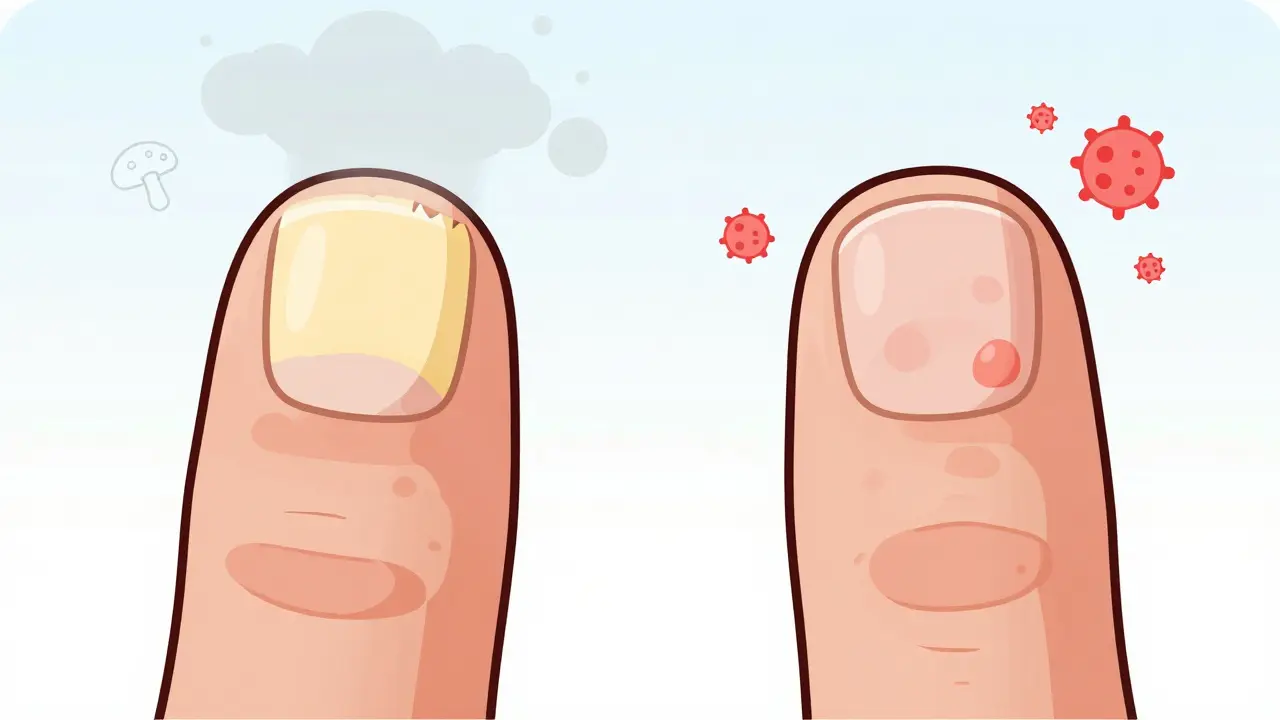
Ever looked at your nails and thought, fungal nail infection? Maybe you saw yellowing, thickening, or bits peeling off and assumed it was just a bad case of athlete’s foot that jumped to your nails. But what if it’s not fungus at all? What if it’s psoriasis? The truth is, these two conditions look almost identical-and too many people get it wrong. And getting it wrong means wasting months on the wrong treatment, watching your nails get worse, and paying for meds that do nothing.
What You’re Actually Seeing
Nail problems don’t just happen out of nowhere. They’re signals. And two of the most common signals-fungal infections and psoriatic changes-are often mistaken for each other. Both can make nails turn yellow, thicken, or lift off the nail bed. But here’s the thing: they’re completely different diseases with different causes, different treatments, and different outcomes.Fungal nail infections, or onychomycosis, are caused by tiny organisms like Trichophyton rubrum. These fungi love warm, damp places. They creep in through tiny cuts or the space between your nail and skin. Once they settle in, they feed on keratin-the same protein your nails are made of. Over time, the nail gets thick, crumbly, and often smells bad. That foul odor? It’s a red flag. It’s rarely, if ever, present in psoriasis.
Nail psoriasis, on the other hand, isn’t an infection. It’s your immune system going haywire. In psoriasis, skin cells multiply too fast-every 3 to 4 days instead of every 30. These extra cells pile up under and around your nails. The result? Pitting (tiny dents), salmon-colored patches under the nail, chalky buildup underneath, and that telltale oil-drop spot-a brownish-yellow mark that looks like a drop of oil trapped under the nail. And here’s the kicker: 70% of people with nail psoriasis have little dents in their nails. You won’t see that in fungal cases.
How to Spot the Difference
It’s not just about what you see. It’s about where you see it and how it behaves.Fungal infections usually start at the tip of the nail or along the side. They creep in slowly. You might notice a small white or yellow spot near the edge. Over 6 to 12 months, it spreads toward the cuticle. It typically hits one or two nails first-often the big toe. And it doesn’t care if you have psoriasis on your skin or not. Anyone can get it.
Nail psoriasis is different. It often hits multiple nails at once. Fingernails more than toenails. And it doesn’t start with a spot. It shows up suddenly. Pitting, oil spots, nail separation-all at once, or in waves. If you’ve had psoriasis on your elbows or scalp for years, and now your nails are changing? That’s a classic sign. About 95% of nail psoriasis cases happen in people who already have skin psoriasis, usually 10 to 15 years after the skin symptoms started.
Here’s a quick cheat sheet:
- Fungal infection: Thickened, crumbly, foul-smelling, starts at the tip or side, often one nail at a time, no pitting.
- Nail psoriasis: Pitting, oil-drop spots, salmon patches, chalky buildup under nail, affects multiple nails, no odor, often linked to skin psoriasis.
But here’s where it gets messy. About 68% of nail psoriasis cases look like fungus because of the yellowing. And 40% of fungal infections get misdiagnosed as psoriasis. That’s why so many people are stuck on antifungals for months-while their psoriasis gets worse.
Why Misdiagnosis Costs You More Than Money
Getting the wrong diagnosis isn’t just frustrating-it’s expensive and damaging.A 2023 study found that 30 to 40% of nail disorders are misdiagnosed. That means around 150,000 people in the U.S. alone are taking antifungal pills or creams that do nothing for their psoriasis. Or worse-they’re getting steroid injections for what they think is psoriasis, but it’s actually fungus. Steroids can make fungal infections flare up, turning a manageable problem into a nasty, spreading one.
Patients report spending months, even years, going from doctor to doctor. One person on Reddit said they used antifungals for eight months-only to find out it was psoriasis. Their nails got worse. They developed painful separation. Another person on a foot health forum was prescribed topical steroids for what they thought was psoriasis. Their nail started crumbling. Turns out, it was fungus.
And the cost? In the U.S. alone, misdiagnosis leads to $850 million in wasted healthcare spending every year. That’s not just prescriptions. It’s extra doctor visits, lab tests, and time off work.

How Doctors Actually Diagnose This
You can’t just guess. You need proof.The first step? A simple test called a KOH prep. A doctor scrapes a bit of debris from under your nail, mixes it with potassium hydroxide, and looks at it under a microscope. If they see fungal threads, it’s fungus. This test is 70-80% accurate. If it’s negative but they still suspect fungus, they’ll send a sample for culture. That takes weeks, but it’s 95% specific-if it grows fungus, it’s fungus.
For psoriasis, there’s no lab test. Diagnosis is visual. Doctors look for the classic signs: pitting, oil spots, salmon patches. They might use the NAPSI score-a system that rates how many nail quadrants are affected and how badly. A score above 4 usually means moderate to severe involvement.
And now there’s something new: reflectance confocal microscopy. It’s like a high-res camera for your nail. In a 2023 Mayo Clinic study, it correctly identified psoriasis vs. fungus in 92% of cases. It’s not everywhere yet, but it’s coming.
Here’s the bottom line: if you have nail changes and you don’t have skin psoriasis, assume it’s fungus until proven otherwise. If you do have skin psoriasis and your nails change? It’s likely psoriasis-but still get it checked. You might have both.
What Actually Works for Each
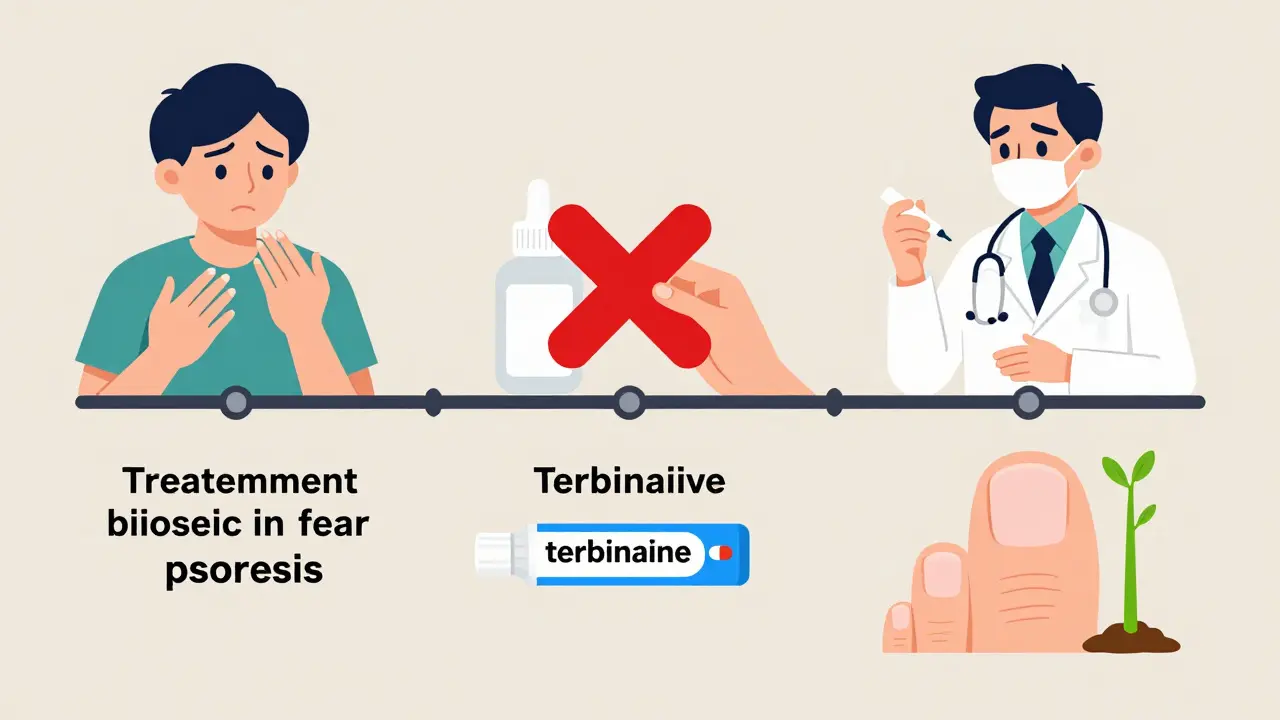
Treatment is where the big differences show up.Fungal infections: The gold standard is oral terbinafine. Take it daily for 12 weeks for toenails, 6 weeks for fingernails. Clearance rates hit 78% when you finish the full course. Topical treatments like efinaconazole (Jublia) work too, but they take 9 to 12 months because nails grow so slow-only 0.1mm per day. You have to be patient. And you must keep your feet dry. Humidity above 40% feeds fungus. Wear open shoes. Change socks twice a day. Don’t walk barefoot in gyms or pools.
Nail psoriasis: Antifungals? Useless. Steroids? Sometimes help, but only if it’s not infected. The real game-changers are biologics-drugs like secukinumab (Cosentyx) or ixekizumab. These target the immune system’s overreaction. In a 2022 survey, 65% of patients saw major improvement after 24 weeks. Injections into the nail bed can also help, especially for thickened or painful nails. Topical steroids or vitamin D analogs applied directly to the nail can reduce scaling and pitting over time. But you need consistency. And you need to avoid trauma. Don’t bite your nails. Don’t cut them too short. Use moisturizer. Psoriasis flares with injury.
What You Can Do Right Now
You don’t need to wait for a specialist to start taking control.- Take photos. Use your phone. Take a clear picture of each nail every month. Same light, same angle. You’ll spot changes you’d miss day to day.
- Keep a journal. Note when your nails changed. Did it happen after trauma? After a vacation? After starting a new medication?
- Don’t self-treat. Don’t buy antifungal cream off the shelf and hope for the best. If it doesn’t improve in 2 months, see a dermatologist.
- Ask for a KOH test. If your doctor says it’s psoriasis but you have no skin symptoms, ask: “Could this be fungus? Can we test for it?”
The Bigger Picture
These conditions aren’t just cosmetic. They affect your confidence, your ability to wear sandals, your job if you work with your hands. They’re linked to pain, mobility issues, and even depression. And they’re getting more common.Climate change is expanding the places fungi can live. More humidity, warmer winters-fungi are moving into new areas. Meanwhile, psoriasis is rising globally, partly due to stress, diet, and environmental triggers.
By 2027, AI tools may help doctors spot the difference just from a photo. But until then, your best tool is awareness. Know the signs. Ask the right questions. And don’t let a misdiagnosis cost you more time, money, or nails.
Can nail psoriasis turn into a fungal infection?
Yes. Nail psoriasis damages the nail structure, creating gaps where fungi can sneak in. Between 4.6% and 30% of people with nail psoriasis develop a secondary fungal infection. That’s why it’s critical to treat psoriasis properly and keep nails trimmed and dry. If your psoriasis treatment stops working and your nails suddenly start smelling bad or crumbling, get tested for fungus.
Is nail psoriasis contagious?
No. Nail psoriasis is an autoimmune condition, not an infection. You can’t catch it from someone else. Fungal nail infections, however, are contagious. They spread through shared towels, showers, or nail clippers. If you have psoriasis, avoid sharing personal items just in case you’ve also picked up fungus.
Why do antifungals make my nails worse?
If you have nail psoriasis and you’re using antifungals, they won’t help-and steroids (sometimes prescribed for psoriasis) can make a fungal infection worse. Steroids suppress the immune system locally, letting fungi grow unchecked. If your nails are getting thicker, more brittle, or smell bad after starting treatment, you might have been misdiagnosed. Stop the treatment and get a KOH test.
How long does it take to see results from treatment?
For fungal infections, you’ll start seeing new, healthy nail grow in after 3 to 4 months, but full clearance can take 6 to 12 months because nails grow slowly. For psoriasis, biologics can show improvement in 8 to 12 weeks, but it takes 24 weeks for full results. Topical treatments for psoriasis may take 3 to 6 months. Patience is key. You’re waiting for your nail to grow out.
Can I treat this at home without seeing a doctor?
You can manage symptoms at home-keep nails trimmed, dry, and clean. Avoid trauma. Use moisturizer. But you can’t diagnose this on your own. Home remedies like vinegar soaks or tea tree oil might help mild fungus, but they won’t touch psoriasis. And if you’re wrong, you risk making it worse. If your nails change for more than 2 months, see a dermatologist. A simple scraping test can save you months of trial and error.
8 Comments

Jacob Milano
January 7, 2026 AT 09:23 AM
Bro this is the kind of post that makes you wanna hug a dermatologist. I’ve seen so many people waste months on antifungals while their nails turn into crispy potato chips. The oil-drop spot? That’s the secret handshake of psoriasis. And the fact that steroids can make fungus explode? Mind blown. 🤯

jigisha Patel
January 8, 2026 AT 16:25 PM
While the article presents a generally accurate clinical distinction between onychomycosis and nail psoriasis, it lacks rigorous statistical citation for several assertions. For instance, the 68% overlap in visual presentation is referenced without a primary source. Additionally, the claim that 95% of nail psoriasis cases occur in patients with prior cutaneous psoriasis is inconsistent with recent meta-analyses which report 70–85%. Furthermore, the assertion that KOH prep is 70–80% accurate is misleading-sensitivity varies by operator skill and specimen quality. The post should be revised to reflect evidence-based thresholds.

Ethan Purser
January 8, 2026 AT 20:33 PM
imagine spending YEARS thinking your nails are just ugly… only to find out your immune system betrayed you AND you got fungus on top of it?? like… why does life do this to people?? i cried reading this. my nails look like cracked porcelain now. i just wanted to wear sandals in summer. 😭

Doreen Pachificus
January 10, 2026 AT 10:29 AM
took a pic of my nails last month and compared it to one from 6 months ago… yep, the pitting is new. also noticed the salmon patch. never had skin psoriasis but my dad did. hmm. maybe i should get that KOH test after all.

Rory Corrigan
January 11, 2026 AT 09:48 AM
life’s a glitch, man. 🤖 nails grow slow, but your pain? It grows fast. we’re all just trying to grow out of our bodies sometimes. if your nail’s falling off… maybe your soul is too. 🌱

Charlotte N
January 12, 2026 AT 03:42 AM
my sister had this and she did the vinegar soak thing for 6 months and then finally saw a derm and it was psoriasis… she started using calcipotriene and it took 4 months but her nails are finally looking normal again… i’m gonna start taking monthly pics like the post said… just in case

bob bob
January 12, 2026 AT 12:14 PM
just wanna say thanks for writing this. i’ve been too scared to go to the doctor because i thought it was just gross feet. now i know it’s not my fault. and i’m gonna ask for the KOH test next time. no more guessing. you’re not alone out there.


Akshaya Gandra _ Student - EastCaryMS
January 6, 2026 AT 08:40 AM
omg i thought my yellow nails were fungus for like 2 years 😭 i kept scrubbing them with vinegar and tea tree oil… turns out it was psoriasis bc i have scalp psoriasis too but never connected the dots. why does no one tell you this??