
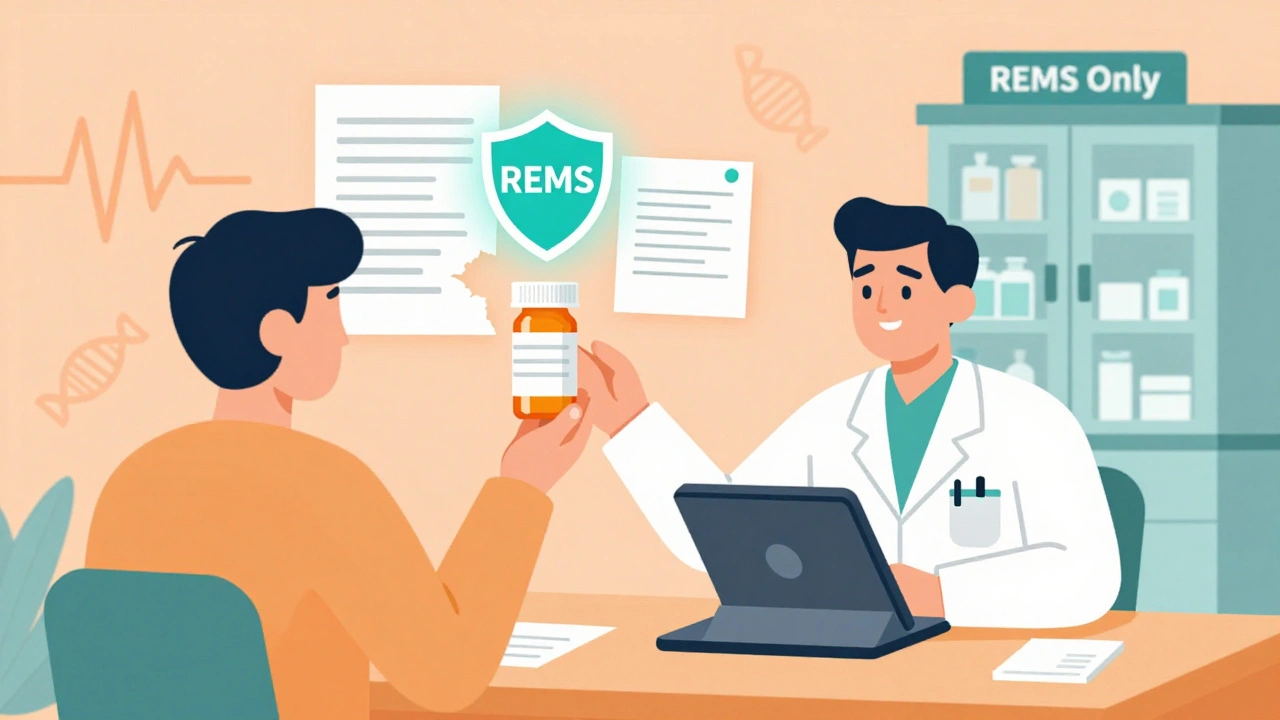
Imagine being prescribed a life-saving drug - but you can’t fill the prescription because your doctor hasn’t completed a certification, your pharmacy doesn’t stock it, or you need to sign up for a government registry just to get it. This isn’t science fiction. It’s the reality for thousands of patients taking medications under REMS programs.
What Exactly Are REMS Programs?
REMS stands for Risk Evaluation and Mitigation Strategies. These are legally required safety plans created by the U.S. Food and Drug Administration (FDA) for certain prescription drugs that carry serious, potentially life-threatening risks. Without REMS, some of these drugs would never be approved. The FDA doesn’t use them to block access - it uses them to make risky but necessary treatments available safely. The law behind REMS came from the Food and Drug Administration Amendments Act of 2007. Before that, the FDA had to rely on patchwork systems. For example, isotretinoin (Accutane) had a voluntary pregnancy prevention program since the 1980s because it causes severe birth defects. Thalidomide, once infamous for causing limb deformities in babies, was reintroduced for cancer and leprosy only after a strict control system was built. REMS turned these one-off efforts into a standardized, enforceable framework. Today, about 120 REMS programs are active, covering roughly 185 drugs. That’s about 5.7% of all prescription medications in the U.S. Most of them are in oncology and hematology - drugs like lenalidomide (Revlimid), pomalidomide (Pomalyst), and alemtuzumab (Lemtrada). These aren’t minor side effects we’re talking about. We’re talking about sudden death, organ failure, birth defects, and rare but deadly blood disorders.The Three Key Parts of Every REMS
Every REMS has at least two components. Many have three. They’re not optional. If you’re a doctor, pharmacist, or patient dealing with one of these drugs, you’re already in the system.- Medication Guides - These are printed handouts you’re supposed to get every time you fill the prescription. They explain the risks in plain language. About 78% of REMS require them. For drugs like clozapine, which can wipe out your white blood cells, the guide tells you exactly what symptoms to watch for and when to rush to the ER.
- Communication Plans - These are targeted messages to doctors and pharmacists. They might be emails, letters, or training videos. About 62% of REMS use these. For example, when a new warning comes out about a drug’s heart risk, the manufacturer sends out a safety alert to every certified prescriber.
- Elements to Assure Safe Use (ETASU) - This is the heavy part. It’s required in 45% of REMS programs and includes real restrictions. Think: you can’t just walk into any pharmacy. You need a doctor who’s been trained and certified. The pharmacy must be registered. You might need to pass blood tests every month. You might have to enroll in a national registry. Some drugs can only be given in a hospital. For Lemtrada, you must be monitored for hours after each infusion because of the risk of severe autoimmune reactions.
How REMS Affects Real People
The theory sounds good. But what does it feel like on the ground? For patients: delays are common. A 2023 GoodRx survey found 42% of people on REMS drugs had their treatment held up - sometimes for weeks - because of paperwork, missing certifications, or pharmacy inventory issues. One patient told Reddit they waited 18 days to get their Revlimid because their oncologist’s office hadn’t updated their certification status. Another said their pharmacy didn’t have Lemtrada in stock and had to order it from a specialty distributor, which took 10 days. For doctors: REMS adds hours to every workweek. A 2023 American Society of Hematology survey found 68% of hematologists spend more than five hours a week just managing REMS tasks - logging into portals, uploading lab results, printing certification forms, calling pharmacies to confirm they’re enrolled. One oncologist said they had to complete five different certification processes for five different drugs, each with its own website, password, and training video. For pharmacists: it’s even worse. Pharmacists aren’t just filling prescriptions. They’re acting as compliance officers. They must verify that the prescriber is certified, that the patient is enrolled, that the lab tests are current, and that the drug is being sent to an approved pharmacy. One pharmacist on Reddit wrote: “The Entyvio REMS adds 15-20 minutes per prescription just to check the online portal. We’re not dispensing meds - we’re doing audit trails.”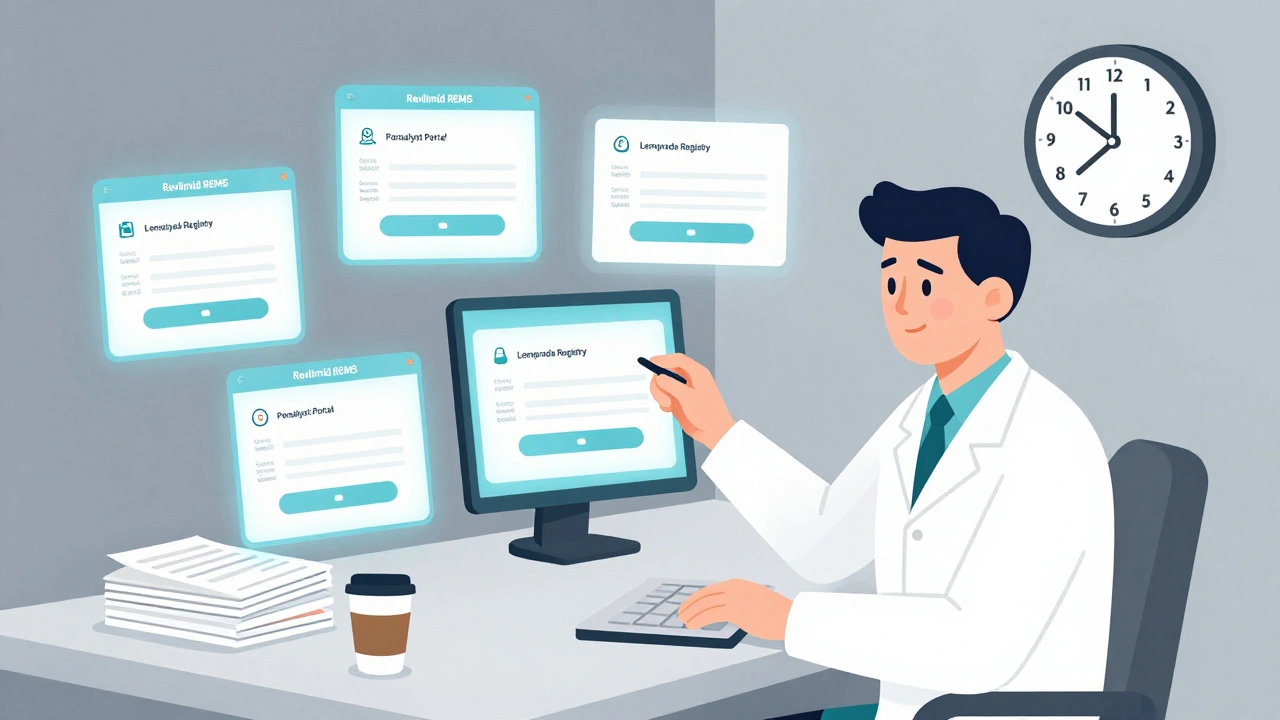
Who Pays for All This?
The cost isn’t hidden. It’s baked into the system. Manufacturers spend an average of $2.7 million per year on each REMS program. That’s for building websites, hiring staff, printing materials, training reps, and running registries. The FDA estimates the total cost across the entire healthcare system is $1.2 billion annually. But here’s the twist: that money is saving an estimated $8.4 billion in avoided hospitalizations and emergency care. The problem? The burden falls unevenly. Small clinics and independent pharmacies struggle. Specialty pharmacies - the only ones allowed to dispense many REMS drugs - handle 89% of these prescriptions. That means patients often have to switch pharmacies, even if they’ve been with the same one for years. Insurance doesn’t always cover the extra shipping or handling fees.Why REMS Blocks Generic Drugs
One of the biggest criticisms of REMS is how it slows down generic competition. In theory, generics should be cheaper and more accessible. But REMS creates roadblocks. To make a generic version of a REMS drug, the manufacturer needs to get samples from the brand-name company. But the brand company controls the REMS. They can delay or deny access. A 2024 Health Affairs study found that 78% of generic drug makers reported delays averaging 14.3 months just to get the samples needed for testing. That’s over a year lost before they can even start selling. This isn’t accidental. It’s a loophole. The law says REMS should protect patients - not protect profits. But in practice, brand companies use REMS as a legal shield to keep generics off the market longer than they should. The FDA is aware. The 21st Century Cures Act Reauthorization (2022) now requires them to create a standard for evaluating REMS effectiveness by December 2025 - and one of the key goals is to stop this kind of abuse.
What’s Changing in 2025?
The FDA knows REMS is broken in places. They’re trying to fix it. The REMS Modernization Initiative is rolling out in 2025. Here’s what’s coming:- A single digital dashboard for all REMS programs - no more logging into 10 different websites.
- Standardized forms and electronic verification - no more faxing or mailing paper forms.
- Real-time data from electronic health records to replace manual lab reports.
- Translations for non-English speakers - right now, most guides are only in English.
What You Should Do If You’re on a REMS Drug
If you’re prescribed a drug with a REMS program:- Ask your doctor: “Is this drug under a REMS? What do I need to do?”
- Get the Medication Guide - read it. Don’t just sign for it.
- Confirm your pharmacy is certified to dispense it. Call ahead.
- If you’re told you need to enroll in a registry, do it immediately. Delays can cost you weeks.
- Keep copies of all certifications, lab reports, and enrollment confirmations.
- If you’re being denied the drug for no clear reason, contact the REMS program directly. Contact info is on the FDA’s REMS@FDA website.
What drugs are covered by REMS programs?
REMS programs apply to prescription drugs with serious safety risks, such as those that can cause birth defects, severe blood disorders, organ damage, or death. Common examples include lenalidomide (Revlimid), pomalidomide (Pomalyst), clozapine (Clozaril), isotretinoin (Accutane), thalidomide (Thalomid), and alemtuzumab (Lemtrada). About 185 drugs are currently under REMS, mostly in cancer, multiple sclerosis, and psychiatric treatment.
Do REMS programs make drugs safer?
Yes, but only if they’re well-designed. The FDA estimates REMS programs prevent $8.4 billion in healthcare costs each year by avoiding hospitalizations and emergency care from adverse events. For example, the REMS for isotretinoin has reduced fetal exposure to the drug by over 95% since its implementation. However, some REMS add unnecessary delays without improving safety - which is why the FDA is now modernizing them.
Can I get a generic version of a REMS drug?
Yes - but it’s often delayed. Generic manufacturers must obtain samples from the brand-name company to test their version. Many brand companies use REMS rules to block or delay access to these samples. A 2024 study found generic entry is delayed by an average of 14.3 months because of REMS. New laws passed in 2022 require the FDA to fix this by December 2025.
Why do I need to register for a REMS program?
Registration helps track who is taking the drug and ensures safety rules are followed. For drugs that cause birth defects, it ensures patients are using birth control. For drugs that affect blood cells, it ensures regular lab tests are done. It’s not about control - it’s about catching problems early. If something goes wrong, the system can trace it back and warn others.
Can REMS be removed once it’s in place?
Yes, but it’s rare. The FDA can remove a REMS if evidence shows it’s no longer needed to protect patients. Since 2007, only three REMS programs have been fully discontinued. The most recent was for Zeposia, a multiple sclerosis drug, in March 2023, after data showed the risks were well-managed through standard labeling and monitoring.
What’s Next?
The next few years will show whether REMS can evolve from a bureaucratic nightmare into a smart, digital safety net. Right now, it’s a patchwork of paper, portals, and delays. But with real-time data, standardized systems, and pressure to stop abuse, it has a chance to become something better - not just a guardrail, but a guide. If you’re on one of these drugs, stay informed. Ask questions. Don’t accept delays as normal. And remember - REMS isn’t meant to keep you from your medicine. It’s meant to make sure you get it safely.9 Comments

Mark Curry
December 6, 2025 AT 12:04 PM
It’s funny how we call this ‘safety’ when it feels like bureaucracy with a heartbeat. I get why it exists… but why does it have to feel like climbing a mountain made of forms?

Mark Ziegenbein
December 7, 2025 AT 00:13 AM
Let’s be real here-the FDA didn’t create REMS to protect patients, they created it to protect the pharmaceutical-industrial complex from liability. The fact that brand-name companies can weaponize REMS to block generics isn’t a bug, it’s a feature. This entire system is a legal loophole dressed in a white coat. And don’t get me started on the $1.2 billion in administrative waste when we could’ve just used plain old black-box warnings like in the 90s. The ‘modernization’ is just window dressing. They’re not fixing the system-they’re just making it look like it’s on a treadmill.

Ada Maklagina
December 7, 2025 AT 05:59 AM
My mom had to wait 3 weeks for Lemtrada because her oncologist forgot to renew his certification. She cried. I called the REMS line. Got it fixed in 2 hours. This system is broken but fixable. Stop blaming the patients.

James Moore
December 7, 2025 AT 09:57 AM
And people wonder why drug prices are so high? It’s because every single one of these REMS programs is a taxpayer-funded corporate tax shelter disguised as public safety. The FDA is a puppet of Big Pharma, and this whole system is engineered to keep generics off the market. We’re not talking about safety here-we’re talking about profit margins. The fact that they’re even considering ‘modernizing’ it proves they know it’s a scam. But they’ll never fix it. Too much money at stake.

Kylee Gregory
December 9, 2025 AT 02:22 AM
I think the real issue isn’t REMS itself-it’s how we’ve turned patient safety into a compliance sport. What if instead of forcing every doctor to log into five different portals, we just built one unified system that talks to EHRs? It’s not rocket science. We do this with vaccines and insurance claims all the time. We just haven’t chosen to prioritize it.

Michael Dioso
December 10, 2025 AT 00:06 AM
Wow. So now we’re gonna let the FDA decide what’s safe? You people are naive. The same agency that approved Vioxx and then buried the data? The same one that let opioid manufacturers write their own REMS? This isn’t safety-it’s a placebo. You think a dashboard will fix what’s fundamentally broken? Wake up. This is corporate theater.

Stephanie Bodde
December 10, 2025 AT 16:08 PM
You’re not alone. I’ve been there. I’ve had to call 3 pharmacies before finding one that had the meds in stock. But you know what? I’m alive because of this system. It’s clunky, yeah-but I’d rather have 15 minutes of paperwork than 15 minutes in the ER. Hang in there. You’ve got this 💪

Philip Kristy Wijaya
December 11, 2025 AT 13:36 PM
While the structural inefficiencies of REMS are undeniable, one must acknowledge the foundational moral imperative underpinning its existence: the preservation of human life against the specter of catastrophic iatrogenic harm. To reduce this complex bioethical architecture to mere bureaucratic inertia is to fundamentally misunderstand the gravity of pharmaceutical risk management in a post-thalidomide world. The system, however imperfect, stands as a bulwark against the abyss. Reform, yes-but never repeal.


Marvin Gordon
December 5, 2025 AT 07:42 AM
Been on Revlimid for 3 years. The first time I had to jump through hoops was brutal. Now? I’ve got the whole process memorized. Pharmacy knows me by name, my docs file everything electronically, and my bloodwork auto-syncs. It’s still a pain, but it’s manageable. REMS isn’t perfect, but it’s kept me alive.