
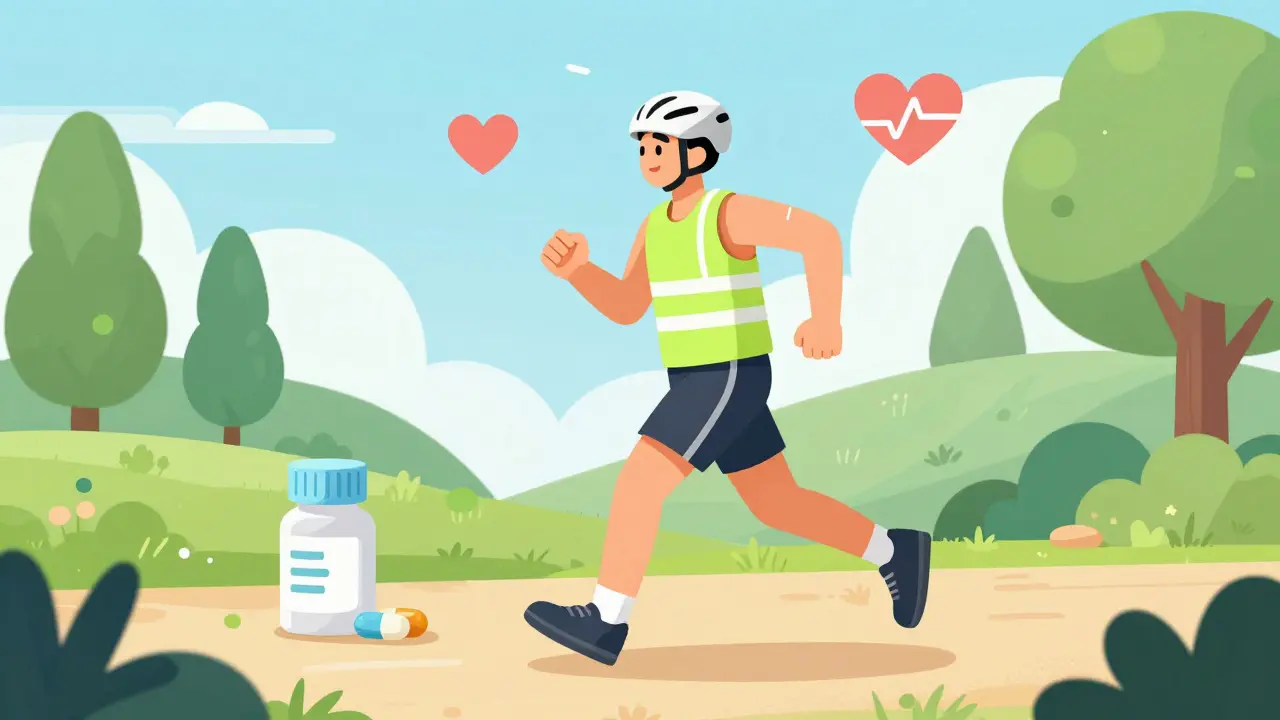
Sports Risk Calculator for Anticoagulant Users
How Safe Is Your Sport?
Answer these questions to get personalized risk assessment based on the latest medical guidelines.
Playing sports while on blood thinners isn’t just risky-it’s a high-stakes balancing act. If you’re an athlete taking anticoagulants, you’re not just managing a medical condition. You’re navigating a world where a single fall, collision, or even a hard tackle could mean life-altering bleeding. The good news? It’s not all or nothing. With the right strategy, many athletes can still compete-safely.
Why Blood Thinners and Sports Don’t Mix Easily
Anticoagulants like warfarin, apixaban, rivaroxaban, and dabigatran are designed to stop dangerous clots. But they also make you bleed more easily. For athletes, that’s a problem. A routine slide tackle in soccer, a crash on a mountain bike, or even a hard fall during a run can lead to internal bleeding that’s hard to detect and dangerous to treat. Studies show athletes on anticoagulants have a 3 to 5 times higher risk of major bleeding than non-athletes. In high-contact sports like rugby or ice hockey, the chance of a major bleed jumps to over 22%. That’s not a small number. It’s why most guidelines outright ban athletes on blood thinners from collision sports.Not All Sports Are Created Equal
The risk isn’t the same across all activities. Experts classify sports into three levels based on trauma likelihood:- High-risk (avoid completely): American football, rugby, boxing, ice hockey. These involve forces over 5G and a 90% chance of impact. Even minor collisions can rupture organs or cause brain bleeds.
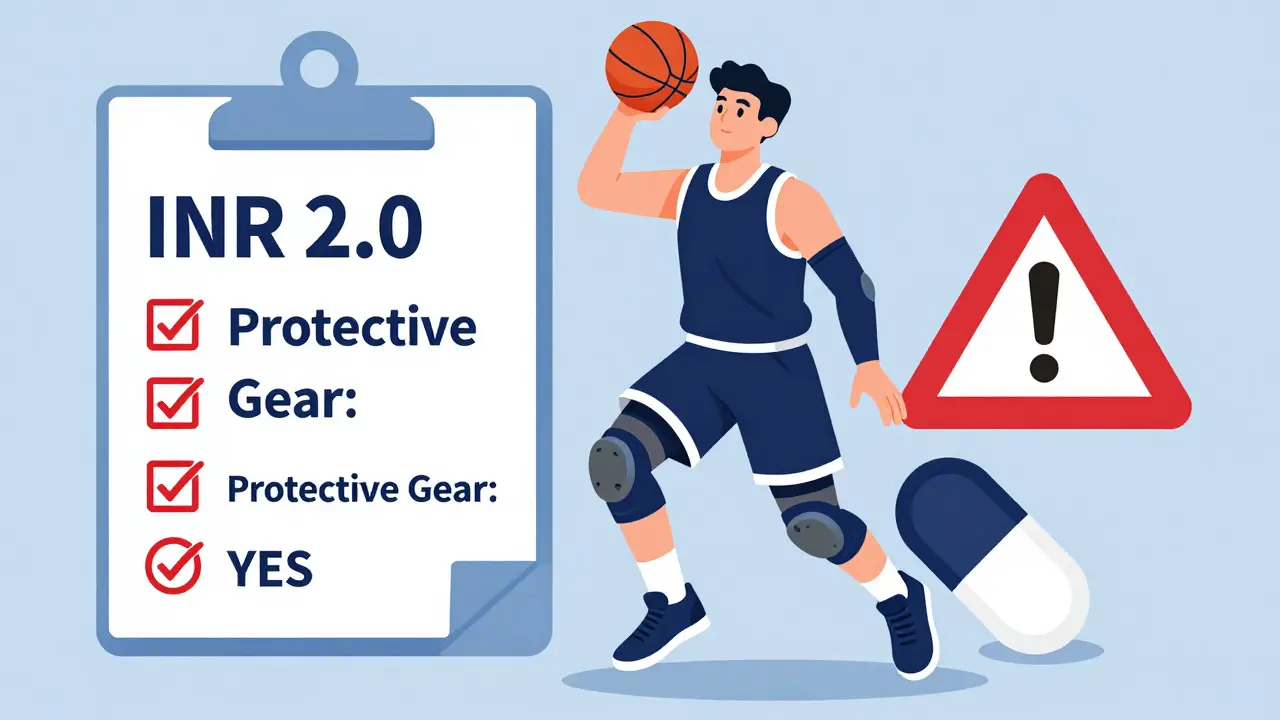
- Intermediate-risk (proceed with caution): Basketball, soccer, alpine skiing, lacrosse. About 30-60% of participants experience trauma. These require careful planning, protective gear, and medical clearance.
- Low-risk (generally safe): Running, cycling, swimming, rowing, yoga. Trauma risk is under 10%. With proper precautions, most athletes can continue these safely.
Warfarin vs. DOACs: Which Is Better for Athletes?
Not all blood thinners are the same. Warfarin, the old-school option, requires weekly blood tests (INR checks) and is affected by diet, alcohol, and other meds. Its long half-life (36-72 hours) means you can’t easily turn it off before a game. Direct Oral Anticoagulants (DOACs)-like apixaban and rivaroxaban-are now preferred for most athletes. Why?- They have predictable effects-no weekly blood tests needed.
- They clear from your system faster: apixaban in 8-15 hours, rivaroxaban in 5-13 hours.
- They’re less likely to cause major bleeding than warfarin. A 2025 JAMA study found apixaban reduced major bleeding by 26% compared to warfarin.
Four Proven Strategies to Stay Active
If you’re an athlete on anticoagulants, you have options. These aren’t theoretical-they’ve been used successfully by real athletes:- Switch to low-risk sports: Run instead of play rugby. Cycle instead of ski downhill. This alone cuts bleeding risk by over 75%.
- Time your DOAC dose: Take your daily pill 24 hours before competition. By game time, levels drop to subtherapeutic, reducing bleeding risk by up to 37% while still protecting against clots. This works because DOACs have short half-lives. You need a blood test (anti-Xa assay) to confirm levels are safe.
- Use LMWH with timed breaks: Switch to enoxaparin (a daily injection) and skip the dose 24 hours before your event. Studies show this reduces bleeding by 42% without increasing clot risk.
- Reduce warfarin dose temporarily: Lower your dose 3-4 days before competition to bring INR down to 1.5-1.8. This isn’t ideal-it raises clot risk slightly (0.8% per event)-but it’s an option for those who can’t switch to DOACs.
Protective Gear Isn’t Optional
Even in low-risk sports, protection matters. A helmet isn’t just for cycling-it’s for runners on uneven trails. Knee pads help if you’re hiking or doing trail running. Custom mouthguards can protect against jaw bleeds in contact sports where partial participation is allowed. A 2023 study of runners on anticoagulants showed that those who wore reflective gear, avoided icy terrain, and used padded backpacks during long runs had 60% fewer minor injuries. It’s not about avoiding activity-it’s about minimizing avoidable trauma.Monitoring Is Key
You can’t guess your blood levels. That’s why home INR monitors like the CoaguChek INRange (FDA-cleared in 2023) are game-changers. They’re accurate within 0.2 INR units. Athletes can check their levels before a big event and adjust timing or dose if needed. For DOAC users, specialized anti-Xa blood tests are required to confirm drug levels. These aren’t routine-but they’re essential if you’re trying to time your dose around competition.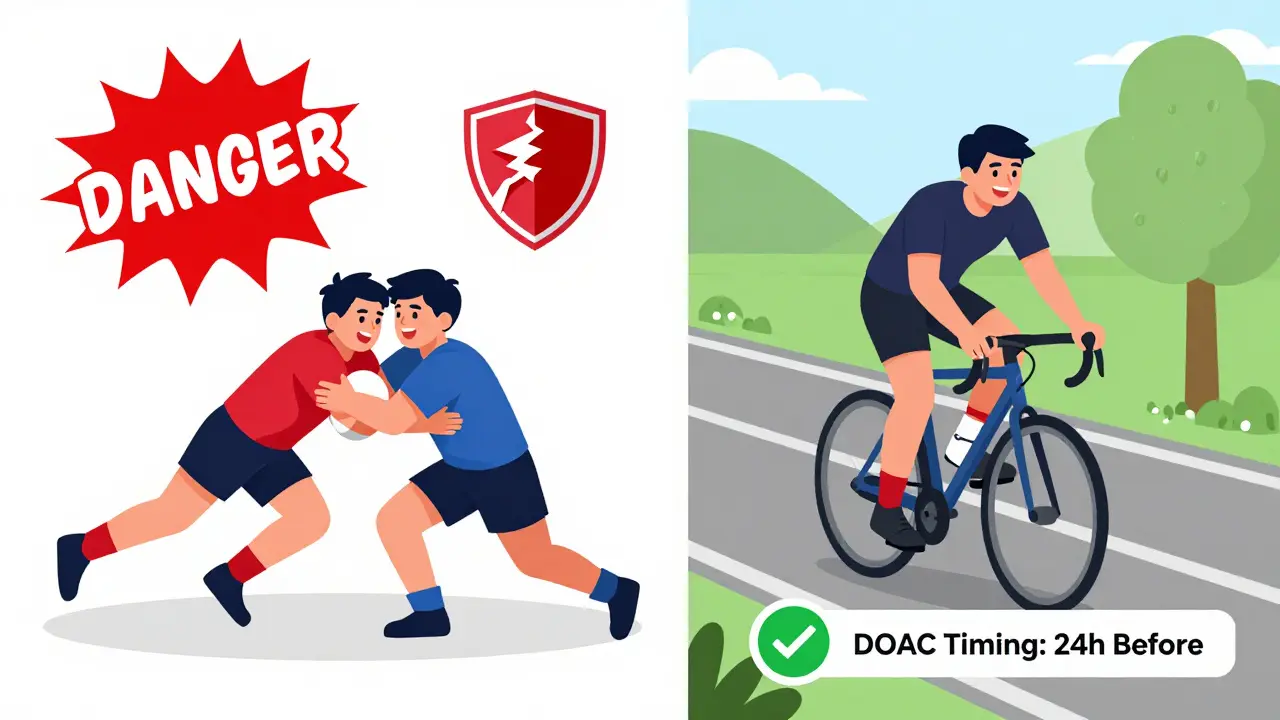
What About Doping Rules?
Good news: the World Anti-Doping Agency (WADA) clarified in 2020 that therapeutic anticoagulants are not banned substances. But you must have a Therapeutic Use Exemption (TUE) on file with your sport’s governing body. No TUE? You risk disqualification-even if your medication is legal and medically necessary.The Future: Personalized Plans for Athletes
Researchers are now building athlete-specific algorithms. Wearable sensors are measuring impact forces in 12 sports-from soccer headers to mountain bike crashes. These numbers are being fed into models that predict exactly when an athlete’s blood thinner is safe to use. One 2023 NIH study found that with personalized dosing based on PK/PD modeling, 68% of athletes could safely return to their sport. That’s a huge leap from just five years ago.Final Reality Check
You can’t ignore the risks. No amount of timing or gear eliminates danger in high-contact sports. If you’re on anticoagulants and play rugby, football, or boxing, you’re playing with fire. The data doesn’t lie. But if you’re a runner, cyclist, or swimmer? You can keep doing what you love. You just need to be smart. Talk to your cardiologist. Get the right tests. Time your meds. Wear protection. Document your TUE. This isn’t about giving up sport. It’s about adapting it. The goal isn’t to stop you from competing-it’s to make sure you can keep competing for years to come.14 Comments

Husain Atther
January 24, 2026 AT 12:19 PM
This is one of the most balanced and well-researched pieces I've read on the topic. The distinction between high, intermediate, and low-risk sports is particularly valuable. Many athletes underestimate the cumulative trauma from seemingly minor impacts. Thank you for sharing evidence-based guidance.

Helen Leite
January 26, 2026 AT 10:15 AM
THE GOVERNMENT AND PHARMA ARE HIDING THE TRUTH 😱 THEY WANT YOU TO THINK DOACS ARE SAFE BUT THEY’RE JUST MAKING YOU DEPENDENT!! I KNOW A GUY WHO GOT A BRAIN BLEED AFTER TAKING APIXABAN AND THEY LIED TO HIS FAMILY!! 🚨💀 #FreeTheTruth

Marlon Mentolaroc
January 27, 2026 AT 08:32 AM
Okay but let’s be real-switching from rugby to cycling isn’t a ‘strategy,’ it’s surrender. I get the risk, but if you’re the type who needs to hit things to feel alive, you’re gonna find a way. The real question is: are we policing athletes or protecting them?

Don Foster
January 27, 2026 AT 11:22 AM
The 24 hour DOAC timing thing sounds great on paper but anyone who thinks they can reliably predict pharmacokinetics without a lab test is delusional. Anti-Xa assays are expensive and not accessible to 90% of athletes. This whole post reads like a pharma ad disguised as medical advice

siva lingam
January 27, 2026 AT 21:42 PM
So basically if you're not rich enough to afford blood tests and fancy meds you should just quit sports

Phil Maxwell
January 29, 2026 AT 12:36 PM
I’ve been on warfarin for 8 years and still run 3x a week. I check my INR every 3 weeks, wear a helmet on trails, and avoid icy sidewalks. It’s not glamorous but it works. Small adjustments make all the difference.

Shelby Marcel
January 31, 2026 AT 11:13 AM
wait so if you take your pill 24 hrs before a game it lowers your risk? but how do you know if its low enough? like do you just guess?? i think i missed something

blackbelt security
February 1, 2026 AT 17:15 PM
You don’t have to give up your sport. You just have to respect the science. I’ve coached athletes on anticoagulants for over a decade. The ones who thrive? They’re the ones who treat their meds like their training plan-disciplined, consistent, non-negotiable.

Luke Davidson
February 2, 2026 AT 03:19 AM
This is the kind of post that makes you feel seen. I used to play college soccer on warfarin-every tackle felt like a lottery ticket. Switching to swimming changed my life. Not because I gave up, but because I finally learned how to play smart. The gear, the timing, the TUE-it’s all part of the game now. And honestly? I feel more alive than ever.

Karen Conlin
February 2, 2026 AT 23:28 PM
To every athlete reading this: your worth isn’t measured by the sport you play, but by your courage to adapt. Whether you’re cycling in Oregon or swimming in Florida, you’re still an athlete. Protect yourself. Advocate for your care. And never let fear silence your passion.

Heather McCubbin
February 3, 2026 AT 02:54 AM
They say you can’t play contact sports but what about the soul? The fire? The raw truth of competition? You think a helmet or a timing chart can replace that? No. You’re just being told to be quiet and fade into the background of a world that doesn’t want your risk

Amelia Williams
February 4, 2026 AT 17:44 PM
I’m a runner on apixaban and I just got my first home INR monitor (well, anti-Xa actually, they sent me the kit). I didn’t think I’d ever feel in control again. Now I check before long runs and feel like I’m finally the captain of my own body. It’s not perfect but it’s mine.

Viola Li
February 5, 2026 AT 18:58 PM
So let me get this straight-DOACs are safer but only if you can afford the tests, have a doctor who believes in timing, and aren’t allergic to bureaucracy? Meanwhile, warfarin users are just supposed to ‘adjust’? This isn’t medicine. It’s a privilege system disguised as science.
Write a comment
Popular Posts



Kat Peterson
January 23, 2026 AT 03:44 AM
I mean... if you're on blood thinners and still doing anything physical, you're basically flirting with death 😭 I saw a guy at the gym collapse last year after a dumbbell drop-turns out he was on rivaroxaban. No warning. No second chance. We need to stop romanticizing this. 💔