Suspicious Moles: What to Watch For and When to See a Doctor
When you notice a suspicious mole, a skin growth that looks different from others or has changed over time. Also known as atypical nevus, it could be a sign of melanoma, the most dangerous form of skin cancer—and early detection saves lives.
Suspicious moles don’t always hurt or itch. They just look wrong. The ABCDE rule helps: A for asymmetry (one half doesn’t match the other), B for irregular borders, C for uneven color, D for diameter larger than a pencil eraser, and E for evolving size, shape, or color. These aren’t just guidelines—they’re warning signs backed by decades of dermatology research. A mole that bleeds, crusts, or doesn’t heal? That’s not normal. Even if it’s small, if it’s changing, it needs attention.
People often ignore moles because they’ve had them for years. But melanoma doesn’t care how long you’ve lived with it. A mole that suddenly darkens, grows quickly, or starts itching could be reacting to UV damage that’s been building up for years. And it’s not just about sunburns—daily exposure adds up. You don’t need to be fair-skinned or spend hours at the beach. A mole on your scalp, between your toes, or under a nail can be just as dangerous. That’s why full-body skin checks matter, not just the ones you can easily see.
It’s not just about the mole itself—it’s about what follows. A dermatologist doesn’t just look at it. They use a dermatoscope, a special magnifying tool, to see layers beneath the surface. If something looks off, they take a biopsy—a tiny sample—before it spreads. Waiting to see if it gets worse is the biggest mistake people make. By the time a mole becomes painful or noticeable to others, it may already be advancing.
You’re not alone if you’re unsure what to look for. Millions of moles are removed every year, and most turn out to be harmless. But the ones that aren’t? They’re the ones you didn’t check. The goal isn’t to panic over every spot. It’s to know the difference between a harmless freckle and a warning sign. And if you’ve ever thought, ‘I should get that looked at,’ you probably should.
What you’ll find below are real cases, clear explanations, and practical advice from medical professionals who’ve seen what happens when people wait too long. From how to track changes at home to understanding what biopsies really mean, these posts give you the tools to act—not just worry. Because when it comes to suspicious moles, knowledge isn’t just helpful. It’s life-saving.
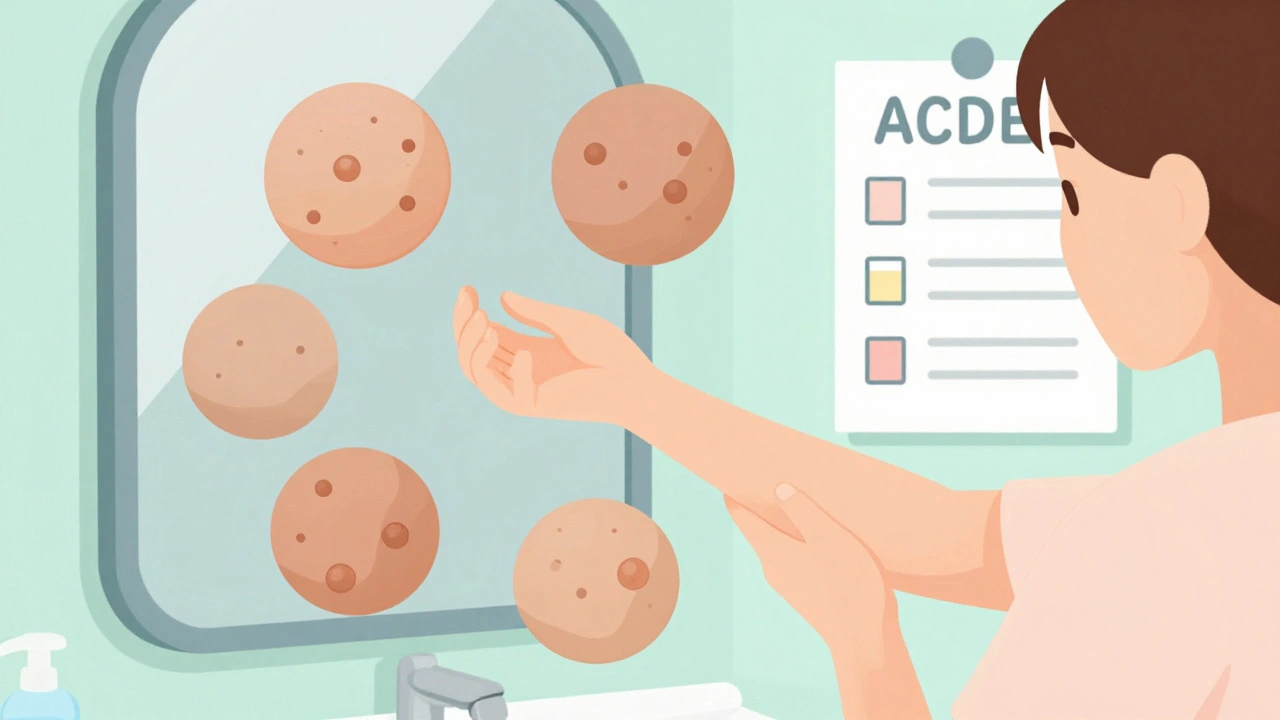
Moles and Melanoma: How the ABCDE Rule Helps Spot Skin Cancer Early
Learn how the ABCDE rule helps spot melanoma early, its limitations, and what to do if a mole looks suspicious. Understand when to get a biopsy and how to check your skin at home.
View MorePopular Posts