
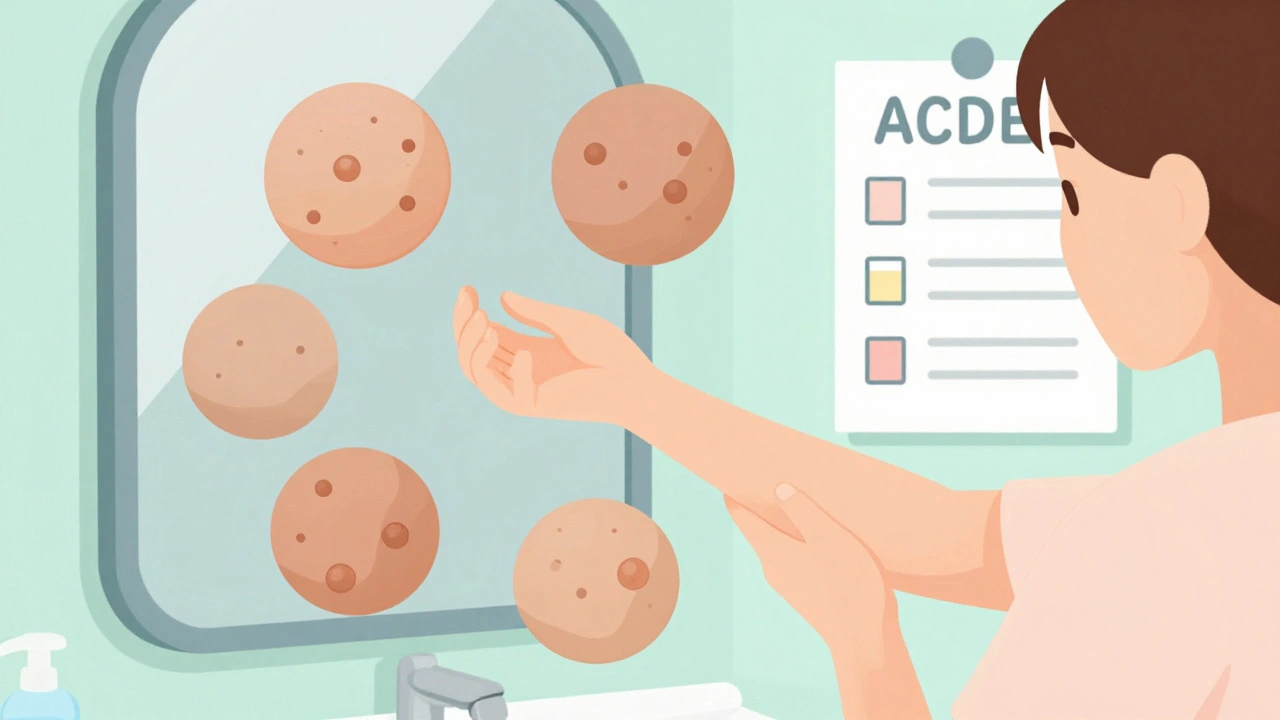
Most people have moles. Some have a few. Others have dozens. But when one starts looking odd, it’s easy to brush it off. Melanoma doesn’t always look like the scary pictures online. It can be small, symmetrical, or even light in color. And that’s exactly why relying only on the ABCDE rule can be dangerous.
What the ABCDE Rule Really Means
The ABCDE rule isn’t a diagnosis. It’s a checklist - a simple way to spot moles that might need a closer look. Dermatologists developed it in the 1980s to help both doctors and regular people notice warning signs early. Here’s what each letter stands for:- A - Asymmetry: One half of the mole doesn’t match the other. If you drew a line through the middle, the two sides wouldn’t look the same.
- B - Border: The edges are ragged, blurred, or notched. Healthy moles have smooth, even borders.
- C - Color: Multiple colors in one mole. Think brown, black, red, white, or blue. A mole that’s all one shade is usually safer.
- D - Diameter: Larger than 6 millimeters - about the size of a pencil eraser. But here’s the catch: 30% of melanomas are smaller than this. Some experts now say to watch for any mole darker than the others, even if it’s tiny.
- E - Evolving: This is the most important one. Has the mole changed in size, shape, color, or texture? Has it started itching, bleeding, or crusting? Any change over weeks or months is a red flag.
Some clinics now use ABCDEFG - adding ‘F’ for ‘Funny looking’ and ‘G’ for ‘Growing fast.’ But even with these updates, the rule isn’t perfect.
Why the ABCDE Rule Misses Melanoma
A 2022 study of 144 melanoma cases found that 36% were in situ - the earliest stage, still confined to the top layer of skin. And here’s the problem: only 32.7% of those early melanomas showed the ‘E’ sign (evolving). That means more than two-thirds of the most treatable melanomas didn’t even meet the most reliable ABCDE criterion.Some melanomas look nothing like the textbook examples. Desmoplastic melanoma - a rare but aggressive type - shows ABCDE features in just 15% of cases. Childhood melanoma? Only 18% fit the pattern. And then there’s the patient who told me about their melanoma: perfectly round, one shade of brown, only 3mm wide. No asymmetry. No irregular border. No color variation. No diameter warning. Just… a mole that didn’t belong. That’s the ugly duckling sign.
The Ugly Duckling Sign: A Better Clue?
Your skin has a pattern. Most of your moles look similar. One that stands out - darker, bigger, flatter, raised, or just odd - is the ugly duckling. A 2019 study in the British Journal of Dermatology found this sign caught 73% of melanomas that ABCDE missed. It’s intuitive. You don’t need medical training. You just need to know your own skin.Think of it like this: if you had 15 moles and 14 looked like little brown freckles, but one was black, raised, and had a rough surface - you’d notice it. That’s your body telling you something’s off. Don’t wait for it to tick every ABCDE box.

When Should You Get a Biopsy?
A biopsy is the only way to know for sure if a mole is cancerous. Dermatologists don’t just biopsy every odd-looking spot. They use a mix of clues:- Three or more ABCDE signs - sensitivity is about 85%
- Documented change over 3-6 months - sensitivity jumps to 92%
- The ugly duckling sign - sensitivity 73%
Even then, doctors consider other things: your skin type, family history, sun exposure, and whether you’ve had skin cancer before. A mole that’s changed slightly over time is more concerning than one that’s been the same for 10 years.
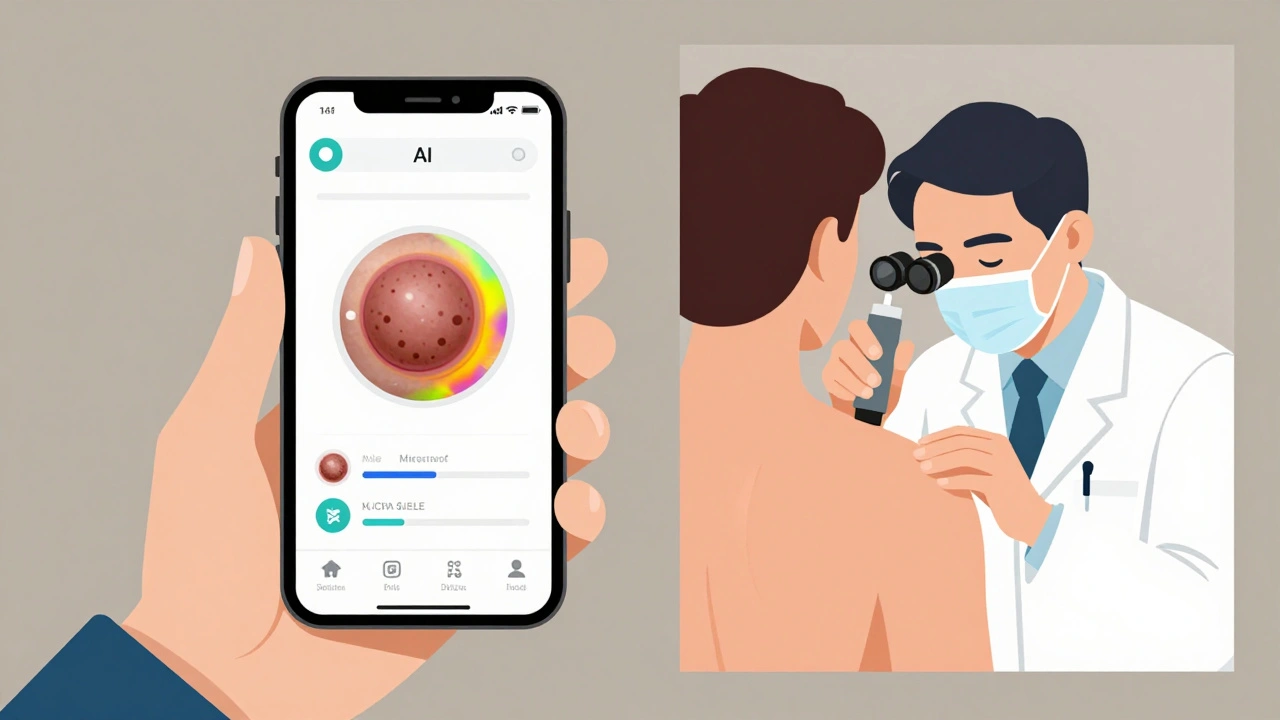
Here’s the hard truth: most biopsies don’t turn out to be melanoma. For every one melanoma found using ABCDE criteria, nearly five benign moles are removed. That’s why dermoscopy - a handheld magnifying tool with polarized light - is now used in 67% of U.S. dermatology practices. It helps doctors see beneath the surface, reducing unnecessary cuts by 89%.
What You Can Do at Home
You don’t need a doctor to spot warning signs. Monthly self-checks are the first line of defense. Here’s how to do it right:- Use a full-length mirror and a hand mirror. Check your back, scalp, between your toes, and under your nails.
- Take photos of any moles you’re unsure about. Compare them every three months.
- Don’t just look for ABCDE - look for anything that doesn’t match your other moles.
- Write down when you first noticed a change. Even a small shift matters.
Only 19% of people have baseline photos of suspicious moles. That makes it hard for doctors to judge if something’s truly evolving. If you’re worried, take a picture today. You’ll thank yourself later.
What’s New in Melanoma Detection
Technology is changing how we catch melanoma. The FDA approved SkinVision, an app that uses AI to analyze mole photos, in 2022. It’s not a replacement for a doctor, but it can help you decide when to go in. In 43% of U.S. dermatology clinics, AI tools now analyze lesions against 12 million images. These systems are 95% sensitive - meaning they catch almost all melanomas.There’s also a blood test called DecisionDx-Melanoma, used in 68% of academic centers. It doesn’t replace a biopsy, but it helps doctors decide if a mole is high-risk or low-risk. For some patients, this means avoiding surgery altogether.
By 2027, experts predict the ABCDE rule won’t be the final word - just the starting point. It’ll be combined with dermoscopy, AI, and genetic testing to make smarter decisions.
The Real Danger: Waiting Too Long
The biggest risk isn’t missing a mole. It’s ignoring it because it didn’t tick every box. A 2022 American Academy of Dermatology survey found that 42% of people waited to see a doctor because their mole didn’t meet enough ABCDE criteria. The average delay? Seven months.That’s critical. Melanoma caught at stage 0 has a 99% five-year survival rate. At stage IV? It drops to 32.6%. Every month you wait matters.
One Reddit user shared: “I noticed my mole was asymmetrical and multi-colored. I went in. It was stage 0.” Another said: “My melanoma was symmetrical, uniform color, 3mm. ABCDE didn’t catch it. It was stage IIB.”
The lesson? Don’t wait for perfection. Wait for change. Wait for something that feels wrong. Your skin knows.
Final Thoughts
The ABCDE rule is a useful tool - but it’s not a safety net. It’s a starting point. Melanoma doesn’t care about rules. It grows quietly. It hides in plain sight. It doesn’t always look like the textbook image.Know your skin. Take photos. Watch for change. Trust your gut. If something looks different, acts different, or just doesn’t feel right - get it checked. You don’t need to be an expert. You just need to be observant.
Early detection saves lives. Not because of perfect criteria - but because someone noticed something was off and didn’t ignore it.
Can a mole be cancerous even if it’s small?
Yes. While melanomas are often larger than 6mm, about 30% are diagnosed when smaller than that. Size alone isn’t a reliable indicator. A tiny mole that’s changing color, bleeding, or looks different from your other moles should be checked.
Do I need a biopsy if my mole only has one ABCDE sign?
Not necessarily. Dermatologists look at the whole picture: how many signs are present, whether the mole has changed over time, and whether it stands out from your other moles. One sign alone isn’t enough to trigger a biopsy - but if it’s evolving, even with just one feature, it may still need evaluation.
Is the ABCDE rule reliable for people with darker skin?
Melanoma in people with darker skin often appears in less sun-exposed areas - under nails, on palms, or soles of feet. The ABCDE rule still applies, but it’s less likely to catch these cases because they don’t always follow the classic pattern. The ugly duckling sign is especially important here: look for any new, dark, or changing spot that doesn’t match your usual skin markings.
Can apps like SkinVision replace a dermatologist?
No. Apps like SkinVision can help you decide whether to seek care, but they can’t diagnose melanoma. They use AI to analyze images based on ABCDE and other factors, but only a biopsy can confirm cancer. These tools are best used as a guide - not a substitute - for professional evaluation.
How often should I check my moles?
Once a month is ideal. Do it after a shower, when your skin is clean and well-lit. Use mirrors to check hard-to-see areas. Take photos of any moles you’re unsure about. If you have a history of skin cancer or many moles, your dermatologist may recommend professional checks every 6-12 months.
What if I’m scared to get a mole checked?
Fear is normal - but delay is dangerous. Most biopsies are simple, quick, and done with local numbing. The vast majority of biopsied moles turn out to be harmless. But if it’s melanoma, catching it early means a 99% chance of full recovery. One check could save your life. Don’t let fear stop you.
12 Comments

James Kerr
December 4, 2025 AT 00:57 AM
Bro, I took a pic of my mole last month and it’s already darker. I didn’t wait for it to tick every box. Just went in. Turns out it’s benign but holy crap I’m glad I went. Don’t be the guy who says ‘it’s probably fine’ and then regrets it for the rest of your life.

Rashi Taliyan
December 4, 2025 AT 03:49 AM
OMG I just checked my back in the mirror and there’s this one mole I’ve had since I was 16 - it’s always been there, but now it’s slightly raised?? I’m literally shaking. I’ve never been so scared of a spot in my life. I’m booking a derm appointment tomorrow. I don’t care if it’s ‘just a mole.’ I’m not risking it.

Rashmin Patel
December 4, 2025 AT 11:54 AM
Listen, I’ve got 27 moles and I’ve been tracking them since I was 21. I use SkinVision every three months, take photos, and I’ve already had two biopsies - both benign. But here’s the thing: the ugly duckling sign saved my life. One mole was darker than the rest, no other ABCDE signs, just… wrong. I didn’t need a doctor to tell me. My gut screamed. And guess what? It was stage 0. ABCDE is a starting point, not a finish line. If you’re not checking your skin like it’s your job, you’re playing Russian roulette with your life.

bobby chandra
December 4, 2025 AT 12:34 PM
Let’s be real - if your dermatologist still relies on ABCDE like it’s gospel, they’re practicing medicine from 1998. We’ve got AI that analyzes 12 million images, dermoscopy that sees layers your eyeball can’t, and blood biomarkers that predict risk before a mole even changes. The ABCDE rule is like using a candle to navigate a highway. It’s cute. It’s nostalgic. But it won’t keep you alive.

Charles Moore
December 6, 2025 AT 03:48 AM
I love how this post doesn’t just throw facts at you - it gives you a framework. The ugly duckling sign? That’s the kind of intuitive, human-centered insight that actually sticks. I teach this to my high school health class. Kids get it. They start noticing their own skin. That’s how you change behavior - not by scaring people, but by helping them see the pattern in their own body.

Cindy Lopez
December 8, 2025 AT 02:03 AM
There’s a missing comma in the sentence: ‘It doesn’t always look like the textbook image.’ It should read: ‘It doesn’t always look like the textbook image.’ Also, ‘dermoscopy - a handheld magnifying tool with polarized light - is now used in 67% of U.S. dermatology practices.’ The em dash usage is inconsistent. Fix your punctuation before you preach about melanoma.

sagar bhute
December 8, 2025 AT 06:25 AM
Everyone’s acting like they’re saving lives by checking moles. Newsflash: most of you are just paranoid. I’ve had the same mole for 15 years. It’s brown. It’s round. It’s not changing. You’re not going to die because you didn’t take a photo of your freckle. Stop turning every skin spot into a crisis.

Kara Bysterbusch
December 9, 2025 AT 00:25 AM
The elegance of this piece lies in its rejection of binary thinking. The ABCDE rule, while historically valuable, is a static metric applied to a dynamic biological phenomenon. Melanoma, as a disease, does not conform to the constraints of human-designed heuristics. The ugly duckling sign, by contrast, is a perceptual heuristic rooted in individual biological context - a form of embodied epistemology. One’s own skin, when observed with consistent mindfulness, becomes a living diagnostic ledger. This is not medicine - it is intimacy with the self.

shalini vaishnav
December 10, 2025 AT 15:08 PM
Why are Westerners so obsessed with moles? In India, we have 10x more sun exposure and yet melanoma rates are 1/10th. It’s because we don’t obsess over every spot. We have natural immunity. We don’t need apps and photos and biopsies. You people are overmedicalizing your skin because you’re bored and have too much time. Stop panicking. Live. Enjoy the sun.

Archie singh
December 11, 2025 AT 07:22 AM
AI can’t diagnose. Dermoscopy can’t diagnose. Only biopsy can. So why are you wasting your time with apps and photos? If you’re worried, go see a doctor. If you’re not, stop scrolling. This whole post is just a marketing funnel for dermatology clinics. You’re being sold fear wrapped in science.

vinoth kumar
December 12, 2025 AT 19:36 PM
Just wanted to say thank you. I used to think moles were just moles. Then my cousin got diagnosed with stage III melanoma because she waited for it to get bigger. Now I check my skin every month. I take photos. I don’t ignore anything weird. It’s not about fear - it’s about responsibility. And honestly? It’s kinda empowering to know your own body that well.


Gavin Boyne
December 3, 2025 AT 19:27 PM
So let me get this straight - we’re supposed to trust a checklist from the 80s that misses over two-thirds of early melanomas? Cool. I’ll just ignore my weird mole because it’s symmetrical and under 6mm. Next you’ll tell me the sun doesn’t burn. ABCDE is like using a ruler to measure a hurricane.