The Purple Book isn’t a novel you read on the couch. It’s the U.S. Food and Drug Administration’s official, searchable database for biological medicines - including biosimilars and interchangeable products. Think of it as the go-to reference for pharmacists, doctors, and patients trying to understand what’s actually approved, what can be swapped, and what’s just similar on paper. If you’ve ever wondered why some biologic drugs can be substituted at the pharmacy while others can’t, the Purple Book holds the answer.
What Exactly Is the Purple Book?
The Purple Book is a living document maintained by the FDA. It lists every biological product approved in the U.S., along with those that are biosimilar or interchangeable with them. Before 2020, this information was split across two separate lists - one for drugs managed by CDER and another for biologics handled by CBER. Now, it’s one unified, searchable system. That change alone made it far easier to find what you need without jumping between documents.
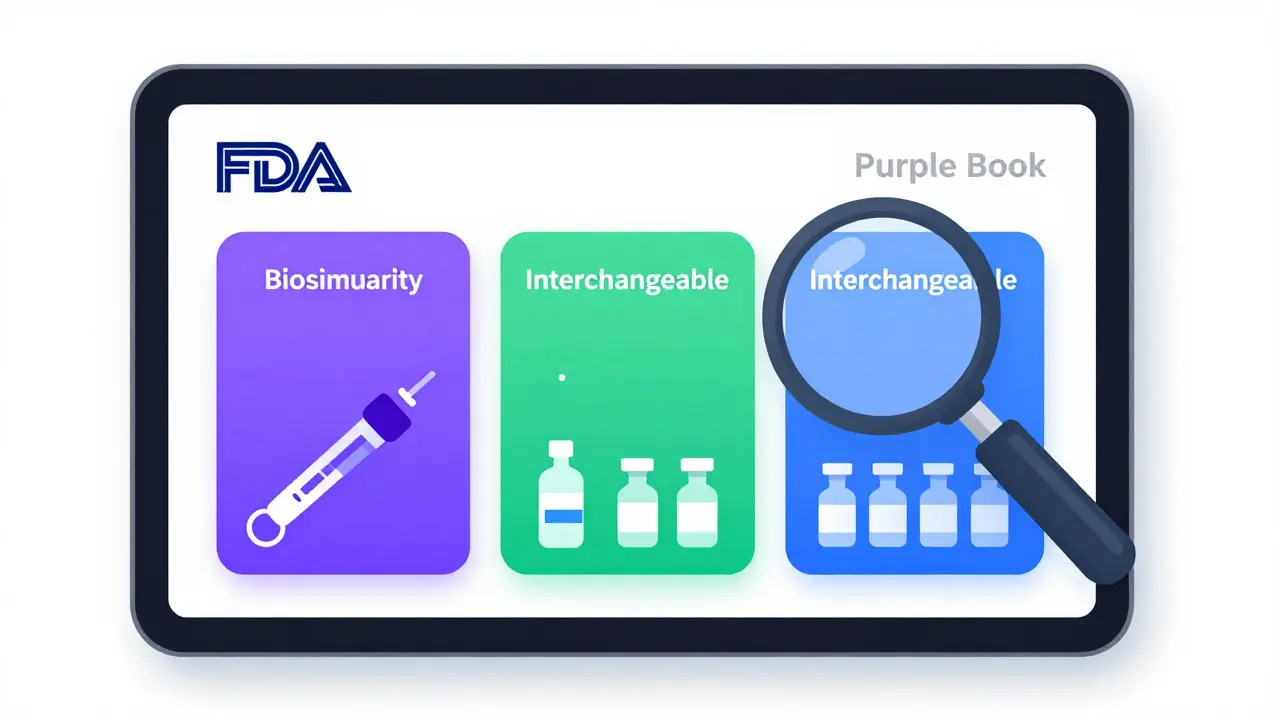
Each entry includes key details: when the product was licensed, whether it’s a reference product (the original), a biosimilar, or an interchangeable version. The database uses color-coded cards to visually group products - if two cards match in color, they’re linked by biosimilarity or interchangeability. You’ll also see icons showing how the product is delivered - autoinjector, pre-filled syringe, vial - so you know what to expect at the pharmacy or clinic.
It’s not just for insiders. The FDA says the Purple Book was designed to be an easy-to-use tool for pharmacists. But patients and providers use it too, especially when questions come up about switching from a brand-name biologic to a cheaper version.
Biosimilar vs. Interchangeable: What’s the Difference?
Here’s where things get tricky - and why the Purple Book matters so much.
All interchangeable products are biosimilars. But not all biosimilars are interchangeable. That’s the core distinction.
A biosimilar is a biological product that’s highly similar to an already-approved reference product. The FDA requires proof that there are no clinically meaningful differences in safety, purity, or potency. That means the drug works the same way, with the same risks and benefits. Minor differences in inactive ingredients are allowed - just like with generic pills.
An interchangeable product goes further. To earn that label, the manufacturer must prove that switching back and forth between the biosimilar and the original reference product won’t increase risk or reduce effectiveness. That’s not just one study. It’s multiple switching studies - where patients alternate between the two drugs over time - to show the outcomes stay consistent.
The FDA doesn’t say interchangeable biosimilars are better. They just say you can swap them with confidence, even multiple times. That’s why interchangeability is such a big deal for pharmacies and insurers. It’s the green light for automatic substitution - if state law allows it.
Why Does Interchangeability Even Matter?
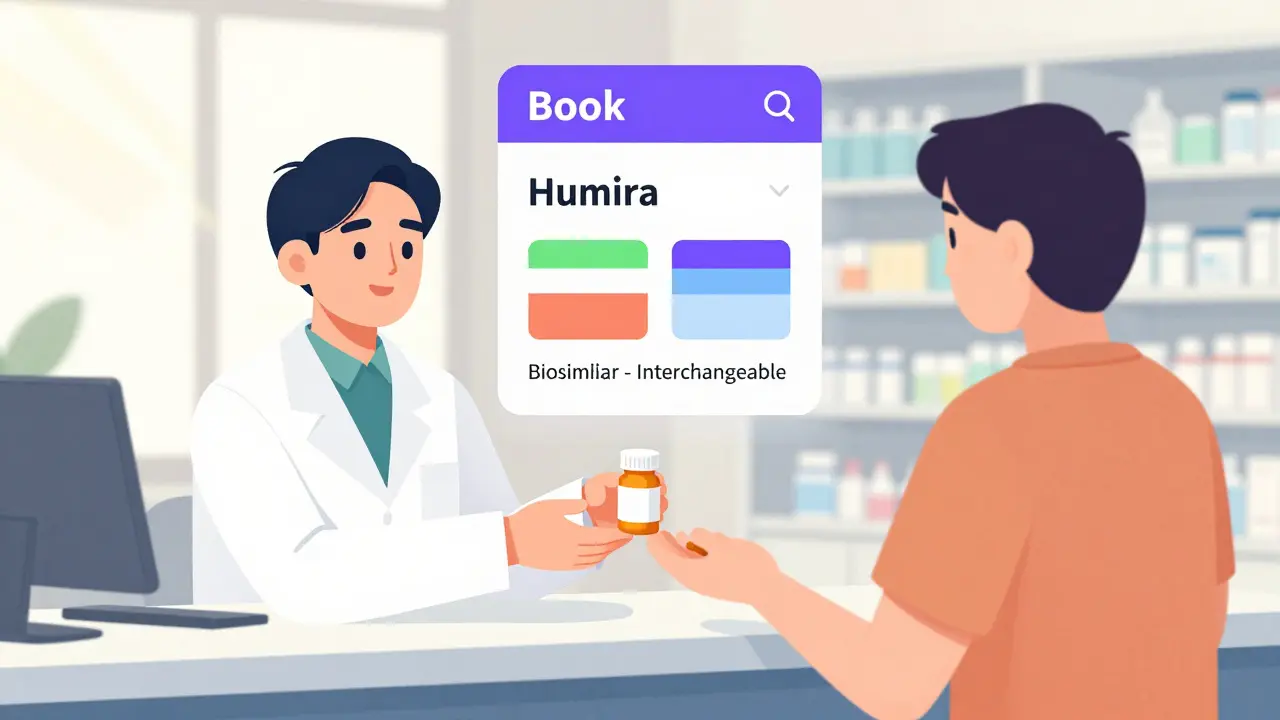
Let’s say your doctor prescribes Humira, a biologic used for rheumatoid arthritis. The brand-name version costs thousands per month. A biosimilar might cost 30% less. But if it’s not labeled interchangeable, your pharmacist can’t swap it out without calling your doctor for permission. That adds delays, paperwork, and confusion.
But if the biosimilar is interchangeable? In most states, the pharmacist can substitute it automatically - just like they would with a generic statin. No call needed. That’s how you get real cost savings at the point of care.
As of late 2023, only seven biosimilars had received the interchangeable designation from the FDA. Two are insulin products. Three treat inflammatory conditions like Crohn’s disease and psoriasis. Two are for eye conditions. More are in the pipeline. Companies are actively seeking this designation because it removes a major barrier to adoption.
But here’s the catch: federal approval doesn’t guarantee automatic substitution. That’s up to each state.
State Laws Are the Wild Card
The FDA sets the federal standard. But pharmacy substitution rules? Those are controlled by state boards of pharmacy.
As of 2023, 47 states and Puerto Rico allow pharmacists to substitute an interchangeable biosimilar without needing the prescriber’s okay. That’s huge. But it’s not automatic. In many of those states, pharmacists still have to:
- Notify the prescribing doctor
- Inform the patient
- Keep a record of the substitution
Some states require the patient to consent in writing. Others require the substitution to be documented in the electronic health record. A few states still don’t allow substitution at all - even if the product is FDA-interchangeable.
This patchwork of rules makes it hard for patients to know what to expect. You might get substituted in New York, but not in California - even if the drug is the same. That’s why the Purple Book includes a note: interchangeability doesn’t mean automatic substitution. It means the FDA says it’s safe to switch. Whether you actually can switch? That’s up to your state.
What About Unbranded Biologics?
You might hear the term “unbranded biologic.” It sounds like it could be interchangeable. But it’s not.
An unbranded biologic is a version of a biologic that doesn’t carry the original brand name. The FDA considers it equivalent to the reference product. But it’s not approved under the 351(k) pathway - so it doesn’t go through the biosimilar review process. That means it’s not listed in the Purple Book as a biosimilar or interchangeable product. It’s a different regulatory track entirely.
Don’t confuse the two. Only products labeled as 351(k) Biosimilar or 351(k) Interchangeable in the Purple Book have been reviewed and approved under the biosimilar pathway.
How to Use the Purple Book
It’s free. It’s online. And it’s searchable.
Go to the FDA’s website. Type in a brand name - like Enbrel or Neulasta. The results will show the original product, plus any biosimilars or interchangeable versions linked to it. Click on any product card to see:
- Its approval date
- Whether it’s a reference, biosimilar, or interchangeable product
- Its regulatory pathway (351(a) or 351(k))
- Whether it has exclusivity protection
- How it’s delivered
Use the filters to narrow results. You can search by product name, manufacturer, or status. The list can get long, but the color-coding helps you group related products quickly.
Pharmacists use this daily. Patients can use it too - especially if they’re being asked to switch medications and want to verify the FDA’s official stance.
What’s Next for the Purple Book?
The FDA continues to update the database as new products are approved. Draft guidance on labeling for interchangeable biosimilars is in the works to ensure clarity in how these products are named and described.
More companies are applying for interchangeability. The pipeline is full. Insulin, autoimmune disease treatments, and eye therapies are the most active areas. As costs come down and confidence grows, we’ll likely see more patients benefiting from these alternatives.
But the real challenge isn’t science. It’s education. Many prescribers still think biosimilars are “inferior.” Pharmacists aren’t always trained on substitution rules. Patients worry about switching. The Purple Book gives the facts. Now, the system needs to catch up.
Frequently Asked Questions
Is the Purple Book only for U.S. products?
Yes. The Purple Book is specific to biological products approved by the U.S. Food and Drug Administration. It does not include products approved in other countries, even if they’re similar. If you’re outside the U.S., your country’s regulatory agency will have its own equivalent database.
Can I trust biosimilars listed in the Purple Book?
Absolutely. Every product listed as a biosimilar or interchangeable has undergone rigorous testing to prove it’s as safe and effective as the original. The FDA doesn’t approve these products lightly. The approval process requires multiple analytical studies, animal testing, and clinical trials - often more than for a generic drug.
Why aren’t more biosimilars interchangeable?
Because proving interchangeability is harder. It requires switching studies - where patients alternate between the biosimilar and the reference product multiple times - to show no loss of effectiveness or increase in side effects. That’s expensive and time-consuming. Many manufacturers focus first on getting biosimilar approval, then pursue interchangeability later - if market demand justifies the cost.
Does the Purple Book tell me which biosimilar is cheapest?
No. The Purple Book lists FDA status - not pricing. It won’t tell you which biosimilar costs less at your pharmacy. For pricing, you’ll need to check with your insurer or pharmacy. But it does tell you which ones are legally substitutable, which helps you ask the right questions about cost.
If my doctor prescribed a brand-name biologic, can my pharmacist give me a biosimilar without asking?
Only if the biosimilar is FDA-interchangeable AND your state allows automatic substitution. Even then, some states require the pharmacist to notify your doctor or get your consent. Always ask your pharmacist what’s allowed in your state - don’t assume.
What to Do Next
If you’re a patient: Look up your biologic in the Purple Book. See if there’s a biosimilar - and whether it’s interchangeable. Ask your pharmacist if substitution is an option.
If you’re a provider: Use the Purple Book to confirm what’s approved and what can be swapped. Don’t rely on outdated assumptions. Biosimilars are not second-rate - they’re rigorously tested.
If you’re a pharmacist: Know your state’s substitution laws. Use the Purple Book daily. It’s your legal guide for when you can and can’t substitute.
The Purple Book isn’t flashy. But it’s the most reliable source we have to cut through the noise. It’s not about hype. It’s about clarity - and making sure patients get safe, affordable care without confusion.