
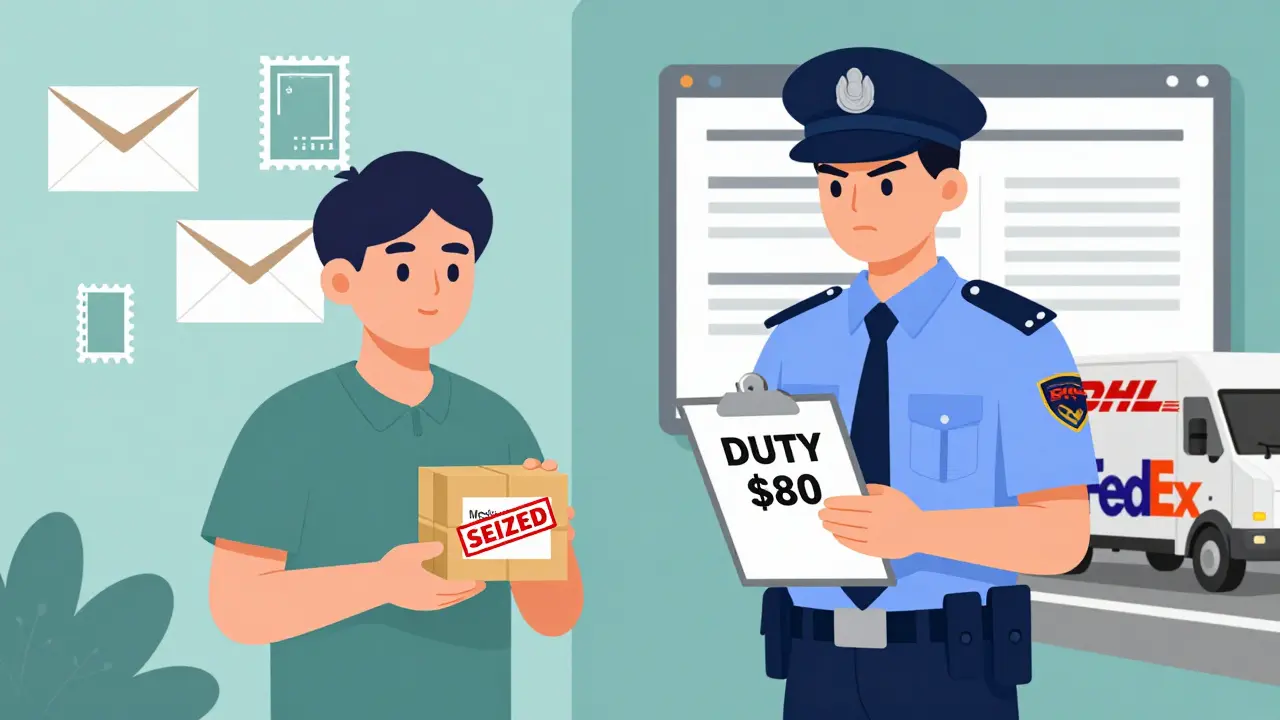
Buying medication from overseas used to be simple. You found a pharmacy abroad, paid a fraction of what you’d pay at home, and waited for it to arrive in your mailbox. But as of August 29, 2025, that’s no longer true - not in the U.S., and not for most countries following similar rules. The $800 duty-free threshold is gone. What once cost $50 in medicine now could cost $80 extra in fees. And if you don’t get the paperwork right, your package might be seized - or worse, you could face legal trouble.
Why the Rules Changed (And What It Means for You)
Before August 2025, any package under $800 could enter the U.S. without paying customs duties. That meant a $40 bottle of insulin from Canada, a $25 prescription from India, or a $70 anti-anxiety med from the UK could arrive without any extra cost. Over 97% of international mail-order packages qualified. Now? Only private gifts under $100 are exempt. That’s it. The change wasn’t about stopping fake drugs - it was about money. The U.S. government lost billions in lost duties on low-value commercial shipments. So they shut it down. The result? For most people buying medication overseas, the cost of shipping just went up 300-400%. Many shipments that were once affordable are now financially impossible.What You Can Still Legally Import (And What You Can’t)
The U.S. Food and Drug Administration (FDA) still allows personal importation of medication under very strict conditions:- You’re importing a 90-day supply or less for personal use
- The drug is not available in the U.S. (or is significantly cheaper abroad)
- The medication is not a controlled substance (like opioids or benzodiazepines)
- You’re not reselling it
- You have a valid prescription from a licensed U.S. doctor
The New Duty System: Method 1 vs. Method 2 (Until February 2026)
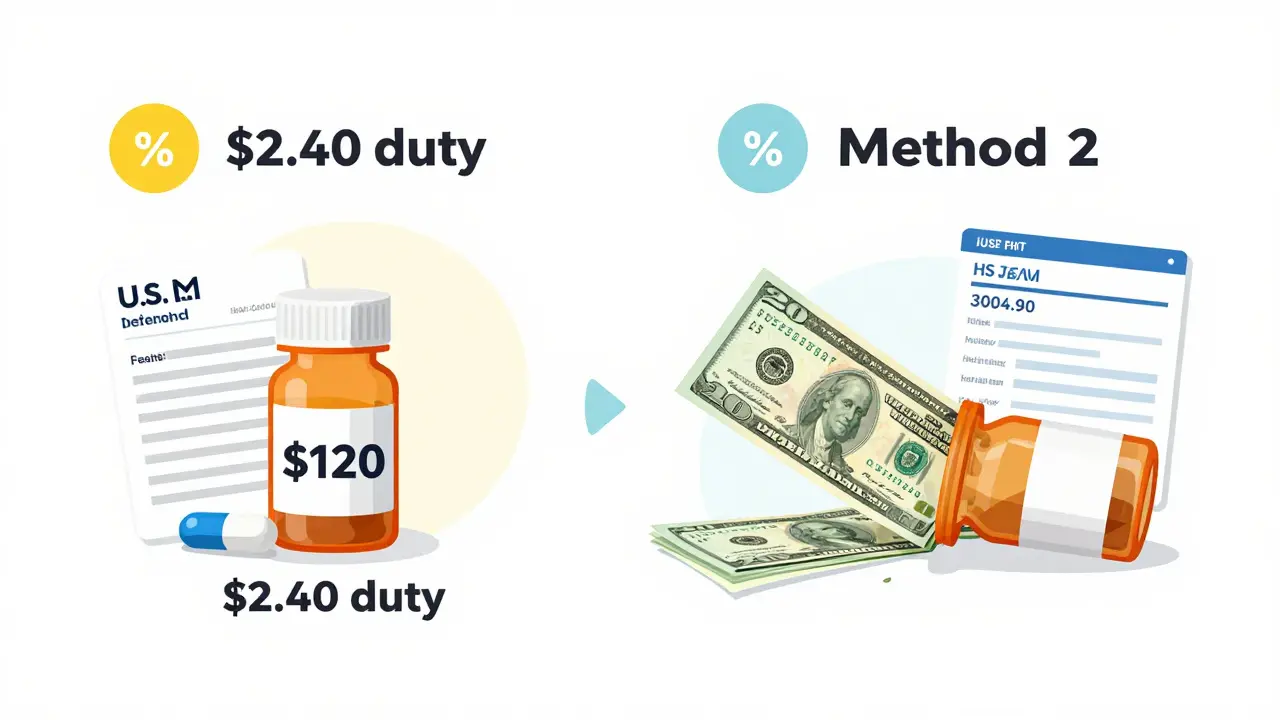
Starting August 29, 2025, all commercial shipments to the U.S. must pay duties. But there’s a temporary window - until February 28, 2026 - where two methods apply:- Method 1 (Ad Valorem): You pay a percentage of the item’s value based on its Harmonized System (HS) code. For most medications, that’s 1.5% to 5%. So a $100 prescription might cost $1.50-$5 in duty.
- Method 2 (Flat Rate): A fixed fee based on the exporting country’s tariff rate: $80 for low-tariff countries, $160 for medium, $200 for high. This sounds bad - and it is - unless your medication is from a country with a low tariff rate and you’re shipping something expensive.
How to Avoid Your Package Being Seized
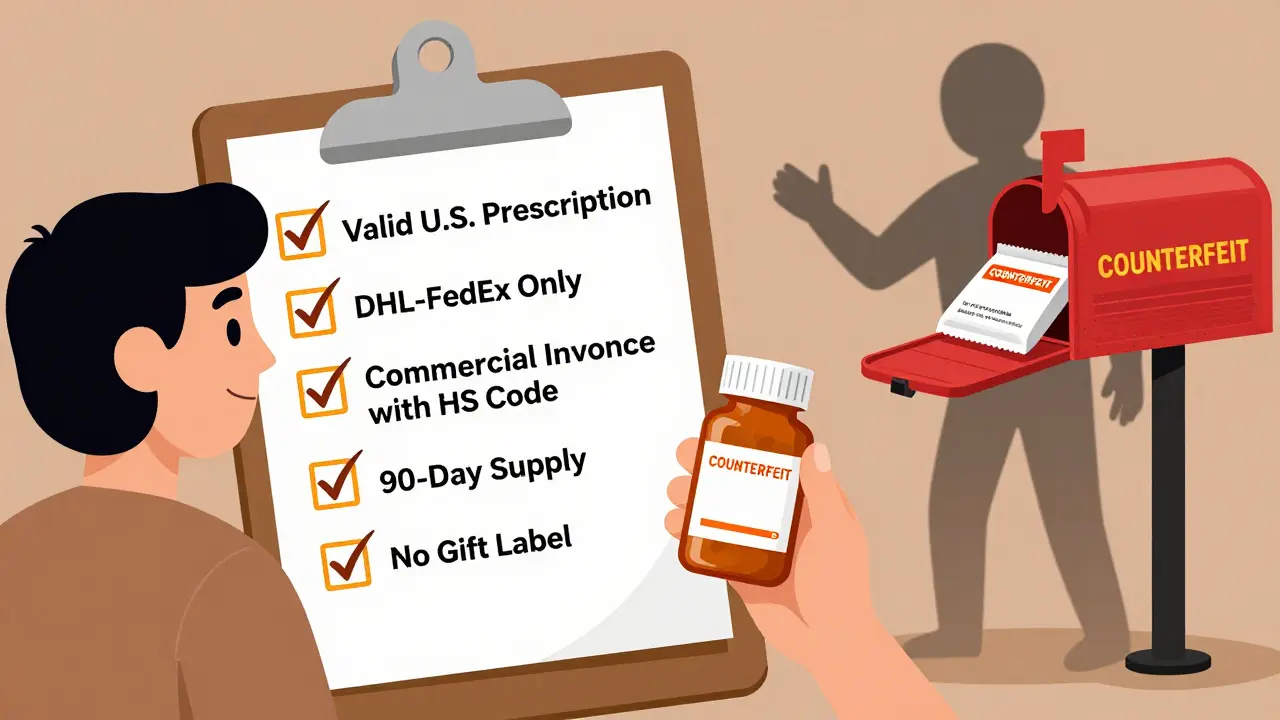
The #1 reason packages get held? Missing or wrong documentation. Here’s what you need:- Commercial Invoice: Not a receipt. Not a gift label. A real invoice with:
- Exact drug name (e.g., “Metformin Hydrochloride 500mg tablets”)
- Quantity and strength
- Manufacturer name
- Value in USD
- HS code (6-digit, mandatory since September 1, 2025)
- Prescription Copy: A scanned copy from your U.S. doctor. No prescription? Your package is at risk.
- Proof of Personal Use: A note stating “For personal use only - 90-day supply.”
Which Carriers Still Deliver Medications?
Most postal services - including USPS, Canada Post, and Royal Mail - have stopped accepting commercial medication shipments. Deutsche Post, DHL Parcel, and others announced they’d stop taking business parcels to the U.S. after August 22, 2025. Your only reliable options now:- DHL Express - Handles customs clearance as part of service. Best for high-value or time-sensitive meds.
- FedEx International - Strong customs brokerage. More expensive but reliable.
- UPS Worldwide - Good for larger shipments. Charges handling fees.
What to Do If Your Package Is Held
If CBP holds your medication:- Don’t panic. Don’t ignore the notice.
- Log into the CBP online portal using the tracking number.
- Upload your prescription, invoice, and personal use letter.
- Pay any assessed duties via Pay.gov.
Alternatives to International Mail-Order
If the cost or risk feels too high, here are safer, legal options:- Canadian pharmacies with U.S. licenses: Some are authorized to ship directly to U.S. patients under the FDA’s Personal Importation Policy.
- Pharmacy discount programs: GoodRx, SingleCare, and RxSaver often offer prices lower than international mail-order - even after shipping.
- Medication assistance programs: Many drug manufacturers offer free or low-cost meds to low-income patients.
- Regional fulfillment hubs: Some companies now warehouse meds in Mexico or Canada and ship them as domestic U.S. orders, avoiding international customs entirely.
Red Flags That Mean You’re at Risk
Avoid these situations - they’re not worth the risk:- Pharmacies that say “no prescription needed”
- Prices that seem too good to be true (e.g., $10 for a 30-day supply of brand-name insulin)
- Shops that use vague product names like “generic diabetes pill” instead of the actual drug name
- Shipping from countries known for counterfeit drugs (e.g., some vendors in Southeast Asia or Eastern Europe)
- Payments made via cryptocurrency or wire transfer only
Final Checklist Before You Order
Before you click “buy” on any international medication:- Is the drug legally available in the U.S.? (Check FDA’s website)
- Do I have a valid U.S. prescription?
- Is the pharmacy licensed and verifiable? (Look for VIPPS certification)
- Will I receive a detailed commercial invoice with HS code?
- Am I using DHL, FedEx, or UPS - not regular mail?
- Do I know the exact duty rate for this HS code? (Use USITC’s online tool)
- Am I prepared to pay the duty and respond to CBP if needed?
What Happens If You Get Caught?
Most people just lose their package. But if CBP suspects you’re reselling, importing controlled substances, or repeatedly violating rules, you could face:- Seizure of future shipments
- Fines up to $100,000 (for repeat offenders)
- Legal action under the Federal Food, Drug, and Cosmetic Act
International mail-order for medication isn’t dead - but it’s no longer a loophole. It’s a regulated, high-stakes process. If you do it right, you can save money. If you do it wrong, you lose your meds, your money, and possibly your peace of mind.
Can I still buy medication from Canada or the UK legally?
Yes - but only if you follow the rules: you must have a U.S. prescription, the drug must be for personal use (90-day supply or less), and you must use a carrier like DHL or FedEx that handles customs clearance. You also need a proper commercial invoice with the correct HS code. Regular mail is no longer safe or allowed for commercial shipments.
What’s the HS code for common medications like metformin or lisinopril?
Most oral prescription medications fall under HS code 3004.90. Other common codes: 3004.20 for insulin, 3004.30 for antibiotics. Always verify using the U.S. International Trade Commission’s free online tariff tool. Using the wrong code can lead to duties being assessed at 300% higher rates.
Why did Deutsche Post stop shipping to the U.S.?
Deutsche Post and other postal operators stopped accepting business parcels to the U.S. because they couldn’t reliably handle the new duty collection system. The flat-rate Method 2 fees were too complex to implement, and the transition to Method 1 required costly customs brokerage systems they didn’t have. They chose to exit the market rather than risk fines or seized shipments.
Can I avoid paying duties by declaring my medication as a gift?
No. Declaring commercial medication as a gift is illegal. CBP uses advanced data matching to flag shipments with mismatched values, sender/recipient patterns, and product descriptions. If you’re caught, your package will be seized, and you may face penalties. Always declare the true value and purpose.
Are there any countries where it’s still easier to order meds by mail?
Not for the U.S. market. The new rules apply globally. However, countries like Australia, Canada, and the EU have their own restrictions - and some offer lower-cost domestic alternatives. For example, Canada’s pharmacies are now legally allowed to ship directly to U.S. patients under certain conditions. Always check local laws before ordering.
What if I need a medication that’s not available in the U.S.?
The FDA allows personal importation of unapproved drugs if they’re for serious conditions and no U.S. alternative exists. You must still have a prescription, limit the supply to 90 days, and use a reputable carrier with proper documentation. Contact the FDA’s Office of Compliance for guidance before ordering.
15 Comments

Russell Thomas
December 31, 2025 AT 02:48 AM
Oh wow, so now I have to pay $80 just to get my metformin? What a joke. Next they’ll charge me for breathing clean air.
Meanwhile, Big Pharma’s stock is up 12% today. Coincidence? I think not.

Joe Kwon
December 31, 2025 AT 21:51 PM
Really appreciate this breakdown - especially the HS code clarification. For anyone not familiar, HS 3004.90 covers most oral solid dosage forms. The USITC tool is your best friend.
Also, DHL’s customs brokerage fee is usually waived for shipments under $250 if you select "Duties and Taxes Paid" at checkout. Huge saver.
Pro tip: Use a PDF printer to generate your invoice from the pharmacy’s site - ensures formatting matches CBP’s system.

Lisa Dore
January 1, 2026 AT 22:08 PM
Hey everyone - if you’re stressed about this, you’re not alone. I’ve been helping my dad order his blood pressure meds from India for years.
It’s scary at first, but once you get the docs right, it’s smooth sailing. You’ve got this. And if you need help filling out the invoice, DM me - happy to walk you through it.

Sharleen Luciano
January 2, 2026 AT 23:25 PM
It’s almost comical how people still think they can bypass the system with a handwritten note and a wish.
If you didn’t take a single economics course in college, maybe don’t try to outsmart federal customs policy. The penalties aren’t theoretical - they’re enforceable, and they’re escalating.

Jim Rice
January 3, 2026 AT 12:37 PM
Wait - so you’re telling me I can’t just order from a site that says "Free shipping to USA" anymore? That’s illegal? But they’ve been doing it for 10 years.
So what, now I’m supposed to pay $200 for a $40 pill? That’s theft. That’s socialism.

Henriette Barrows
January 3, 2026 AT 22:21 PM
My cousin got her epilepsy meds from the UK last month. She was terrified, but followed the checklist. CBP held it for 11 days - she panicked, but uploaded everything and paid the $3.80 duty.
It arrived. She cried. Honestly? If you’re doing this for health, not savings, you’re already doing the right thing. Just be meticulous.

Alex Ronald
January 5, 2026 AT 17:40 PM
For anyone using GoodRx - I compared prices on lisinopril 20mg. My local CVS was $14.99 with coupon. A verified Canadian pharmacy (with DHL) was $12.50 + $4.20 duty + $12 shipping = $28.70 total.
So yeah, sometimes the domestic option wins. But for insulin? No contest - Canada’s still 70% cheaper even after fees.

Teresa Rodriguez leon
January 7, 2026 AT 03:38 AM
This is why I hate America. They make it impossible for people to survive. My brother’s insulin costs $1,200 here. He’s dying because of bureaucracy. This isn’t regulation - it’s murder by paperwork.

Manan Pandya
January 8, 2026 AT 09:20 AM
As someone who regularly ships medications from India to the U.S., I can confirm the HS code is critical. For metformin, it’s 3004.90.50 - the last two digits matter. Use the USITC’s HTS Search Tool - it’s free and updated daily.
Also, always use the pharmacy’s official letterhead on the invoice. CBP cross-references domain registrations now. Fake invoices get flagged instantly.

Aliza Efraimov
January 8, 2026 AT 10:22 AM
I just lost my entire 90-day supply of sertraline because I used USPS. They held it for three weeks, then destroyed it. No warning. No refund. No apology.
Now I only use FedEx. Yes, it’s $45 to ship, but at least I know it’ll get here. If you’re on mental health meds - don’t gamble. Pay the extra. Your life depends on it.

Nisha Marwaha
January 9, 2026 AT 15:19 PM
For those unfamiliar with HS codes: 3004.90 is the umbrella for "other medicaments" - oral tablets, capsules, etc. Sub-codes vary by active ingredient. For insulin (3004.20) and antibiotics (3004.30), the duty rate is lower because they’re essential medicines.
Also, if you’re shipping from a country with a free trade agreement (e.g., Canada, Mexico), Method 1 duty is often 0% - check the FTA database.

Paige Shipe
January 10, 2026 AT 06:39 AM
So let me get this straight. You’re telling me I can’t just order from a website that says "US-friendly"? And I need a prescription from my doctor to buy my own medicine? What year is this? 1995? I thought we were past this nonsense.
Also, "commercial invoice"? That sounds like something a corporation would use. I’m not a business. I’m a person who needs pills.

Tamar Dunlop
January 12, 2026 AT 00:48 AM
As a Canadian resident who frequently ships to U.S. patients, I must emphasize that Canadian pharmacies operating under the Canadian Pharmacists Association’s VIPPS-equivalent certification are legally permitted to ship under the FDA’s personal importation policy.
It is not a loophole - it is a statutory exception codified in 21 CFR 130.11. Documentation must be retained for audit purposes. I urge all users to consult their pharmacist before initiating any shipment.

David Chase
January 12, 2026 AT 12:21 PM
HAHAHAHAHA!!! 😂😂😂 So now we’re taxing life-saving drugs?? Who’s the real criminal here? The guy who saves $800 on insulin… or the fat cat CEO who charges $300 for a vial?!
Let me guess - the government’s gonna use this "revenue" to fund another drone strike or a new aircraft carrier?!
Meanwhile, my cousin’s kid can’t afford his asthma inhaler. This isn’t policy - it’s cruelty with a spreadsheet. 💀🇺🇸
Write a comment
Popular Posts


10 Best Alternatives to Bactrim in 2025
Mar, 23 2025

Fabian Riewe
December 29, 2025 AT 13:48 PM
Just ordered my insulin from Canada last week using DHL Express. Followed the checklist to the letter - commercial invoice with HS code 3004.20, prescription scan, personal use note. Paid $2.10 in duty. Got it in 5 days. No drama.
It’s not hard if you do it right. Stop letting fear scare you off.