
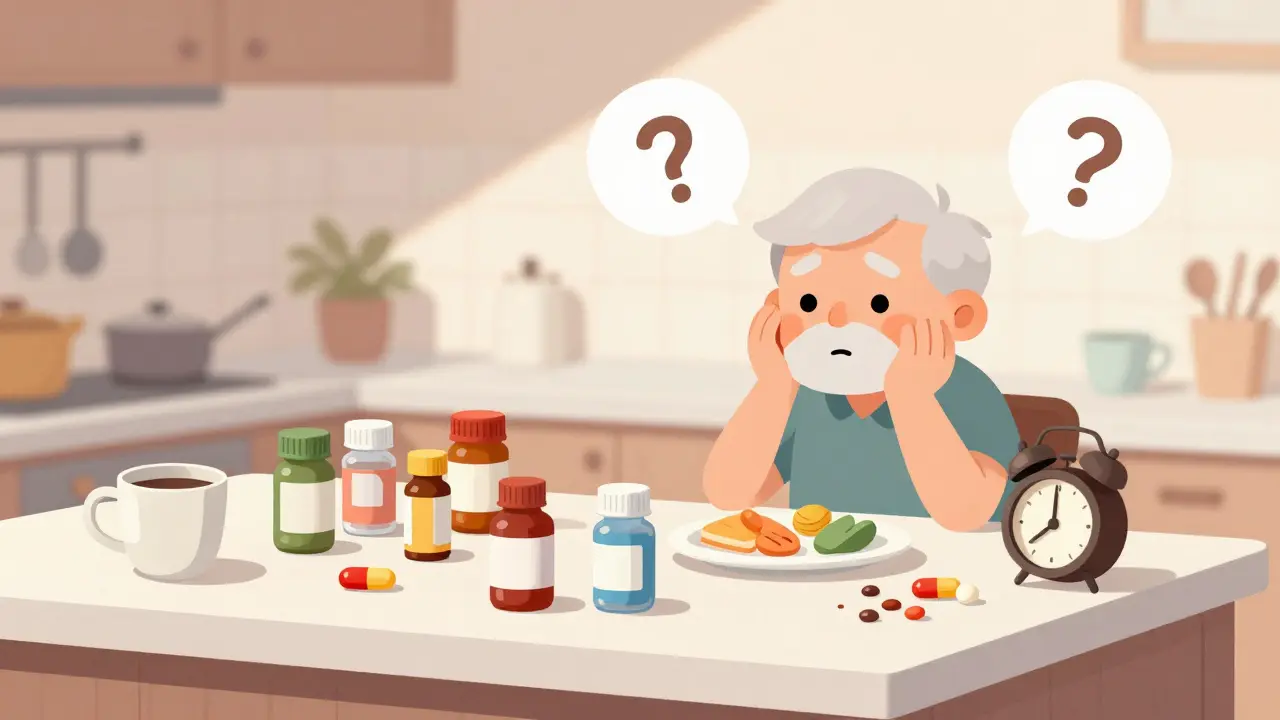
Imagine taking 12 pills a day-morning, noon, afternoon, evening, bedtime-each with different instructions. Some need food, some don’t. Some you have to space out by two hours. You forget one. Then another. Soon, you’re guessing what you took and when. This isn’t rare. It’s everyday life for millions of older adults and people managing chronic conditions. The good news? You don’t have to live like this. Simplifying your medication regimen by reducing daily doses isn’t just convenient-it’s proven to save lives.
Why Fewer Doses Mean Better Adherence
It’s simple math: the more times you have to remember to take a pill, the more likely you are to miss one. Studies show that people taking four or fewer doses a day are twice as likely to stick to their plan compared to those taking seven or more. In fact, nearly 30% of patients take medications seven or more times daily, while only 15% organize them into four or fewer time slots. That gap is where things fall apart.
When doses are reduced, adherence improves-not because people suddenly become more disciplined, but because the system works with their lives, not against them. A 2020 study found that 41% of medication regimens in community-dwelling older adults could be safely simplified. That’s almost half of all patients who could be taking fewer pills, fewer times, with the same or better results.
How to Actually Simplify Your Regimen
Simplification isn’t just about taking fewer pills. It’s about smart, safe changes that match your body’s needs and your daily routine. Here’s how it’s done in real life:
- Fixed-dose combinations (FDCs): Two or more medications merged into one pill. For example, a single tablet might combine blood pressure meds that were previously separate. About one-third of all simplifications use this method. It cuts pill count without changing effectiveness.
- Once-daily dosing: Switching from twice or three times a day to just once. This works best with extended-release formulations. For people on HIV treatment, switching to once-daily antiretrovirals dropped missed doses from 12% to 4% monthly. But not all drugs can do this-some have short half-lives and need multiple doses to stay effective.
- Medication synchronization: Getting all your prescriptions due on the same day each month. Instead of running to the pharmacy every week for different meds, you pick them all up at once. This cuts pharmacy visits by 60% and prevents gaps in treatment.
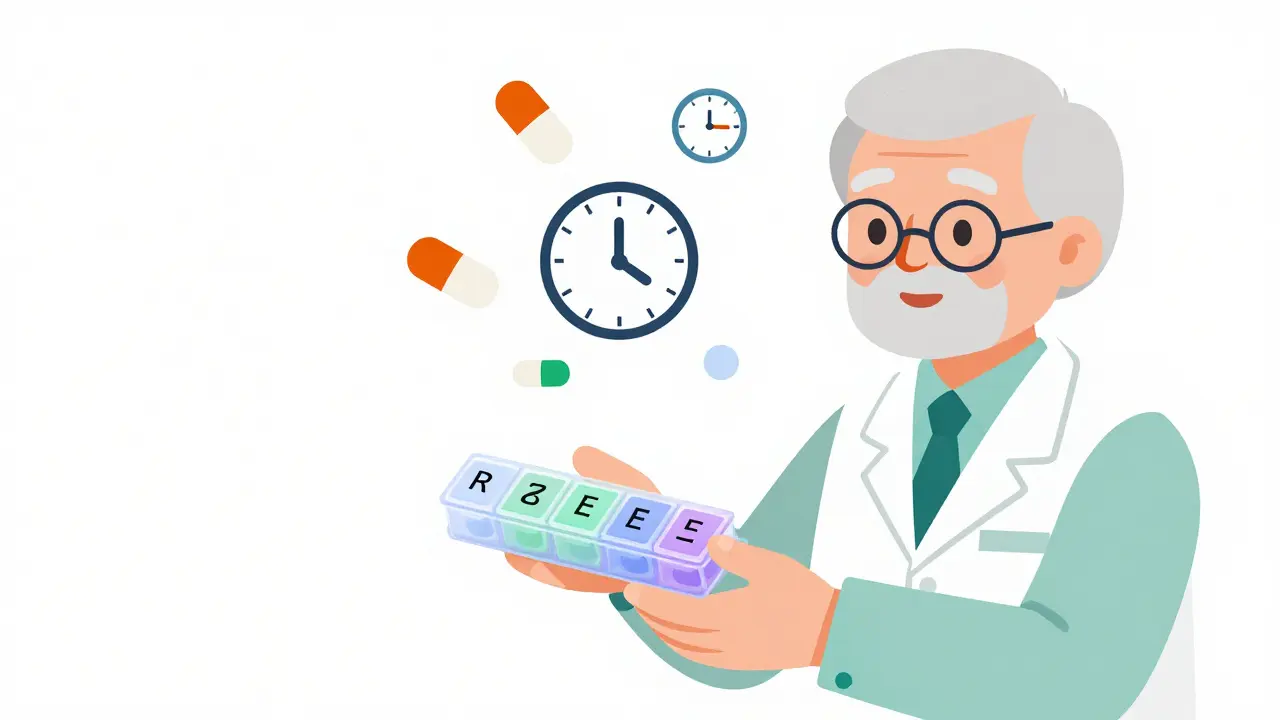
- Multi-dose compliance packaging: Your meds are pre-sorted into daily or weekly compartments labeled AM, PM, bedtime. No more sorting through 10 bottles. Studies show this improves adherence by 22% in older adults.
The Universal Medication Schedule helps too. It standardizes timing to just four slots: morning, noon, evening, bedtime. If you can fit all your meds into those four windows, you’re already simplifying.
What Works Best-and What Doesn’t
Not all medications respond the same way to simplification. Some are perfect candidates. Others aren’t.
Fixed-dose combinations work brilliantly for HIV, heart disease, and some mental health conditions. Once-daily dosing shines in hypertension and diabetes when the right extended-release versions are available. Medication synchronization is a game-changer for people on multiple chronic meds, especially if they rely on Medicare or Medicaid.
But here’s the catch: it doesn’t always work for oral diabetes meds or certain blood pressure drugs. In six comparative studies, simplifying these regimens showed no real improvement in adherence. Why? Because the timing, food interactions, or drug half-life just don’t allow it. You can’t force a pill to last longer than it can.
And cost matters. Multi-dose packaging can cost 15-20% more than standard bottles. Insurance doesn’t always cover it. Some patients get stuck with the simpler plan on paper but can’t afford the packaging. That’s why real-world success depends on access, not just theory.
Who Should Lead the Change?
You can’t do this alone. Simplification requires a team.
Pharmacists are your best ally. They’re trained to spot redundant meds, check for interactions, and find alternatives. A 2020 study found that when pharmacists, doctors, and caregivers all worked together, 50% of simplification plans were actually implemented. When only the pharmacist recommended changes, only 12% stuck.
Doctors need to sign off. But they often don’t know what’s in your pillbox. That’s why medication reconciliation is critical. It’s the process of comparing what your doctor thinks you’re taking with what you’re actually taking. On average, people have six discrepancies between their list and reality. That’s not a mistake-it’s a hazard.
And caregivers? They’re the unsung heroes. One woman on AgingCare.com said switching her mother to a four-compartment organizer cut her confusion in half. “I stopped worrying she was overdosing,” she wrote. “Now I just hand her the box.”
The Hidden Barriers
Even with perfect plans, things go wrong.
Insurance denials are common. A 2020 Medicare study found 45% of patients were denied access to once-daily formulations because the insurer didn’t cover the newer, combined version. Patients end up stuck with the old, harder-to-take regimen.
Then there’s misunderstanding. A survey of 200 pharmacists found 68% said patients often mix up simplified regimens-like taking two pills that shouldn’t be together because they look similar. One man thought his “morning pill” was his blood pressure med, but it was actually a cholesterol drug. He took it at night. His levels went haywire.
And let’s not forget culture and routine. Some people take meds with coffee. Others with dinner. Some work night shifts. A one-size-fits-all schedule fails if it ignores real life. The FDA warns that many simplification efforts collapse because they don’t consider these personal rhythms.

What You Can Do Right Now
You don’t need a PhD to start simplifying. Here’s your action plan:
- Write down every medication-including over-the-counter pills, vitamins, and supplements. Don’t guess. Check the bottles.
- Count how many times a day you take something. Are you hitting seven or more? That’s your red flag.
- Call your pharmacist. Ask: “Can any of these be combined? Can any be switched to once-daily?”
- Ask about synchronization. Can all my refills be on the same day?
- Request compliance packaging if you’re struggling to keep track. Many pharmacies offer it for free or low cost with insurance.
- Bring your list to your doctor. Say: “I want to reduce my pill burden. Can we review this together?”
Don’t wait for your annual checkup. Start now. Even one fewer daily dose can mean fewer missed pills, fewer hospital visits, and more peace of mind.
What’s Next for Medication Simplification
The future is getting smarter. AI tools now scan your meds and suggest optimal combinations based on half-life, food interactions, and kidney function. The FDA approved 12 new fixed-dose combos in 2022 alone-a 25% jump from 2020.
Smart pillboxes are starting to appear. Some connect to apps, send alerts, and even notify your care team if you skip a dose. Medicare Advantage plans are testing these in pilot programs.
But the biggest shift? Payment models. Value-based care now ties reimbursement to how well patients take their meds. That means hospitals and pharmacies have a financial reason to help you simplify. It’s no longer just a nice idea-it’s becoming standard practice.
The goal isn’t fewer pills for the sake of it. It’s fewer barriers to staying healthy. And that’s something everyone deserves.
Can I just combine my pills myself?
No. Never crush, split, or mix pills without professional guidance. Some medications are designed to release slowly over time. Breaking them can cause dangerous spikes in drug levels. Others can’t be mixed due to chemical reactions. Always talk to your pharmacist or doctor before making any changes.
Will simplifying my meds lower their effectiveness?
Not if done correctly. Studies show that when simplification follows clinical guidelines-like using extended-release versions or fixed-dose combos-effectiveness stays the same or improves. The key is professional oversight. A 2020 NIH study found no drop in treatment success when regimens were properly simplified.
Does insurance cover simplified medications?
Sometimes. Fixed-dose combinations and extended-release versions are often covered, but insurers may require prior authorization. Multi-dose packaging may be covered under Medicare Part D or Medicaid, but not always. Ask your pharmacist to check your plan’s formulary before switching.
How long does it take to simplify a regimen?
It varies. A pharmacist can identify opportunities in 15-20 minutes during a medication review. But actual changes-like switching prescriptions, getting new packaging, or waiting for insurance approval-can take days to weeks. Be patient. The goal is safety, not speed.
What if my doctor says no to simplification?
Ask why. Sometimes it’s a misunderstanding. Bring your own research or ask for a second opinion from a pharmacist. Many doctors aren’t trained in medication complexity. A pharmacist with Medication Therapy Management certification can often help negotiate safer, simpler options-even if your doctor is hesitant.
8 Comments

Sophia Daniels
December 27, 2025 AT 09:34 AM
Oh sweet merciful god, I’ve seen people crush time-release meds because they ‘can’t swallow big pills.’ I’m not even mad-I’m just disappointed. You’re not a superhero, Karen. You’re not a chemist. Stop playing doctor with your heart medication. If it’s time-release, leave it the hell alone. Your kidneys will thank you. Or at least not sue you.

Fabio Raphael
December 29, 2025 AT 05:46 AM
I love how this post breaks it down without jargon. My uncle’s on 9 meds, and his doctor never asked him how he actually takes them. Turns out he’s mixing his blood pressure pill with his coffee because ‘it helps it go down.’ Problem? Coffee kills the absorption. He’s been taking it wrong for two years. Just… talk to your patients. Seriously.

Sumler Luu
December 29, 2025 AT 18:22 PM
My mom’s on a fixed-dose combo for hypertension and diabetes now-two pills instead of seven. She cries every time she opens her new pill organizer. Not from sadness. From relief. She said, ‘I finally feel like I’m not a walking pharmacy.’ That’s the real win here-not fewer pills, but fewer burdens.

Sandeep Jain
December 30, 2025 AT 00:15 AM
my pharmacist did this for me last month and i was skeptical but like… i used to forget half my stuff. now i just grab my weekly box and go. no more scrolling through 10 bottles at 2am wondering if i took my blood sugar pill. i even started sleeping better. thanks, pharmacy.

Steven Destiny
December 31, 2025 AT 01:58 AM
Insurance denies the good stuff every time. I got denied for a once-daily combo because ‘the generic is cheaper.’ But the generic is three pills. Three. I can’t keep track of three. My life isn’t a spreadsheet. I’m not a robot. Stop punishing people for wanting to live without chaos.

Nikki Brown
January 1, 2026 AT 00:28 AM
It’s not rocket science. People take too many pills because no one bothered to simplify it for them. It’s lazy medicine. And if you’re still giving people 12 separate prescriptions in 2024, you’re not a doctor-you’re a logistical disaster. Stop pretending you’re helping. You’re just making people feel like failures when they forget a pill they were never meant to manage.

sakshi nagpal
January 2, 2026 AT 12:27 PM
In India, many elderly patients take medications from multiple doctors without coordination. I’ve seen patients with 15+ daily doses from three different specialists. The system doesn’t support integration. But when pharmacists step in-especially those trained in MTM-they become the glue. We need more of them. Not just in the US, but everywhere. Medication safety is a human right, not a privilege.





Becky Baker
December 25, 2025 AT 21:06 PM
I swear, my grandma took 17 pills a day and thought it was normal until I forced her to see a pharmacist. Now she uses one of those fancy pill boxes and actually remembers to take them. No more guessing. No more panic. Just one box, four times a day. Life changed.