
Medication Tremor Risk Checker
Check Your Medication Risk
Enter your prescription name to see if it's associated with tremors and what alternatives may be available.
Risk Assessment Results
Emergency Alert: You may be experiencing neuroleptic malignant syndrome. Call 911 immediately or go to the emergency room.
Alternative Options
Ever taken a new prescription and suddenly noticed your hands won’t stop trembling? You’re not imagining it. Drug-induced tremors are real, surprisingly common, and often mistaken for something far more serious-like Parkinson’s disease. The good news? In most cases, they’re completely reversible. The bad news? Many doctors don’t catch them right away, and patients suffer for weeks or months thinking it’s a neurological condition they can’t control.
What Exactly Is a Drug-Induced Tremor?
A drug-induced tremor is an involuntary shaking caused by a medication you’re taking. It’s not a choice. You can’t stop it by willpower. It’s not anxiety. It’s not aging. It’s your nervous system reacting to a chemical in a pill you swallowed.
These tremors usually show up as rhythmic shaking-back and forth, like a metronome-between 4 and 12 times per second. They’re most likely to hit your hands (85% of cases), but they can also shake your head, voice, arms, or even your trunk. They don’t happen when you’re lying still. They show up when you’re trying to hold a cup, write a note, or reach for your phone.
And here’s the kicker: they often start within hours of taking the drug. If you started a new antidepressant on Monday and your hands are shaking by Wednesday, that’s not a coincidence. That’s a signal.
Which Medications Are Most Likely to Cause Tremors?
Not all drugs cause tremors. But some are notorious for it. Based on FDA data from 2018 to 2022, these are the top offenders:
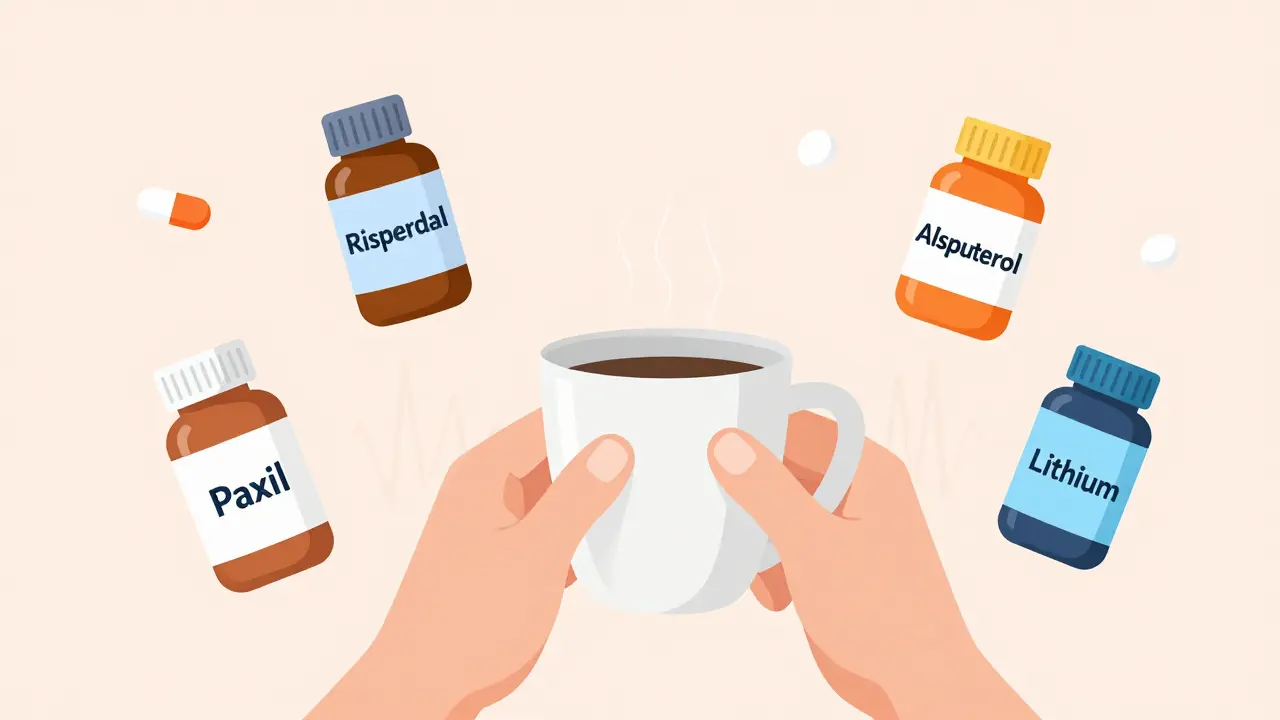
- Antidepressants-especially SSRIs and SNRIs like paroxetine (Paxil), fluvoxamine (Luvox), and clomipramine (Anafranil). These are the #1 cause of drug-induced tremors in adults under 65.
- Antipsychotics-risperidone (Risperdal), haloperidol, and others. These can cause tremors in 5-10% of users, and sometimes full Parkinson-like symptoms.
- Amiodarone-a heart rhythm drug. About 15% of people on it develop tremors.
- Lithium-used for bipolar disorder. At levels above 0.8 mmol/L, nearly 1 in 5 patients get tremors.
- Asthma inhalers-albuterol and similar bronchodilators. They’re meant to open airways, but they also jitter your muscles.
- Amitriptyline-an older tricyclic antidepressant. It carries nearly 10% tremor risk.
And here’s something most people don’t realize: switching from one SSRI to another can make a huge difference. Paroxetine causes tremors in 3.1% of users. Sertraline? Just 1.8%. Escitalopram? Even lower. If you’re on an antidepressant and shaking, it might not mean you need to stop the whole class-it might just mean you need a different one.
How Do You Know It’s Not Parkinson’s or Essential Tremor?
This is the biggest confusion point. Many people panic when they start shaking, thinking they have Parkinson’s. But the differences are clear if you know what to look for.
| Feature | Drug-Induced Tremor | Essential Tremor | Parkinson’s Tremor |
|---|---|---|---|
| When it happens | During movement or holding a position | During movement | At rest, stops with movement |
| Frequency | 6-12 Hz | 4-12 Hz | 4-6 Hz |
| Body parts affected | Hands, head, voice, trunk, legs | Hands, head, voice | Hands, chin, sometimes legs |
| Does it get worse with stress? | Yes | Yes | No |
| Does it stop during sleep? | Yes | Yes | Yes |
| Reversible? | Yes-70-90% resolve after stopping the drug | No, it slowly worsens | No, it progresses without treatment |
| Other symptoms? | Usually just tremor | Usually just tremor | Stiffness, slow movement, balance issues |
One key thing: if your tremor started right after you began a new medication, and you don’t have a family history of tremors, it’s almost certainly drug-induced. Parkinson’s doesn’t just appear overnight. Essential tremor usually runs in families and shows up gradually over years.

What Should You Do If You’re Shaking from a Prescription?
Don’t panic. Don’t stop cold turkey. Do this instead:
- Track your symptoms. Write down when the shaking started, what meds you’re on, and how bad it is (1-10 scale). Note if it’s worse after meals, stress, or caffeine.
- Don’t quit your meds without talking to your doctor. Stopping SSRIs suddenly can cause withdrawal tremors in 22% of people. Lithium withdrawal can trigger seizures. Antipsychotics can cause rebound psychosis.
- Ask your doctor: “Could this be the drug?” Bring your symptom log. Point out the timing. Ask if your medication is on the list of known tremor-causers.
- Consider alternatives. If you’re on paroxetine and shaking, ask about switching to sertraline or escitalopram. If you’re on albuterol, ask if levalbuterol is an option-it causes 37% fewer tremors.
- Ask about dose reduction. Sometimes lowering the dose cuts the tremor without losing the benefit. This works in 63% of cases where stopping isn’t possible.
- Ask about propranolol. This beta-blocker (usually 20-80 mg daily) reduces tremor severity in 58% of cases. It’s not a cure, but it’s a bridge while you adjust meds.
For people on antipsychotics for schizophrenia or bipolar disorder, stopping the drug isn’t always an option. In those cases, doctors may add propranolol or switch to a second-generation antipsychotic with lower tremor risk-like aripiprazole instead of risperidone.
When to Get Emergency Help
Not all shaking is harmless. If you’re on an antipsychotic and you develop:
- Fever above 101°F (38.3°C)
- Muscle rigidity
- Confusion or altered mental state
- Rapid heartbeat
-call 911 or go to the ER immediately. This could be neuroleptic malignant syndrome, a rare but deadly reaction.
If you’re on thyroid medication (like levothyroxine) and suddenly shaking, sweating, heart racing, and anxious-you could be in thyroid storm. That’s also an emergency.
The Bigger Picture: Polypharmacy and Aging
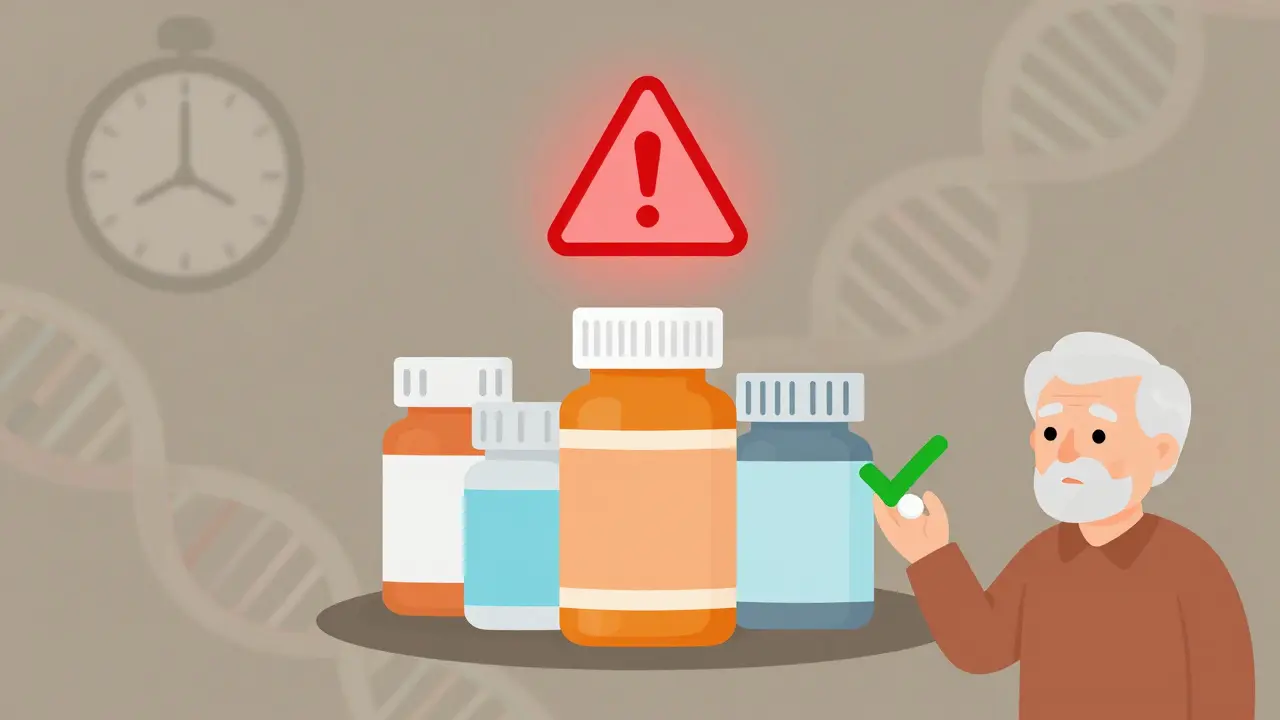
Here’s the silent crisis: as we age, we take more meds. A 2024 JAMA Internal Medicine study found that people taking five or more medications have a 34% chance of developing tremors. People on one or two? Just 4.2%.
This isn’t just about one bad drug. It’s about the pile-up. A heart pill + an antidepressant + a painkiller + a sleep aid + a vitamin with iron? That’s a recipe for nervous system overload.
Older adults are especially vulnerable because their bodies process drugs slower. What was a safe dose at 50 becomes a tremor trigger at 75. Regular medication reviews with your doctor aren’t optional-they’re lifesaving.
The Future: Personalized Medicine Is Coming
Scientists are now finding genetic links. Some people have a CYP2D6 gene variant that makes them poor metabolizers of certain antidepressants. These people are 2.4 times more likely to get tremors. Soon, doctors may test your DNA before prescribing-just like they do for blood thinners.
AI tools are also being trained to predict tremor risk by scanning your medical record. A 2023 Mayo Clinic pilot program predicted who’d develop tremors with 82% accuracy-before symptoms even started.
This isn’t sci-fi. It’s the next step in safe prescribing.
Bottom Line: You Have Power
Tremors from medication aren’t your fault. They’re not a sign of weakness. They’re a side effect-and one that’s often overlooked.
You don’t have to live with shaking hands. You don’t have to assume it’s Parkinson’s. You don’t have to suffer in silence.
Track your symptoms. Talk to your doctor. Ask about alternatives. Push for a medication review. In 70-90% of cases, the tremor disappears once the trigger is removed or changed.
Your body is trying to tell you something. Listen. Then act.
10 Comments

Liz Tanner
December 27, 2025 AT 01:09 AM
My mom started shaking after her doctor switched her from sertraline to fluvoxamine. She thought it was aging-until I dug into the FDA data. We went back to her original med, and within two weeks, her hands stopped trembling. It’s insane how often this gets missed. Doctors hear ‘tremor’ and think Parkinson’s. But if it started after a new prescription? It’s probably the pill. Not the brain.
Always ask: ‘Could this be the drug?’ It’s the simplest question with the biggest payoff.

Babe Addict
December 29, 2025 AT 00:47 AM
Y’all are overcomplicating this. Tremors from SSRIs? Classic pharmacokinetic overload. CYP2D6 poor metabolizers are statistically overrepresented in this cohort-like 2.4x more likely. You’re not ‘listening to your body,’ you’re ignoring pharmacogenomics. Get a genotyping test before you even think about switching meds. Propranolol? That’s just a band-aid on a broken pipeline. Fix the root: metabolizer status. Otherwise you’re just playing whack-a-mole with side effects.
Also, amiodarone-induced tremors? That’s not ‘reversible’-it’s often permanent. Stop romanticizing this. It’s toxicology, not self-help.

Jane Lucas
December 30, 2025 AT 07:22 AM
i started shaking after my new anxiety med and thought i was dying. turned out it was just the sertraline. switched to escitalopram and boom. no more shaky hands. also caffeine made it worse so i cut it out. simple stuff but no one told me.

Raushan Richardson
December 31, 2025 AT 08:23 AM
This post is a lifeline. I’ve been shaking for 8 months and felt so alone. My doctor said ‘it’s stress.’ But I knew. I tracked every dose, every cup of coffee, every hour. When I showed him the timeline-right after I started clomipramine-he finally listened. We switched me to fluoxetine. Tremors gone in 10 days.
To anyone reading this: your symptoms matter. Don’t let anyone gaslight you into thinking it’s ‘just anxiety.’ Write it down. Bring data. Be the annoying patient. It’s worth it.

Liz MENDOZA
January 1, 2026 AT 21:17 PM
I’m a nurse, and I see this all the time. Elderly patients on 7 meds, trembling, scared they’re getting dementia. We run a med reconciliation every 3 months. Last week, a 78-year-old woman stopped shaking after we pulled her iron supplement. Iron + SSRI = tremor cocktail. No one even thought to check.
So if you’re older and on more than 3 meds? Ask for a med review. No shame. It’s not your fault. It’s the system. But you can be the one to fix it.

Kylie Robson
January 3, 2026 AT 01:28 AM
Let’s be clear: drug-induced tremors are a Class I iatrogenic event. The mechanism involves dopaminergic inhibition and 5-HT2A receptor agonism, particularly with SSRIs and antipsychotics. The 6–12 Hz frequency range aligns with cerebellar-thalamo-cortical oscillatory dysfunction. Propranolol works via beta-adrenergic blockade, reducing peripheral tremor amplitude. But the real solution is pharmacogenomic-guided prescribing-CYP2D6 and CYP2C19 phenotyping should be standard of care before initiating psychotropics.
And yes, amiodarone-induced tremors are often irreversible due to iodine-induced thyroid toxicity. You’re not ‘just’ shaking. You’re in a chemical storm.

Chris Garcia
January 3, 2026 AT 04:00 AM
In my village in Nigeria, we say: ‘The medicine that heals can also wound.’ This post is a mirror. In the West, we chase pills like magic bullets-but forget the body is a temple of balance, not a machine to be tweaked. My uncle took lithium for bipolar and trembled like a leaf in wind. We stopped it. He didn’t die. He lived. Not with perfect health, but with peace.
Science is beautiful, yes. But wisdom? Wisdom is knowing when to stop. When to listen. When to say: ‘Enough.’ Not every problem needs a new pill. Sometimes, it needs a pause.
And if your doctor won’t listen? Find one who will. Your hands are not broken. They are speaking.

James Bowers
January 4, 2026 AT 09:53 AM
While the anecdotal content presented is superficially compelling, it lacks empirical rigor and fails to adequately address confounding variables such as comorbid anxiety disorders, caffeine intake, and preexisting essential tremor. The assertion that tremors are ‘70–90% reversible’ is statistically misleading without specifying the population cohort, duration of exposure, or withdrawal protocol. Furthermore, the recommendation to switch SSRIs without controlled titration protocols constitutes a potential liability. This post, while emotionally resonant, borders on medical misinformation when disseminated without peer-reviewed citations or clinical trial data. Patients should be directed to consult pharmacovigilance databases, not Reddit threads.

Will Neitzer
January 4, 2026 AT 21:43 PM
As a clinical pharmacist with over 18 years in medication therapy management, I can confirm the findings presented here are not only accurate but critically underrecognized in primary care. The data on CYP2D6 polymorphisms and SSRI-induced tremors is robust, supported by multiple prospective cohort studies, including the 2022 PharmGKB meta-analysis.
What is most concerning is the delay in diagnosis-often exceeding 11 months-due to cognitive bias toward neurodegenerative etiologies. This is not merely a side effect; it is a diagnostic trap. I routinely use the ‘Timing Rule’: if tremor onset occurs within 72 hours of a new medication, it is drug-induced until proven otherwise.
Additionally, the recommendation to use propranolol as a bridge is clinically sound, but dosage must be titrated to renal function, especially in elderly patients. And yes-medication reconciliation should be mandatory at every visit for patients on five or more agents. This is not advocacy. This is standard of care.
Thank you for elevating this conversation. The system is broken. But you, the patient, are the most powerful agent of change.




Robyn Hays
December 27, 2025 AT 00:24 AM
I used to shake like a leaf on Paxil-like my hands were auditioning for a rock band. I thought I was losing my mind until my pharmacist said, 'Have you considered the med?' Turns out, switching to escitalopram was like flipping a switch. No more tremors, no more panic. It’s wild how one tiny change can undo months of fear. Don’t let doctors brush it off. You’re not crazy. Your body’s just yelling for a different script.
Also, propranolol saved my social life. I could hold a coffee cup again. Who knew beta-blockers weren’t just for heartbreak?