

When someone hears metabolic surgery, they often think of weight loss. But the real story is deeper. For many people with type 2 diabetes, this surgery doesn’t just help them lose pounds-it can turn off their diabetes. Not temporarily. Not partially. For years, sometimes permanently.
How Much Weight Do People Actually Lose?
The numbers don’t lie. People who undergo metabolic surgery lose, on average, 27.7% of their starting body weight. That’s not a guess. It’s from a 2012 JAMA study comparing surgery to medical therapy alone-where the control group lost just 0.2%. That’s the difference between a life-changing shift and barely moving the needle. Six years later, those who had gastric bypass lost nearly 20% of their body weight. Compare that to the medical group, who lost less than 9%. Even more telling: patients with severe obesity (BMI over 45) saw their excess weight drop by 55% on average after surgery. That’s not just losing a few dress sizes-it’s shedding the physical burden that makes walking, sleeping, and breathing harder every day. Not all surgeries are the same. Gastric bypass and sleeve gastrectomy are the most common today. Biliopancreatic diversion with duodenal switch leads in weight loss, but it’s more complex and carries higher risks. For most people, gastric bypass offers the best balance of results and safety.Diabetes Remission: It’s Not Just About Losing Weight
Here’s where things get surprising. Many patients see their blood sugar drop to normal levels within days of surgery-long before they’ve lost much weight. That’s not coincidence. It’s biology. Dr. Francesco Rubino and others have shown that changing the gut’s anatomy triggers a cascade of hormonal signals. Hormones like GLP-1 and PYY, which regulate insulin and appetite, spike almost immediately after surgery. This resets how the body handles sugar, independent of how much weight is lost. The data backs this up. One year after gastric bypass, 42% of patients with type 2 diabetes no longer needed medication. Three years later, it was still 38%. Five years? 29%. That’s not a fluke. It’s durability. Sleeve gastrectomy follows close behind: 37% remission at one year, 23% at five. Even more striking? In patients with lower BMIs (24-30), gastric bypass led to 93% remission at one year. This isn’t just for people with extreme obesity. It’s for anyone with type 2 diabetes who hasn’t responded to diet, pills, or insulin.What Happens After Five Years?
No surgery is a magic fix. The biggest question isn’t “Does it work?”-it’s “How long does it last?” The Swedish Obese Subjects (SOS) study followed patients for 15 years. At the two-year mark, 72% were in diabetes remission. By year 10, that dropped to 36%. At 15 years, 30.4% still had no diabetes meds and normal blood sugar. That’s still far better than the 6.5% of non-surgical patients who reached the same point. Why does remission fade for some? Weight regain. Loss of insulin-producing beta cells over time. And the simple truth: your body doesn’t stay in “surgery mode” forever. That’s why long-term follow-up isn’t optional-it’s essential. Even when full remission fades, most patients still do better. They need fewer drugs. Their A1C stays lower. Their risk of kidney damage, nerve pain, and vision loss drops by 19% for every year they’re in remission. That’s not just feeling better-it’s living longer.
Who Benefits the Most?
Not everyone responds the same. Certain factors make success far more likely.- Insulin use before surgery: If you’re still taking insulin, your chances of remission drop. Patients not on insulin had a 53.8% remission rate 14 months after surgery. Insulin users? Much lower.
- BMI under 35: Even people with mild obesity (BMI 30-34.9) can achieve 36% complete remission after surgery-compared to just 1.2% with medication alone.
- Shorter diabetes duration: If you’ve had type 2 for less than 5 years, your pancreas still has more insulin-producing cells left. Surgery gives them a fighting chance.
- Younger age: Younger patients tend to have better metabolic recovery and fewer complications.
The Hidden Costs: Risks and Lifelong Care
Metabolic surgery isn’t risk-free. It’s major surgery. You’ll need to take vitamins for life. Iron, B12, calcium, and vitamin D levels must be checked regularly. Anemia, bone fractures, and gastrointestinal issues are more common after surgery than in non-surgical patients. The ARMMS-T2D trial found that surgical patients had higher rates of these problems over 12 years. But here’s the key: these risks are manageable. With proper follow-up care-regular blood tests, nutritionists, and doctors who know what to look for-most patients avoid serious complications. Another hidden cost? Time. Recovery takes weeks. You’ll need to adjust your eating habits forever. No more large meals. No sugary drinks. No mindless snacking. It’s not a quick fix. It’s a lifestyle reset.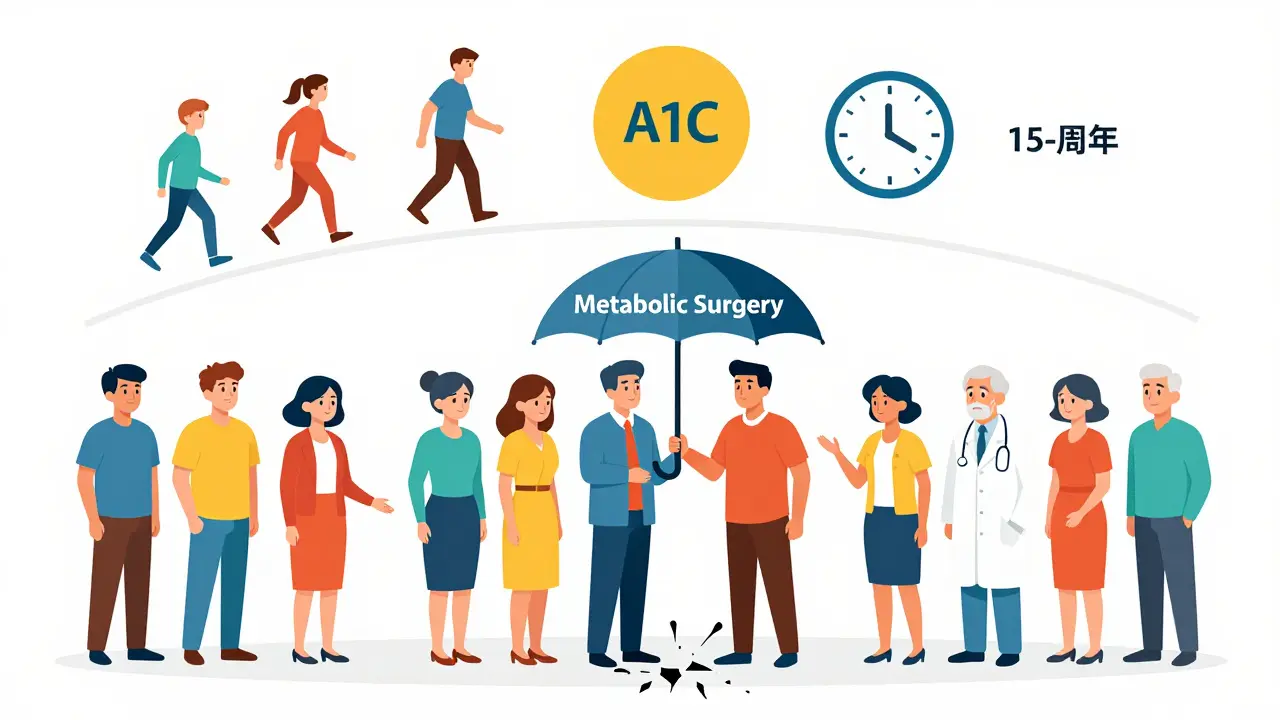
Why Isn’t Everyone Getting It?
You’d think, with this level of evidence, everyone with type 2 diabetes and obesity would be lining up for surgery. But only 1-2% of eligible people in the U.S. get it each year. Why? Three big reasons:- Insurance won’t cover it. Many insurers still only approve surgery for BMIs above 35-even though guidelines say 30+ is enough if diabetes is uncontrolled.
- Doctors don’t offer it. Many primary care providers don’t know the latest data. They still think surgery is only for “morbidly obese” patients.
- Patients are scared. The word “surgery” triggers fear. People worry about complications, or think it’s a “cop-out.” They don’t realize that living with uncontrolled diabetes is far riskier.
What’s Next?
New procedures are emerging. Endoscopic sleeves, gastric balloons, and aspiration devices offer less invasive options. They’re not as powerful as bypass or sleeve, but they’re a bridge for people not ready for major surgery. The RESET trial is testing surgery in people with BMI 27-35. Early results suggest even leaner patients can benefit. This could change who qualifies for surgery-and who gets to live without diabetes meds. Meanwhile, the DiRECT trial showed that very low-calorie diets can reverse diabetes in 46% of patients at one year. That’s impressive. But after two years, most of those patients regained weight-and their diabetes came back. Surgery, by contrast, keeps the weight off longer and keeps the remission going.Final Thought: It’s Not a Cure. It’s a Tool.
Metabolic surgery isn’t a cure for diabetes. It’s a powerful tool. One that can give people back control-over their blood sugar, their meds, their energy, their future. It works best when paired with lifelong care: nutrition, movement, mental health support, and regular checkups. It’s not a one-time fix. It’s a new beginning. For someone tired of checking blood sugar, counting carbs, and wondering if their next pill will work-this might be the answer they’ve been waiting for. Not because it’s easy. But because it works.14 Comments

Shanna Sung
January 5, 2026 AT 19:40 PM
They’re lying about the remission rates. Big Pharma and the surgical industry are pushing this because they make billions off lifelong vitamin prescriptions. You think they want you healthy? No. They want you dependent. Read the ARMMS-T2D trial again-look at the fine print. They don’t tell you most patients end up with osteoporosis by year 8. This isn’t medicine. It’s a business model.

Justin Lowans
January 7, 2026 AT 10:24 AM
There’s something deeply human about this. It’s not just about glucose levels or BMI charts-it’s about someone being able to play with their kid again without gasping for air. About walking to the mailbox without stopping halfway. About not dreading the next A1C test.
The data is compelling, but the real victory is in the quiet moments-the ones no study can measure.

Brendan F. Cochran
January 8, 2026 AT 00:29 AM
Why the hell are we letting people get this surgery if they’re just gonna eat junk food anyway? I mean, I get it, but come on. You don’t get a free pass because you had your stomach stapled. Now I gotta pay for your vitamins through my insurance? This is socialism for lazy people.

en Max
January 9, 2026 AT 05:48 AM
It is imperative to underscore that the metabolic and endocrine recalibration induced by bariatric intervention is not merely a consequence of caloric restriction or mechanical restriction. Rather, it is a complex neurohormonal cascade, mediated predominantly by enteroendocrine signaling pathways involving GLP-1, PYY, ghrelin suppression, and bile acid flux modulation. The durability of remission correlates strongly with baseline beta-cell functional reserve, as evidenced by C-peptide assays in longitudinal cohorts.

saurabh singh
January 9, 2026 AT 08:48 AM
Bro, in India we got people with BMI 26 doing this and it’s life-changing. My uncle had diabetes for 12 years, took 5 pills a day, and now he’s off everything. He walks 10k steps every morning. No more leg pain. No more fatigue. Surgery isn’t cheating-it’s giving your body a second chance. Stop judging, start helping.

John Ross
January 10, 2026 AT 14:45 PM
Let’s be real-the real bottleneck isn’t the surgery, it’s the system. You’ve got primary care docs who haven’t read a paper since 2015 telling patients, ‘Just lose weight.’ Meanwhile, the endocrinologists are buried under 200 patients and can’t even get a referral approved. Insurance? Don’t get me started. This isn’t a medical issue. It’s a bureaucratic disaster.

Abhishek Mondal
January 11, 2026 AT 09:28 AM
...and yet, the peer-reviewed literature from the NIH, the Cochrane Collaboration, and the Lancet Diabetes & Endocrinology journals-each of which independently corroborates the efficacy of metabolic surgery in non-morbidly obese populations-remains conspicuously absent from the public discourse, which is dominated by anecdotal testimonials and emotionally manipulative narratives propagated by for-profit surgical centers...
...which, incidentally, are often owned by private equity firms with no clinical background whatsoever.

Doreen Pachificus
January 11, 2026 AT 12:13 PM
My dad had the bypass. He’s been off insulin for 7 years. But he still takes his vitamins like clockwork. Every morning. Like a ritual. I asked him why. He said, ‘Because if I don’t, I’ll end up back where I started.’ It’s not a cure. It’s a contract. With yourself.

Enrique González
January 13, 2026 AT 08:25 AM
Just got off the phone with my endo. She said if my A1C doesn’t drop by next month, she’s referring me. I’ve been scared to even think about surgery. But reading this... I feel like I’ve been waiting for this my whole life. Not for the weight. For the freedom.

Chris Cantey
January 14, 2026 AT 19:27 PM
They say it’s not a cure. But what if it’s the closest thing we’ve got? What if the real failure isn’t the surgery? It’s the system that makes people wait until they’re blind, amputated, or on dialysis before they even consider it? We treat diabetes like a moral failing. It’s not. It’s biology. And biology can be rewired.

Ethan Purser
January 16, 2026 AT 10:29 AM
It’s not about the stomach. It’s about the soul. You think people choose this because they’re weak? No. They choose it because they’re tired of being broken. Tired of being told to ‘just eat less’ while their pancreas dies a little more every day. This isn’t a procedure. It’s a resurrection.

Angie Rehe
January 16, 2026 AT 12:04 PM
My sister had the sleeve. Lost 120 lbs. But now she’s got chronic anemia, can’t absorb B12, and her bones are crumbling. She’s on 12 supplements a day. Is this really better than taking metformin? I don’t know. But I do know she cries every time she has to swallow those pills.

Jacob Milano
January 17, 2026 AT 15:31 PM
That’s the thing nobody talks about-the grief. You lose your old relationship with food. And sometimes, you don’t know who you are without it. It’s not just physical. It’s identity. But if you’re lucky? You find a better version of yourself on the other side.
Write a comment
Popular Posts



Jacob Milano
January 3, 2026 AT 22:05 PM
Man, I never realized how much of a game-changer this is. I had a cousin go through gastric bypass last year-she was on insulin for 8 years. Three months later? No meds. No cravings. Just... normal. Like her body forgot it was diabetic. It’s not magic, but it’s close enough.
And the part about GLP-1 spiking right after surgery? That’s wild. It’s not just about stomach size-it’s like your gut gets a firmware update.