
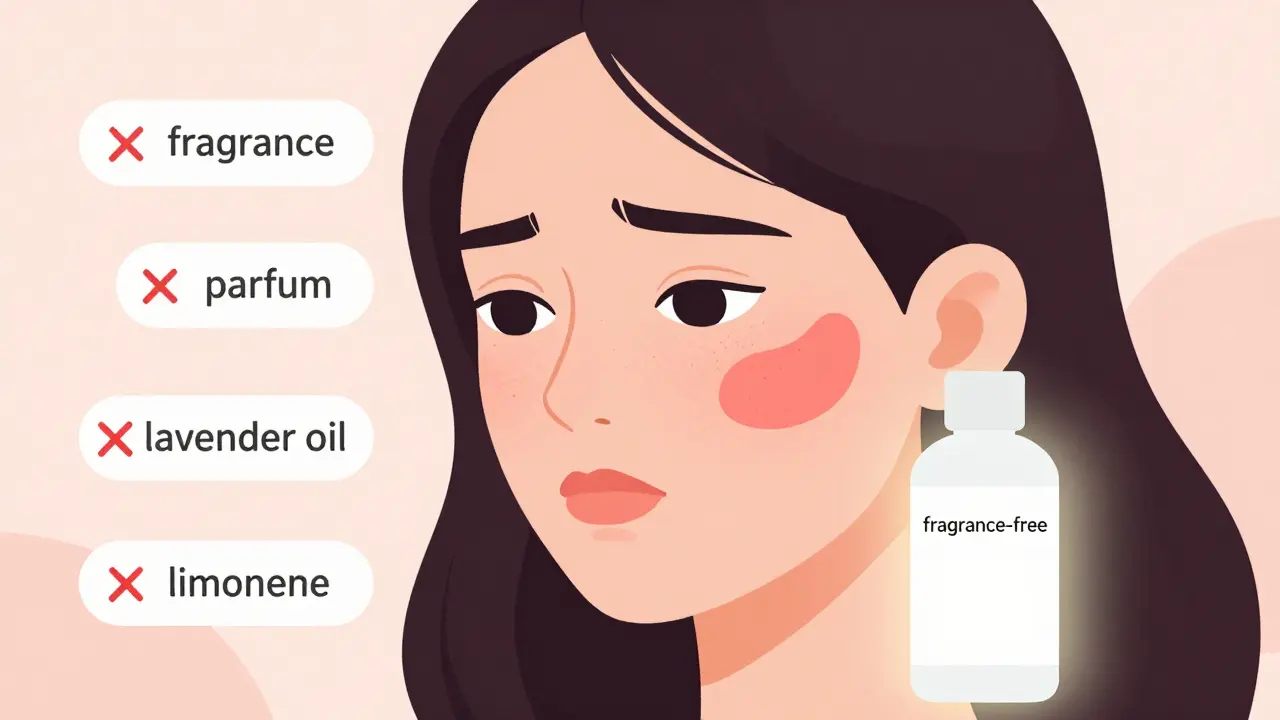
If your skin stings when you wash your face, turns red after using a new lotion, or feels tight even after moisturizing, you’re not alone. Millions of people struggle with sensitive skin, and the biggest culprit isn’t dirt, pollution, or even stress-it’s often something hidden in plain sight: fragrance.
Why Fragrance Is the Hidden Irritant
Fragrance isn’t just about smell. It’s a chemical cocktail, sometimes made of dozens of ingredients, added to make products smell like lavender, coconut, or fresh linen. Even products labeled "natural" or "essential oil-based" can trigger reactions. According to the American Contact Dermatitis Society, fragrance compounds cause 30-45% of all cosmetic-related skin reactions. That’s nearly half of all irritations linked to skincare. What’s worse? The word "fragrance" or "parfum" on an ingredient list doesn’t tell you what’s actually in there. It’s a legal loophole. Companies don’t have to list individual fragrance chemicals, even if they’re known allergens like limonene or linalool. And yes-essential oils like tea tree, lavender, or citrus are still fragrances. They may be natural, but they’re not gentle. Dr. David J. Leffell from Yale School of Medicine found that 22% of sensitive skin patients react to essential oils, even when they avoid synthetic scents.Fragrance-Free vs. Unscented: The Difference That Matters
Not all "no-scent" products are created equal. There’s a big difference between "fragrance-free" and "unscented." - Fragrance-free means no added scent ingredients-period. No essential oils, no masking agents, no synthetic perfumes. This is what your skin needs. - Unscented means the product has a fragrance added to mask an unpleasant odor. It’s still there-you just can’t smell it. This is a common trick used in "natural" brands. A 2023 analysis by Pretty Farm Girl found that 68% of products labeled "natural" still contain hidden fragrance compounds. If your skin reacts, always look for the words "fragrance-free" on the label-and then check the ingredient list. If you see "parfum," "aroma," "essential oil," or "fragrance," put it back.What Your Skin Actually Needs
Sensitive skin isn’t just dry-it’s damaged. The outer layer, called the skin barrier, is thin and leaky. That’s why irritants get in and moisture escapes. To fix it, you don’t need 10 steps. You need three things:- Ceramides (0.5-3% concentration): These are the mortar that holds skin cells together. Without them, your barrier crumbles. CeraVe and Vanicream both use ceramide blends proven to rebuild the barrier.
- Hyaluronic acid (0.5-2%): This pulls water into the skin. It doesn’t moisturize-it hydrates. Use it right after cleansing on damp skin.
- Glycerin (3-10%): A simple, safe humectant that draws moisture in and locks it there. It’s in almost every dermatologist-recommended product for a reason.
Testing New Products: The 72-Hour Rule
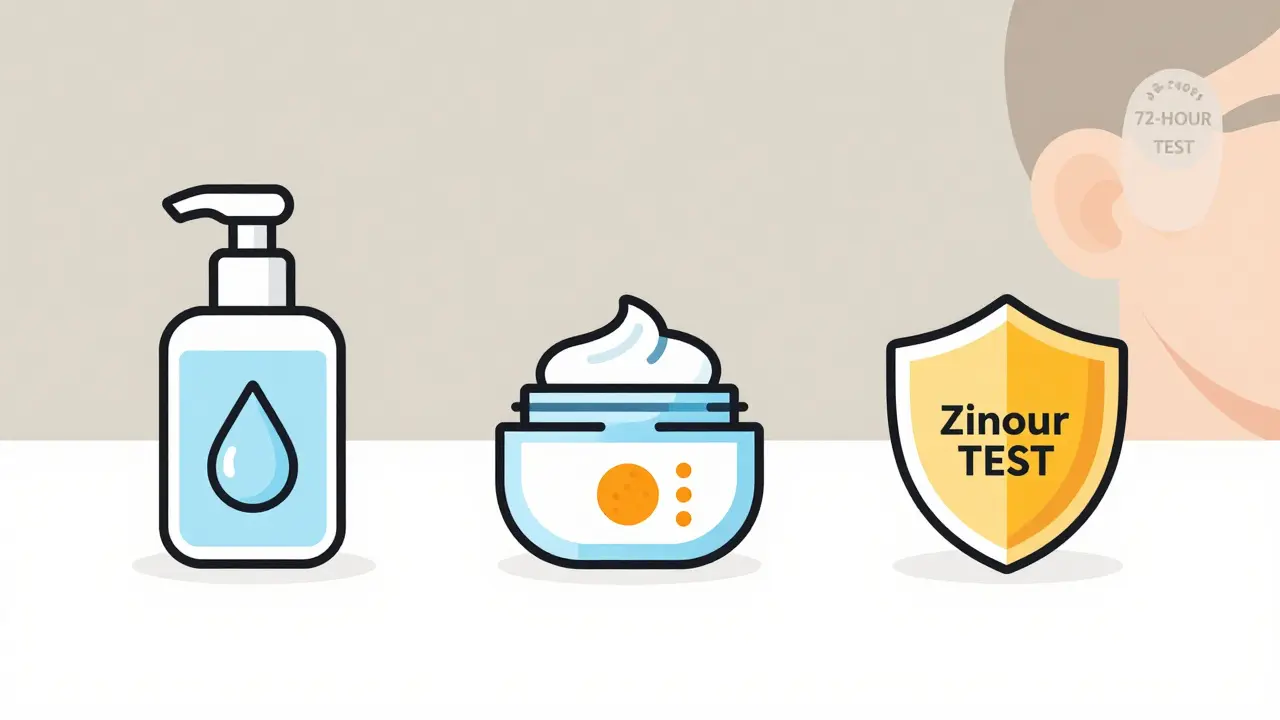
Never apply a new product all over your face right away. Even if it’s labeled "hypoallergenic" or "dermatologist-tested," your skin might still react. Here’s what works:- Apply a pea-sized amount behind your ear.
- Leave it on for 72 hours. Don’t wash it off.
- Watch for redness, itching, burning, or flaking.
The Minimalist Routine That Actually Works
You don’t need serums, toners, exfoliants, or eye creams. Start with this:- Cleanser: Use a fragrance-free, non-foaming cleanser once a day (at night). Morning water is fine for most. Try CeraVe Hydrating Cleanser or SVR SENSIFINE Cleansing Balm. The SVR balm removes makeup and sunscreen without stripping moisture-retaining 82% hydration after 24 hours, compared to 65-70% in regular cleansers.
- Moisturizer: Apply a fragrance-free cream with ceramides and glycerin within 30 seconds of washing. Vanicream Moisturizing Cream scored 42% higher hydration retention than scented moisturizers in Dermstore’s 2023 testing. Apply to damp skin to seal in water.
- Sunscreen: Use a mineral sunscreen with zinc oxide (minimum SPF 30). Chemical sunscreens often contain fragrances and preservatives that irritate. Look for "fragrance-free" and "non-comedogenic" on the label.
What the Experts Say
Dr. Whitney Bowe, a board-certified dermatologist, says fragrance is "the single most common cause of allergic contact dermatitis in skincare." Her clinical data shows it triggers 38% of cases she sees. Dr. Sandy Skotnicki’s 2023 study in the Journal of Cosmetic Dermatology found that removing fragrance from a routine dropped inflammatory markers like IL-6 by 57% in sensitive skin patients. That’s a massive drop in skin inflammation. The American Academy of Dermatology’s 2023 guidelines say: Start with fragrance-free cleanser, moisturizer, and sunscreen. Add one new product every 4-6 weeks. If your skin flares up, stop the last thing you added.Real Results from Real People
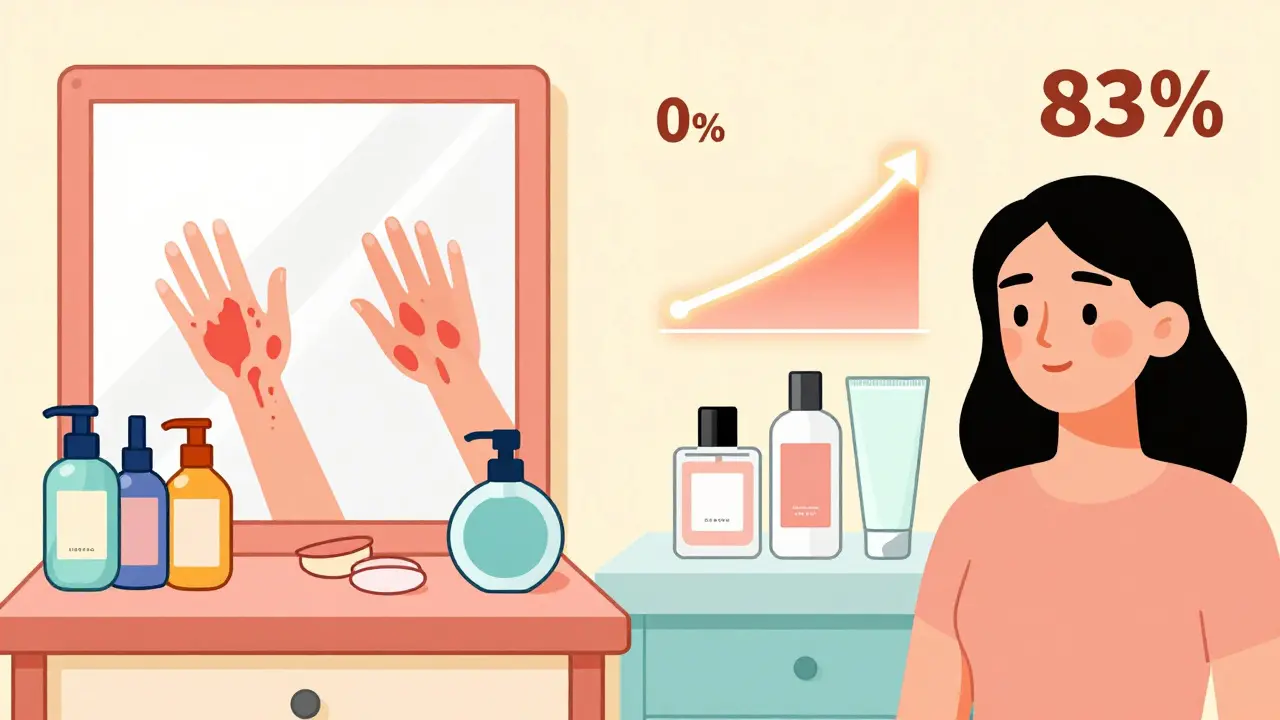
On Reddit’s r/SkincareAddiction, 78% of users with sensitive skin reported major improvements within 4-6 weeks of switching to fragrance-free products. The most common feedback?- 83% saw less redness
- 76% noticed less reactivity to wind, cold, or changes in humidity
- 62% said their skin stopped feeling tight after washing
The Downsides (And How to Deal With Them)
Fragrance-free skincare isn’t perfect. Here’s what you might not like:- No scent: 63% of users in Skincare.com’s survey say it feels "clinical" or "bland." If you miss the smell, try the "wrist perfume method"-apply your favorite scent to your wrist before putting on skincare. You get the aroma without the facial irritation. 68% of users who tried this reported success.
- Higher cost: Fragrance-free products average $28.50, while regular ones are $22.75. But consider this: if you’re spending $100 a month on products that make your skin worse, you’re wasting money. A good fragrance-free routine lasts longer and prevents flare-ups that lead to doctor visits.
- Hard to find: 43% of users say they’ve been misled by "hypoallergenic" claims. Use the National Eczema Association’s product verification app. It lists over 1,200 certified fragrance-free products tested for safety.
What’s Changing in 2026
The fragrance-free market is growing fast. It was worth $3.8 billion in 2023 and is projected to hit $6.1 billion by 2026. Why? More people are learning the truth about fragrance. California is considering the Fragrance Ingredient Transparency Act, which would force companies to list every single fragrance ingredient on labels. If passed, it’ll be the first law of its kind in the U.S. Brands like Cleure and SVR are launching clinical trial kits for dermatologists. Over 1,200 practices now use them to help patients find safe products. And CeraVe’s fragrance-free line now brings in $1.2 billion a year-proving that sensitive skin care isn’t a niche anymore.Final Checklist: Your Fragrance-Free Starter Kit
Before you buy anything, ask:- Does the label say "fragrance-free," not "unscented"?
- Is "parfum," "aroma," or "essential oil" on the ingredient list? If yes, skip it.
- Does it contain ceramides, glycerin, or hyaluronic acid?
- Is the pH between 4.5 and 5.5? (Check the brand’s website if not listed.)
- Have I done a 72-hour patch test behind the ear?
Can I still use essential oils if I have sensitive skin?
No. Essential oils like lavender, tea tree, citrus, and eucalyptus are still fragrances. They contain volatile compounds that can trigger inflammation, redness, and itching in sensitive skin. Studies show 22% of people with sensitive skin react to essential oils-even those labeled "natural" or "pure." Skip them entirely.
Is fragrance-free skincare only for people with eczema?
No. While it’s especially helpful for eczema, rosacea, and psoriasis, over half of people who use fragrance-free products don’t have a formal diagnosis. They just have skin that stings, burns, or reacts easily. If your skin feels uncomfortable after using a product, fragrance-free is the safest place to start.
Why do some fragrance-free products feel greasy or thick?
They’re designed to repair your skin barrier, not just feel nice. Thick creams often contain more ceramides, fatty acids, and emollients that seal in moisture. If texture bothers you, try a lighter lotion like CeraVe PM Facial Moisturizing Lotion-it’s fragrance-free, non-greasy, and still packed with barrier-repairing ingredients.
Can I use makeup with a fragrance-free routine?
Yes, but choose carefully. Look for makeup labeled "fragrance-free" and "non-comedogenic." Mineral foundations with zinc oxide are often the safest. Avoid powder foundations with talc or mica if your skin is reactive. Always remove makeup with a fragrance-free cleanser, never just wipes.
How long does it take to see results?
Most people notice less redness and tightness within 2-3 weeks. Full barrier repair takes 4-8 weeks. Be patient. Your skin has been damaged over time, and healing takes time. Don’t switch products every week-stick with your three-step routine for at least a month before judging.
12 Comments

Karen Droege
January 28, 2026 AT 03:58 AM
Y’all need to stop buying into the ‘natural = safe’ lie. I’m a derm assistant and I’ve seen it too many times: people dumping tea tree oil on their faces because ‘it’s plant-based,’ then showing up with angry, weeping cheeks. No. Just no. Essential oils are concentrated neurotoxins disguised as aromatherapy. And don’t get me started on ‘unscented’ products-that’s just corporate gaslighting with a side of greenwashing.
Stick to ceramides, glycerin, and zinc oxide. That’s it. No fluff. No ‘calming chamomile.’ No ‘soothing rosehip.’ If it doesn’t have those three pillars, it’s not helping. And if your moisturizer smells like a spa, it’s probably poisoning your barrier.
Also-Vanicream is a miracle. I give it to every patient who walks in with red, flaky skin. It’s cheap, it’s clean, and it doesn’t pretend to be something it’s not. No drama. Just repair.

Angie Thompson
January 28, 2026 AT 12:24 PM
OMG YES. I switched to fragrance-free after my face started looking like a tomato that cried for 3 weeks. 🥲 I used this fancy $80 serum with ‘natural botanicals’ and it felt like my skin was on fire. Then I tried CeraVe cleanser and Vanicream… and my skin just… calmed down? Like, it stopped screaming. I didn’t even know my skin could feel this peaceful. I’m telling all my friends. No more pretty bottles. Just plain, boring, magic cream. 💪❤️

Neil Thorogood
January 30, 2026 AT 08:42 AM
Oh wow. So we’re just supposed to accept that skincare is now a clinical trial you run behind your ear? No more smelling like a summer garden? No more ‘luxury’ rituals? Cool. I’ll just go back to rubbing lavender oil on my neck and calling it ‘self-care.’ At least I’m happy. Even if my skin is screaming in the background. 🤡
Also, who wrote this? A dermatologist or a cult leader? Either way, I’m buying the Vanicream. And the silence. And the existential dread that comes with it.

George Rahn
January 31, 2026 AT 22:15 PM
Let us not forget the geopolitical implications of fragrance-free skincare. The global fragrance industry, dominated by Western conglomerates, has weaponized olfactory pleasure as a tool of consumer compliance. By conditioning us to equate scent with cleanliness, they’ve pathologized natural human odor and commodified emotional response. Your skin’s reaction? It’s not an allergy-it’s a revolution. The 72-hour patch test is not a skincare protocol-it’s an act of epistemic resistance. You are not testing a cream. You are testing the legitimacy of corporate narratives. And if your skin flares? It’s not broken. It’s awake.
Also, the fact that California is considering ingredient transparency? That’s not policy. That’s reparation.
Wear your ceramides like armor.

Shweta Deshpande
February 1, 2026 AT 15:58 PM
Hi! I’m from India and I used to think fragrance-free meant ‘boring’-until my face broke out after using a ‘natural’ face wash with jasmine oil. I was so frustrated! Then I found CeraVe and Vanicream on Amazon India (yes, they ship here!) and I swear, within two weeks, my skin felt like it was breathing again. No more burning when I stepped outside in the dust. No more red cheeks after yoga. I even started using the same moisturizer for my mom-she’s 65 and her skin loved it too!
Don’t let the lack of scent fool you. This isn’t deprivation. It’s liberation. And yes, the texture can feel thick at first-but your skin isn’t a perfume bottle. It’s a temple. Treat it like one. 🌿💛

Ashley Porter
February 2, 2026 AT 09:03 AM
Interesting data points, but the 72-hour rule is overstated. In clinical practice, most reactions manifest within 24 hours. The 37% delayed reaction stat is from a small cohort with self-reported sensitivity. Also, ‘fragrance-free’ isn’t regulated-brands can still use masking agents. The real solution? Patch test with your own serum, then use a spectrophotometer to measure TEWL. Otherwise, you’re just swapping one placebo for another.

Geoff Miskinis
February 2, 2026 AT 23:57 PM
How quaint. A 1,200-product database? A $6.1 billion market projection? Please. You’ve turned dermatology into a consumerist parlor trick. Real science doesn’t need Reddit testimonials or Amazon review percentages. It needs double-blind RCTs with biopsy validation. And yet here we are-celebrating a moisturizer with 89% five-star reviews as if it were the Holy Grail. The real tragedy isn’t fragrance-it’s the collective surrender to anecdotal empiricism. Your skin isn’t a product review. It’s a biological system. And you’ve outsourced its care to influencers.

Shawn Raja
February 4, 2026 AT 07:43 AM
Let me get this straight: you’re telling me I can’t smell like vanilla while my skin is screaming? And I’m supposed to be grateful for a $28 cream that feels like cold butter? Cool. I’ll just keep my $120 ‘artisan’ serum with bergamot and ylang-ylang. At least I die happy.
But then again… I did try the Vanicream after my face looked like a sunburned potato. And… it worked. Like, stupidly well. My skin didn’t just stop burning-it started looking like skin again. Like, actual skin. Not a war zone.
So yeah. I’m a hypocrite. But I’m a healed hypocrite. And I’m buying three more tubes. 💅

Betty Bomber
February 4, 2026 AT 19:02 PM
So… no scent. Got it. I’ve been using this ‘unscented’ moisturizer for months. Turns out it had ‘natural fragrance’ in the ingredients. Whoops. My skin’s still a mess. Guess I’ll try the patch test. Or maybe I’ll just stop caring. Honestly, I just want to wash my face and go to bed without feeling like I’m doing a chemistry experiment.

Napoleon Huere
February 5, 2026 AT 14:19 PM
What if the real problem isn’t fragrance-but our relationship with time? We expect skincare to work overnight. We want instant calm, instant glow, instant transformation. But the skin doesn’t operate on TikTok speed. It operates on cellular rhythm. The 72-hour test isn’t about detecting allergens-it’s about learning patience. It’s about sitting with discomfort long enough to hear your body speak. And the silence of a fragrance-free routine? That’s not emptiness. That’s presence.
We don’t need more products.
We need more stillness.
Karen Droege
February 7, 2026 AT 11:45 AM
Wait-you just said ‘natural fragrance’ is a lie? Then why do I see it on every ‘clean’ brand? That’s not just misleading-it’s predatory. I’m calling out Sephora’s ‘Clean at Sephora’ label. Half those products have limonene or linalool. They’re using ‘natural’ as a loophole. I’ve started screenshotting ingredient lists and posting them on Instagram. People need to know. This isn’t skincare. It’s deception dressed in bamboo packaging.
And if you’re using essential oils? You’re not being holistic. You’re being reckless.
Stop romanticizing plants. They’re not your friends. They’re chemical weapons.





Ashley Karanja
January 26, 2026 AT 13:32 PM
Okay, but let’s be real-fragrance isn’t just an irritant, it’s a capitalist illusion. We’ve been sold the idea that scent = purity, scent = luxury, scent = self-care. But what if the entire emotional architecture of modern skincare is built on a lie? Essential oils? They’re just plant-based VOCs with a marketing halo. The skin doesn’t care if it’s lavender or synthetic musk-it only cares if the molecule binds to its TRP receptors and triggers inflammation. We’re not just avoiding fragrance; we’re rejecting a cultural myth that equates beauty with olfactory performance. And honestly? The silence of a fragrance-free routine is the loudest act of self-respect we can practice.
Also, the 72-hour patch test? That’s not skincare. That’s ritual. That’s science as spiritual discipline.
And yes-I cried when my skin stopped burning. Not because it was ‘fixed.’ But because I finally felt like my body wasn’t a battlefield.