
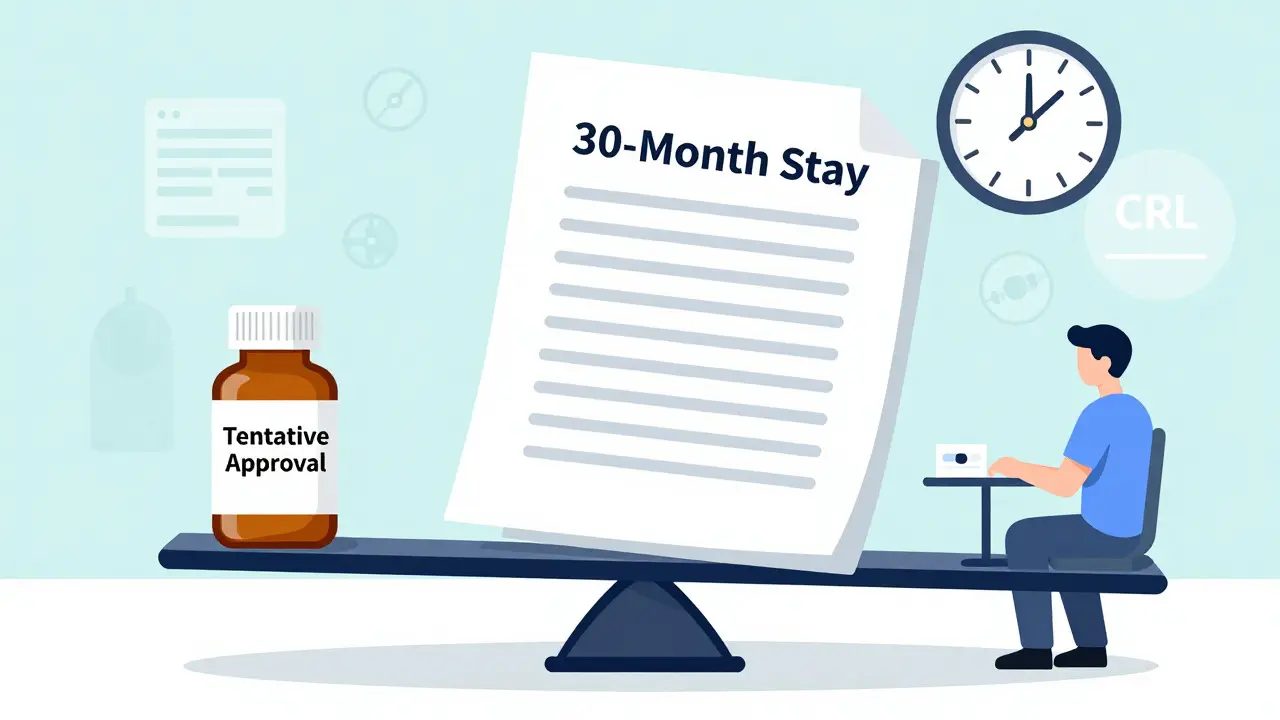
When a generic drug gets tentative approval from the FDA, it doesn’t mean it’s ready to hit shelves. It means the agency has reviewed the application and found it scientifically sound - but something is still blocking its release. And that something often takes years to clear. For patients waiting for affordable alternatives to expensive brand-name drugs, this delay isn’t just frustrating - it’s costly. In 2022, the median time between tentative approval and actual market launch was 16.5 months. Some generics never launch at all.
Why Tentative Approval Isn’t Final Approval
Tentative approval exists because of patent law, not science. The FDA can confirm that a generic drug is just as safe and effective as the brand-name version. It can verify the manufacturing process, the active ingredient, and even the bioequivalence data. But if the original drug is still under patent protection or has regulatory exclusivity, the FDA legally can’t approve the generic for sale. That’s where tentative approval comes in: it’s a green light on paper, but a red light in practice.This system was designed under the Hatch-Waxman Act of 1984 to speed up generic entry after patents expire. But over time, the process has become a bottleneck. Instead of getting generics to market faster, many companies now use the system to delay competition - and keep prices high.
Review Cycles: The Slow Dance of Paperwork
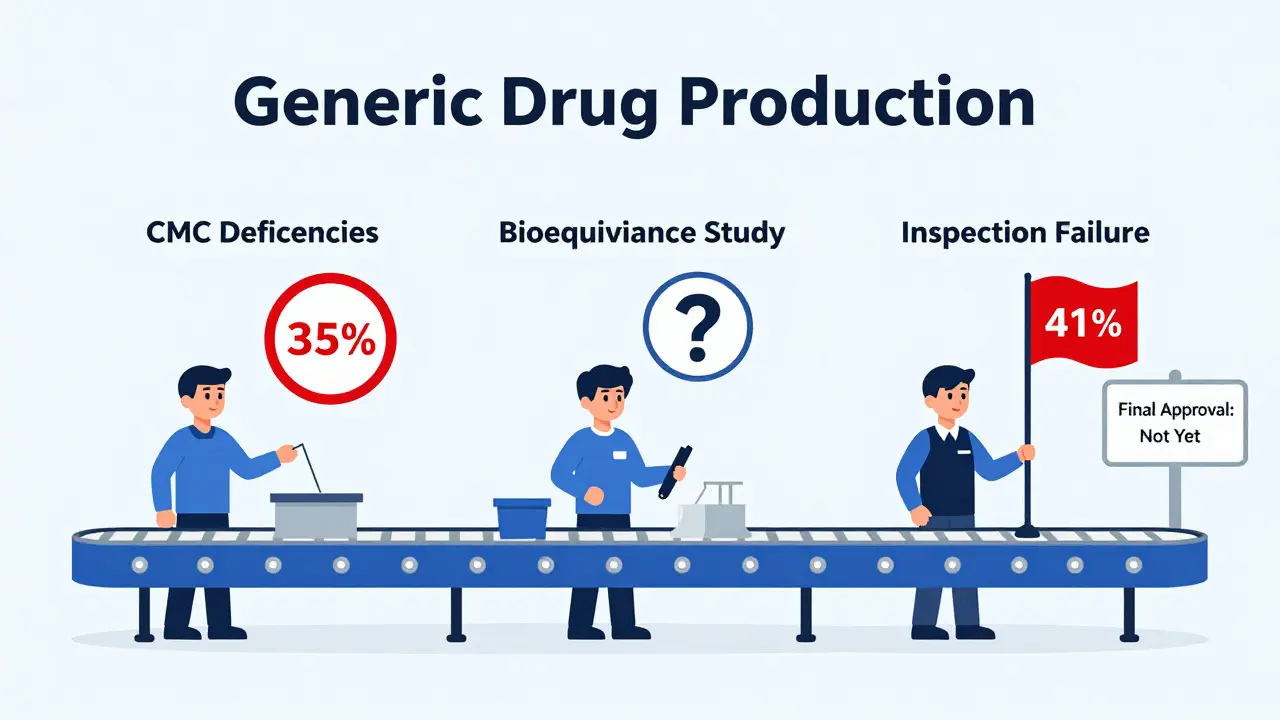
One of the biggest reasons tentative approvals stall is the number of times the FDA has to ask for more information. Before the Generic Drug User Fee Amendments (GDUFA) started in 2012, generic applications went through an average of 3.9 review cycles before approval. Even after GDUFA II tried to cut that down to 2.5 cycles, the 2022 data showed it was still at 3.2 cycles.Each cycle means the applicant gets a Complete Response Letter (CRL) listing deficiencies. The most common issues?
- Chemistry, Manufacturing, and Controls (CMC) - 35% of all deficiencies. This includes unclear descriptions of how the drug is made, inconsistent raw material sourcing, or poorly documented quality controls.
- Bioequivalence studies - 28% of problems. Did the study use the right number of participants? Was the dosing accurate? Was the statistical analysis sound? If not, the FDA sends it back.
- Analytical method validation - 22% of delays. The lab methods used to test the drug’s purity and strength must be proven reliable. Many applicants skip this step or don’t document it well enough.
Manufacturing facilities are another major hurdle. In FY 2022, 41% of CRLs came from inspectional findings at production sites. Common red flags? Poor environmental monitoring, unqualified equipment, or weak quality control systems. If a facility has been flagged before, the FDA may require a second inspection - adding months to the timeline.
Patent Games: The Biggest Delay Tactic
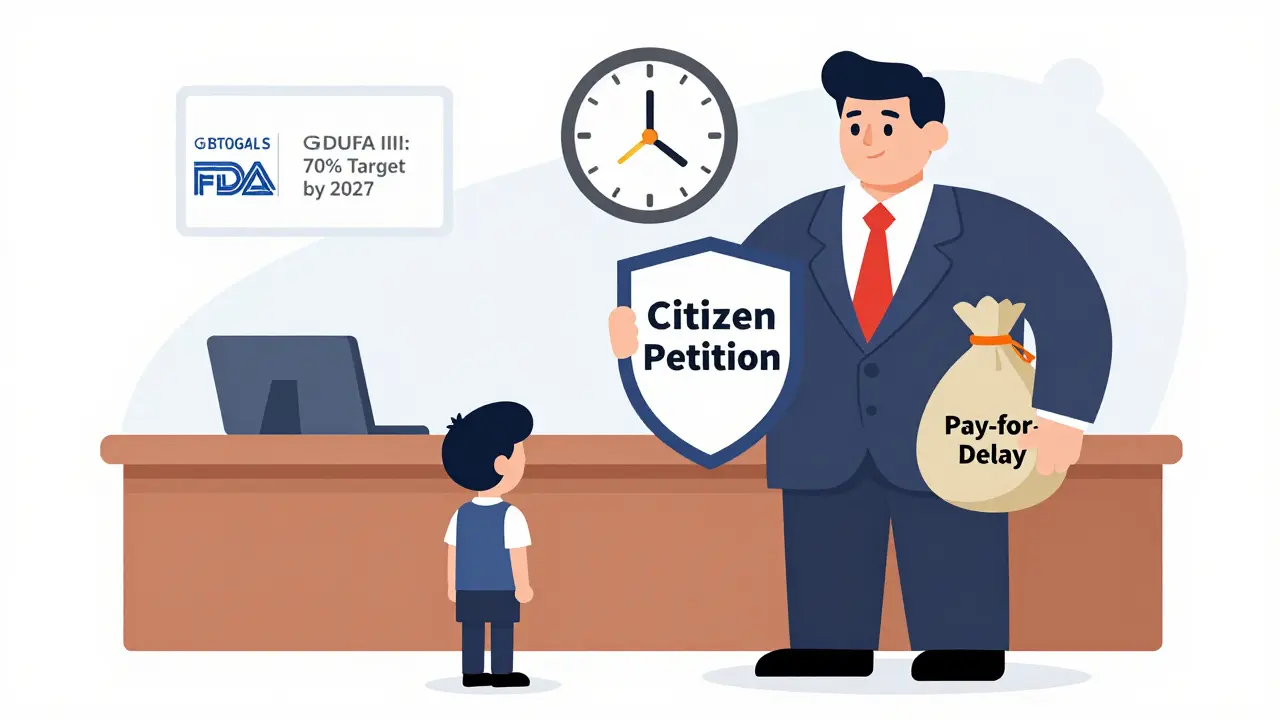
Here’s where things get messy. Even if the FDA gives tentative approval, the generic can’t launch if the brand-name company files a patent lawsuit. Under the law, this triggers a 30-month stay - a legal pause that blocks final approval.Between 2010 and 2016, 68% of tentatively approved generics were held up by these lawsuits. But it gets worse. Brand companies don’t just file lawsuits - they file citizen petitions. These are formal requests asking the FDA to delay approval by claiming the generic isn’t equivalent. Between 2013 and 2015, 67 petitions were filed. The FDA approved only three.
These petitions often use shaky science. A 2017 FDA review found that 72% of petitions from brand companies were based on arguments that didn’t hold up under scrutiny. Still, they work. Each petition adds an average of 7.2 months to the timeline.
Then there’s “product hopping” - when a brand company slightly changes the drug’s form (like switching from a pill to a capsule) to get a new patent. A 2018 FTC study found this happened in 17% of top-selling drugs. And “pay-for-delay” deals? Where brand companies pay generics to stay off the market. Between 2009 and 2014, these deals delayed 987 generic entries.
Application Errors and Slow Responses
Sometimes the delay isn’t the FDA’s fault - it’s the applicant’s. In 2021, the FDA found that 29% of initial ANDA submissions were missing key data: clinical info, labeling, or chemistry details. These incomplete applications get rejected outright, forcing companies to resubmit.Even when the FDA sends a CRL, companies don’t always respond quickly. The average time to reply? 9.2 months. The FDA recommends a response within six months. But many applicants drag their feet - either because they’re under-resourced, lack expertise, or are waiting for internal approvals.
Complex drugs are especially slow. Modified-release pills, inhalers, topical creams - these take 2.3 times more review cycles than simple tablets. One study found topical products averaged 3.7 review cycles, compared to 2.9 for oral solids. That’s an extra 14 months of waiting.
Market Economics: Why Some Generics Never Launch
Even after all the paperwork clears and patents expire, some generics still don’t hit the market. Why? Because it’s not profitable.Drugpatentwatch.com found that 30% of tentatively approved generics never launch. For drugs with annual U.S. sales under $50 million, that number jumps to 47%. If the market is too small, or if the manufacturing cost is too high, companies decide it’s not worth it.
And even when generics do launch, prices don’t always drop. A 2019 JAMA study showed that when only one generic enters the market, prices stay at 80% of the brand price for two full years. Why? Because other manufacturers wait. They don’t want to enter a market where the first generic is already capturing most of the sales - and keeping prices high.
What’s Being Done to Fix It?
The FDA has tried. The Competitive Generic Therapy (CGT) pathway, created in 2017, gives priority review to drugs with little or no generic competition. Of the drugs designated under CGT, 78% received tentative approval in under 8 months - compared to the usual 18.The FDA’s 2022 Tentative Approval Initiative targeted 102 high-priority drugs with no generics on the market. Of those, 67% got final approval within 12 months, up from just 34% in previous years.
Legislation like the CREATES Act (2019) is helping too. It stops brand companies from blocking generic manufacturers from getting samples of their own drugs - a tactic used to delay testing. And GDUFA III (2023-2027) aims to raise first-cycle approval rates from 28% to 70% by 2027.
But progress is slow. The FDA’s 2023 report admits that patent litigation, complex products, and resource limits will keep delays high through at least 2025. And analysts predict patent-related delays will still cost U.S. consumers $12.4 billion a year by 2027.
What This Means for Patients
Every delay in generic approval means higher drug costs. Every year a generic stays off the market, patients pay more. Every time a brand company files a lawsuit or a petition, it’s not just a legal move - it’s a financial one.The system was meant to bring affordable drugs to market faster. But today, it’s often used to protect profits, not patients. Tentative approval is a promise - but without real enforcement against patent abuse and manufacturing delays, that promise stays unfulfilled.
What is tentative approval for generic drugs?
Tentative approval is a status granted by the FDA to generic drug applications that meet all scientific and quality standards for approval, but cannot be marketed yet because of patents or regulatory exclusivity on the brand-name drug. It allows manufacturers to prepare for market entry as soon as legal barriers expire.
How long does it take for a tentatively approved generic to launch?
The median time from tentative approval to market launch is 16.5 months. Some take longer - up to 2 years or more - especially if patent litigation or manufacturing issues delay final approval.
Why do some tentatively approved generics never reach the market?
Many never launch because the market isn’t profitable enough. For drugs with annual U.S. sales under $50 million, nearly half of tentatively approved generics are abandoned. Companies decide the cost of manufacturing and competition isn’t worth the return.
Can the FDA approve a generic before the patent expires?
No. Even with tentative approval, the FDA cannot grant final approval until all patents and exclusivities on the brand drug have expired. Any attempt to launch before then would violate federal law.
What role do citizen petitions play in delaying generic drugs?
Brand companies often file citizen petitions to ask the FDA to delay generic approval, usually by challenging bioequivalence methods. Though the FDA approves only a small percentage, each petition adds an average of 7.2 months to the timeline - effectively stalling competition.
How does the FDA plan to reduce delays in the future?
Under GDUFA III (2023-2027), the FDA aims to increase first-cycle approval rates from 28% to 70% by 2027 and reduce review times for priority applications to 8 months. It’s also improving guidance for complex generics and cracking down on patent abuse through legislation like the CREATES Act.
13 Comments

Megan Nayak
March 2, 2026 AT 18:09 PM
You think this is bad? Wait till you see how they manipulate clinical trial data to extend exclusivity. I've seen the internal memos. It's not about patents. It's about corporate psychology. They don't want competition. They want you to believe you're lucky to get the brand at all.

Tildi Fletes
March 3, 2026 AT 21:13 PM
The CMC deficiencies cited in FDA letters are overwhelmingly attributable to insufficient process validation documentation. A 2021 GDUFA audit revealed that 63% of non-compliant submissions lacked validated cleaning procedures for shared equipment. This is not a regulatory failure-it is a systemic failure of quality assurance culture in many generic manufacturing facilities.

Dean Jones
March 5, 2026 AT 11:29 AM
Look. I get it. The system was designed to balance innovation and access. But now? It's a labyrinth of legal loopholes and bureaucratic inertia. The 30-month stay isn't a delay-it's a weapon. And the citizen petitions? They're not science. They're theater. The brand companies know the FDA will take months to respond. They don't care if they win. They just want to drag out the clock. And patients? They're the ones paying the price in insulin co-pays and asthma inhaler costs. It's not capitalism. It's corporate feudalism with a FDA stamp on it.

Gretchen Rivas
March 5, 2026 AT 14:08 PM
Topical creams take 2.3x longer? That tracks. I worked in a lab that made transdermal gels. The analytical methods alone took 11 months to validate. Not because we were slow. Because the FDA's guidance on viscosity stability testing changed mid-review. We had to redo everything. And no one told us.

Helen Brown
March 5, 2026 AT 19:36 PM
I heard this is all part of a secret deal between Big Pharma and the FDA. They let the generics sit there on purpose so they can sell more of the expensive stuff. The government is in on it. You think your pills are safe? Think again. They're testing them on you.

John Cyrus
March 7, 2026 AT 10:15 AM
The real problem is lazy applicants. Stop blaming the FDA. If you can't submit a complete ANDA then don't apply. I've seen companies file with half the data missing and then wonder why it takes 3 years. It's not rocket science. Fill out the forms. Do the work. Stop whining

Zacharia Reda
March 8, 2026 AT 04:20 AM
I'm gonna say something unpopular. The 16.5 month median? That's actually pretty good. Compared to how long it took in the 90s. And yes, patent litigation is abusive. But the real issue is market economics. If a drug only makes $40M a year, why would a company spend $10M to manufacture it? The system isn't broken. The incentives are.

John Smith
March 9, 2026 AT 23:56 PM
You ever hear of the word 'capitalism'? Companies aren't evil. They're responding to incentives. If you want generics to launch faster, stop giving pharma companies 20-year monopolies. Stop letting them patent the color of the pill. And stop pretending this is about science. It's about money. Plain and simple. Fix the incentives or shut up.

Mike Dubes
March 11, 2026 AT 11:58 AM
I work in rural health. People are literally choosing between their meds and rent. I've seen folks split pills in half just to make them last. This isn't policy. This is cruelty dressed up as regulation. We need to stop pretending this is about safety. It's about who gets to live and who gets to suffer because the math didn't add up for someone's quarterly report.

Sharon Lammas
March 12, 2026 AT 21:05 PM
I read this whole thing. And I just felt... heavy. Not angry. Not surprised. Just heavy. Like the weight of all those people waiting. All those families. All those nights wondering if the next refill will come. It's not just a delay. It's a slow erosion of dignity. And we let it happen because it's complicated. But it shouldn't be.

marjorie arsenault
March 14, 2026 AT 03:02 AM
I want to give you all some hope. The CGT pathway is working. I helped submit two applications last year. One got tentative approval in 5 months. Final approval in 8. It’s not perfect. But change is happening. We need to keep pushing. And yes, it’s frustrating. But giving up helps no one.

Alex Brad
March 14, 2026 AT 13:16 PM
The FDA isn't the enemy. The system is. And the system is rigged.
Write a comment
Popular Posts



Doxt-SL: Uses, Dosage, Side Effects & Price Guide
Sep, 21 2025
Ivan Viktor
March 1, 2026 AT 12:27 PM
So let me get this straight. The FDA says 'you're good to go'... but then some pharma exec with a law degree says 'nope' and the whole thing stalls for years? This isn't regulation. It's a pay-to-play game where patients get stuck with the bill. I'm not even mad. I'm just disappointed.